Domestic Research Team, First Confirmation in History
[Asia Economy Reporter Kim Bong-su] A study has found that ultrafine plastic waste dissolved in the ocean harms the intestinal function of fish.
According to the Korea Research Foundation on the 3rd, Professor Ahn Yoon-joo's research team at Konkuk University conducted a study on indirect exposure to nano plastics in the highly consumed food resource, the yellow croaker, and discovered that nano plastics are transferred through the food chain and inhibit digestive enzyme activity.
Recently, as plastic pollution has intensified worldwide, microplastics smaller than 5mm have been detected in various environments, and the accumulation of contamination has increased public concern about the effects of micro- and nano-plastics on the health of organisms and humans. Although it is known that micro- and nano-plastics are sequentially transferred to predator organisms through trophic levels, evaluations of their effects on higher predator organisms have been very rare. In particular, for fish species used as protein sources for humans, research targeting highly consumed species has been limited.
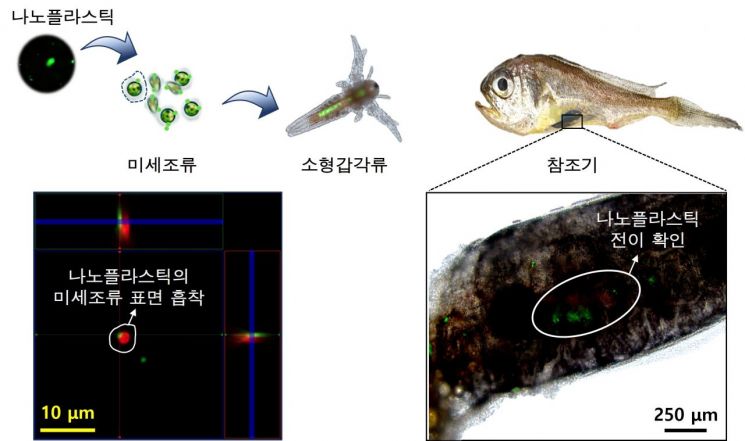
The research team comparatively analyzed the effects on marine organisms that indirectly ingested nano plastics. The experiment involved culturing microalgae (Dunaliella salina) in an environment contaminated with 190nm spherical polystyrene nano plastics that exhibit fluorescence, then feeding these to small crustaceans, which were subsequently provided to yellow croakers.
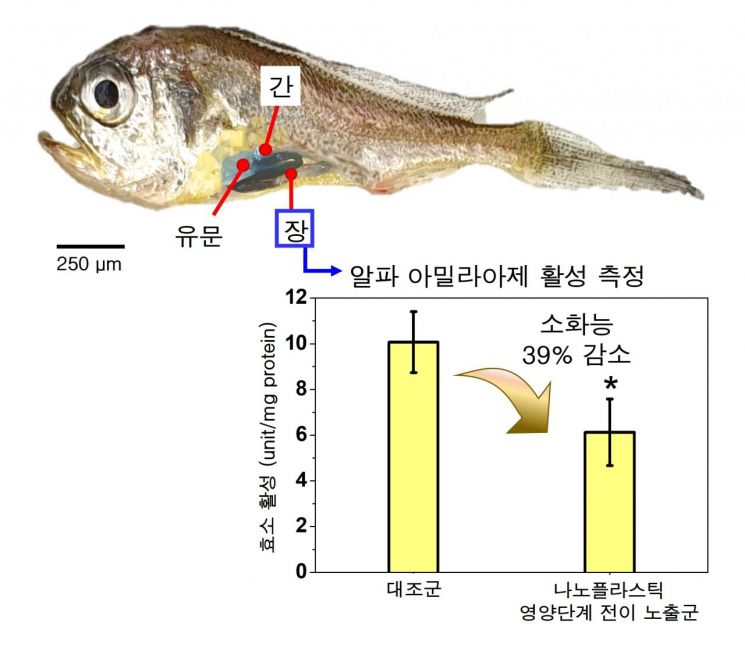
Observing the digestive tract of the yellow croaker with a fluorescence microscope capable of identifying fluorescent substances, the team confirmed that nano plastics were transferred to the yellow croaker, and nano plastics were still observed in the digestive tract after 24 hours. In particular, nano plastics were found to have adverse effects on microalgae, small crustaceans, and yellow croakers. When small crustaceans consumed microalgae contaminated with nano plastics, the intestinal wall was damaged. This suggests that the effects of nano plastics may appear when other marine organisms are indirectly exposed. Additionally, measuring the activity of the digestive enzyme alpha-amylase showed a 39% decrease in enzyme activity compared to the normal yellow croaker control group, confirming that digestive function was impaired.
Professor Ahn said, “This achievement quantifies the toxicity caused by nano plastics as digestive function inhibition, intuitively presenting the impact on humans,” adding, “It is a case showing that nano plastics present in the environment can affect food resources consumed by humans through trophic levels.”
The results of this study were published online on August 4 in the international journal in the field of environmental science, the Journal of Hazardous Materials.
© The Asia Business Daily(www.asiae.co.kr). All rights reserved.


















