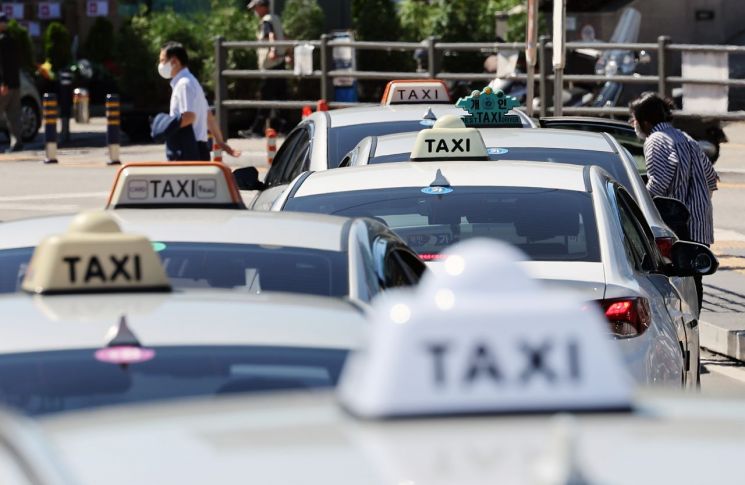
 An electric taxi collided with an oncoming vehicle at the intersection of Jorye-dong, Suncheon-si, Jeollanam-do, leading to a chain collision accident. The photo is a stock image of the taxi stand at Seoul Station on the 2nd and is not related to any specific expressions in the article.
 [Photo by Yonhap News]
[Asia Economy Reporter Hwang Sumi] In Jeonnam, an electric taxi collided with an oncoming vehicle, leading to a chain collision accident. The driver claimed that the cause of the accident was a sudden unintended acceleration of the vehicle.
According to the Suncheon Police Station in Jeonnam on the 2nd, at around 6:10 PM the previous day, an electric taxi driven by a man in his 60s, Mr. A, crashed into a vehicle waiting at a signal in the opposite lane at an intersection in Jorye-dong, Suncheon City. The taxi then collided with other vehicles, and only stopped after flipping over due to the impact.
As a result of the accident, three people including Mr. A, the taxi passenger, and other vehicle drivers were taken to the hospital and classified as having minor injuries. Additionally, a total of 13 vehicles suffered property damage directly or indirectly caused by the collision.
In the subsequent investigation, Mr. A reportedly claimed that the accident was caused by sudden unintended acceleration of the vehicle. The taxi’s internal black box footage confirmed by the police captured the vehicle suddenly accelerating near the intersection and Mr. A’s voice sounding panicked.
The police plan to accurately determine the cause of the accident based on closed-circuit television (CCTV) footage around the intersection and data from the Event Data Recorder (EDR) of the vehicle. If necessary, they will also request a detailed analysis from the National Forensic Service.
Meanwhile, as the supply of electric vehicles expands recently, sudden unintended acceleration accidents involving electric vehicles have also surged. According to data titled “Sudden Unintended Acceleration Reports at the Vehicle Recall Center” submitted by Hong Giwon, a member of the National Assembly Land, Infrastructure and Transport Committee from the Democratic Party of Korea, to the Korea Transportation Safety Authority under the Ministry of Land, Infrastructure and Transport on the 1st, there were a total of 201 sudden unintended acceleration reports from 2017 to July this year.
By fuel type, there were 72 diesel vehicle cases, 65 gasoline, 25 LPG, 20 electric, and 19 hybrid cases. In particular, reports of sudden unintended acceleration involving electric vehicles were only 4 cases in 2019 but have increased to 8 cases in 2021 as the supply of electric vehicles grew.
Currently, the Korea Transportation Safety Authority’s Vehicle Recall Center, operated by the Ministry of Land, Infrastructure and Transport, continuously conducts comprehensive investigations on sudden unintended acceleration vehicles through the vehicle defect investigation system. Victims of sudden unintended acceleration accidents can also seek relief through the vehicle recall system.
However, among the approximately 200 sudden unintended acceleration damage reports, not a single case has been recognized as caused by a vehicle defect. The Ministry of Land, Infrastructure and Transport and the Transportation Safety Authority have yet to identify the cause. Some critics point out that the process of proving the cause after reporting to the recall center is complicated, and since the burden of proof does not lie with the manufacturers, it is difficult for consumers to receive actual relief.
© The Asia Business Daily(www.asiae.co.kr). All rights reserved.

















