High-Risk Product Investing Ants
Can Yield Large Profits, but Losses Are Also Risky
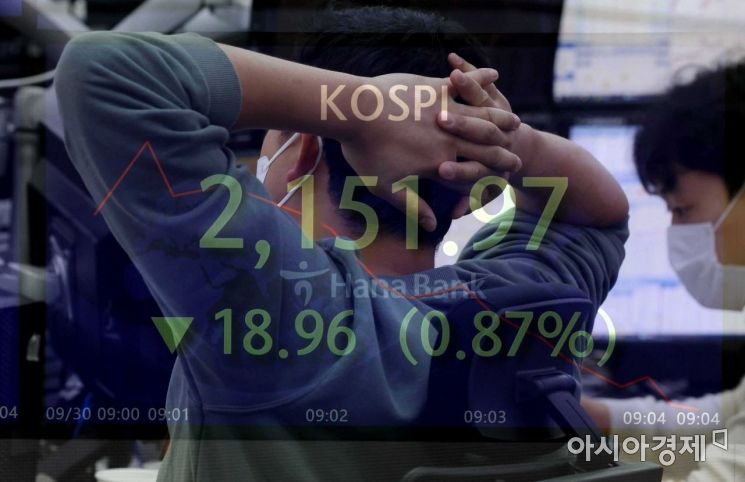 On the 30th of last month, when the domestic stock market also started lower due to the sharp decline in the US stock market, dealers were busy working in the dealing room of Hana Bank in Euljiro, Seoul. Photo by Moon Honam munonam@
[Asia Economy Reporter Han Seung-gon] As the global stock market and domestic stock market continue to stagnate, some individual investors are venturing into leverage, inverse products, futures, and derivatives. However, due to their extremely high-risk nature, some critics argue that these are more akin to gambling than investing.
According to data received by Kim Byung-wook, a member of the Democratic Party of Korea, from the Financial Supervisory Service, the scale of overseas derivatives trading by individual investors in the first half of this year (January to June) was recorded at 4677.4992 trillion won. This exceeds four times the trading volume of institutional investors and corporations (1104.7534 trillion won), with individuals in their 30s and 40s accounting for 61% of the personal trading volume during the first half.
Derivatives are financial products based on traditional assets such as stocks and bonds, including financial products like stocks, bonds, currencies, and agricultural, fishery, and livestock products. They have advantages such as hedging functions to reduce risk, leverage functions, and the ability to synthesize derivatives to create new financial products. However, they also have the disadvantage of being more sensitive to changes in interest rates or exchange rates, resulting in high price volatility.
Additionally, according to the Korea Securities Depository, among the top 10 overseas ETFs (Exchange-Traded Funds) and ETNs (Exchange-Traded Notes) purchased by domestic investors in the past month (August 20 to September 19), nine are known to be leverage or inverse products. Leverage products can yield several times the returns of the index they track. Inverse products generate profits when prices fall and are mainly in demand during bear markets.
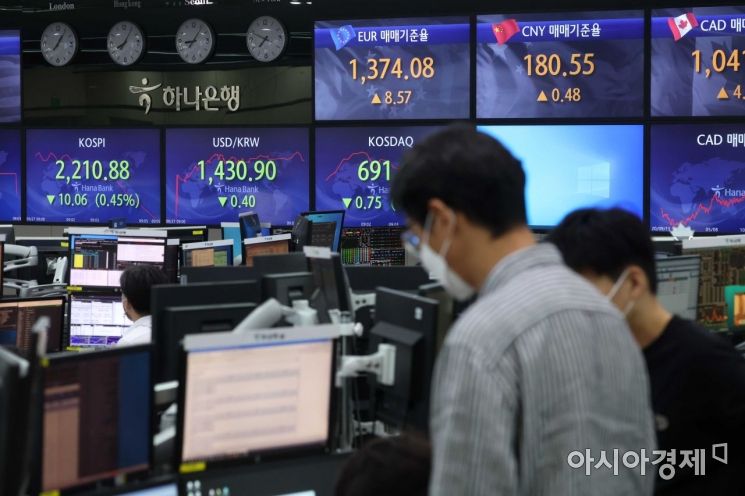 On the 27th of last month, dealers were working in the dealing room of Hana Bank in Euljiro, Seoul. On that day, the KOSPI index opened at 2224.39, up 3.45 points (0.16%) from the previous day. The won-dollar exchange rate opened at 1428 won, down 3.3 won. Photo by Moon Honam munonam@
The problem lies in the extent of losses. Leverage and inverse products can generate large profits when the tracked index rises, but depending on the stock market situation, they can also incur greater losses. Individual investors who ventured into overseas derivatives suffered losses amounting to 518.6 billion won in the first half of this year alone. The scale of losses exceeded 1 trillion won annually for two consecutive years in 2020 (1.2203 trillion won) and last year (1.1091 trillion won).
The cryptocurrency market is facing a similar situation. According to blockchain analysis site The Block, the global Bitcoin futures trading volume surged from 288.4 billion dollars in July 2020 to 1.32 trillion dollars in June this year.
Kim, a company employee in his 30s who recently suffered significant losses after engaging in futures trading, said, "Honestly, even while investing, I was told by those around me that it was more like speculation," but added, "Since you can make large profits, if you can manage it well, it seems like an attractive market." He also mentioned, "Actually, I did not invest such a large amount."
The futures Kim refers to are contracts to buy or sell at a predetermined price at a future date, meaning trading on the future value. While they can yield large profits, they can also cause substantial losses.
Industry insiders emphasize planned and analytical investment rather than excessive investment. An industry official said, "The judgment and results of investment rest solely with the individual," adding, "It would be good to make profits, but when investments in ultra-high-risk products like futures fail, one inevitably faces significant risks. Investment should be considered carefully."
© The Asia Business Daily(www.asiae.co.kr). All rights reserved.


















