Shinhan Financial Investment, Asset Strategy
At the Center of Volatility

[Asia Economy Reporter Junho Hwang] Unprecedented volatility continues in the stock and bond markets. Around us, there are increasing numbers of people whose stock holdings have halved in value or who respond with sighs. Shinhan Financial Investment expects that improvements in the challenging market environment may only occur next year and has presented asset-specific management strategies.
For domestic stocks, a reduction in allocation is deemed necessary. Laborngil, a researcher at Shinhan Financial Investment, stated, "In a phase where it is necessary to keep the won/dollar exchange rate open to the upside and respond accordingly, index volatility is likely to persist," adding, "It is too early to expect a weakening in monetary policy strength next month’s stock market, so a conservative approach is needed."
However, for the KOSPI below 2200, which is considered a range where some resilience can be drawn, some export stocks such as automobiles, IT hardware, and IT home appliances (secondary batteries) that are expected to have third-quarter earnings higher than anticipated this year may outperform the index. Furthermore, defensive stocks such as telecommunications, essential consumer goods, and insurance are explained as alternatives with strong earnings defense and attractive dividend perspectives.
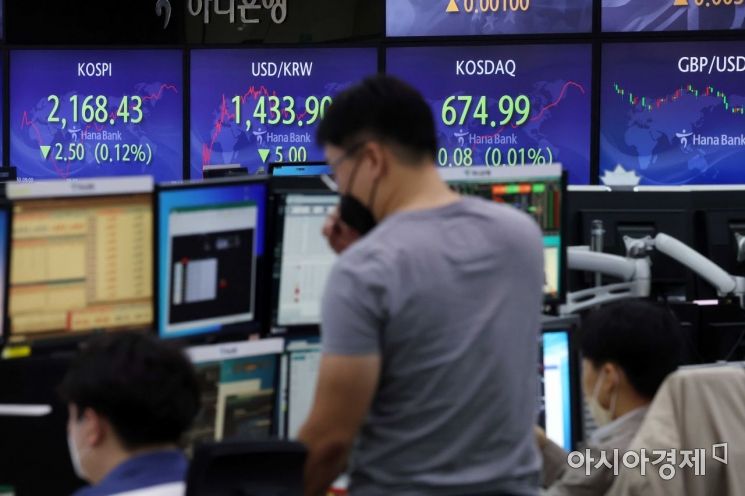 Due to the sharp decline in the U.S. stock market, the domestic stock market also started lower on the 30th, with dealers busy working in the dealing room of Hana Bank in Euljiro, Seoul. Photo by Moon Honam munonam@
A conservative approach is also maintained for overseas stocks. Sungwhan Kim, a senior researcher, said, "The tightening impact has been painfully priced in, but now it is time to face fundamental deterioration," and forecasted, "There is a high possibility that confidence in future outlooks during this year’s third-quarter earnings season will be lacking." He added, "The U.S. is expected to have high durability in enduring uncertainty, but other advanced regions (Europe, Japan) face poor fundamentals and maximized policy uncertainty, placing their investment appeal at a disadvantage," and "Emerging markets generally maintain a conservative view amid the absence of momentum to reverse the strong dollar."
The domestic bond market is likely to continue its volatile phase until the next Monetary Policy Committee meeting. Jaekyun Ahn, a research fellow, said, "On the 28th of last month, the Bank of Korea decided on a simple purchase of about 3 trillion won in government bonds, and the Ministry of Strategy and Finance conducted an emergency buyback of 2 trillion won," explaining, "This was a bond market stabilization response triggered by signs that the 3-year government bond yield would exceed the 4.5% level." He continued, "This is interpreted as a recognition that the mid-4% bond yield level is excessive," and predicted, "High interest rate volatility is likely to continue until the Monetary Policy Committee confirmation in October."
The won/dollar exchange rate is expected to rise further to 1,500 won per dollar. Chanhee Kim, a senior researcher, stated, "With strong dollar pressure expected to continue and Korea’s domestic fundamental factors also unlikely to improve in the short term, the won/dollar exchange rate should be considered capable of further rising into the 1,500 won range."
The export economy is at the early stage of a downturn, raising concerns about a negative (-) shift in the fourth quarter of this year alongside shrinking demand from advanced countries. Domestic demand, which had performed well due to the reopening effect, is also expected to gradually weaken in momentum. Nevertheless, considering the short-term external debt size at about 10% of GDP and an adequate level of foreign exchange reserves, external soundness is expected to remain favorable. However, he warned, "Foreign investors’ net inflows into bonds from the first quarter of 2020 to the second quarter of this year reached 128 billion dollars, so the possibility of increased won/dollar exchange rate volatility during capital outflows should be guarded against," according to his outlook.
© The Asia Business Daily(www.asiae.co.kr). All rights reserved.
![A Woman with 50 Million Won Debt Clutches a Stolen Dior Bag and Jumps... A Monster Is Born [Slate]](https://cwcontent.asiae.co.kr/asiaresize/183/2026021902243444107_1771435474.jpg)

















