In academia and beyond, there is unanimous agreement on the issue of the Legislation and Judiciary Committee's authority to review system and wording, but significant disagreement remains on concrete solutions
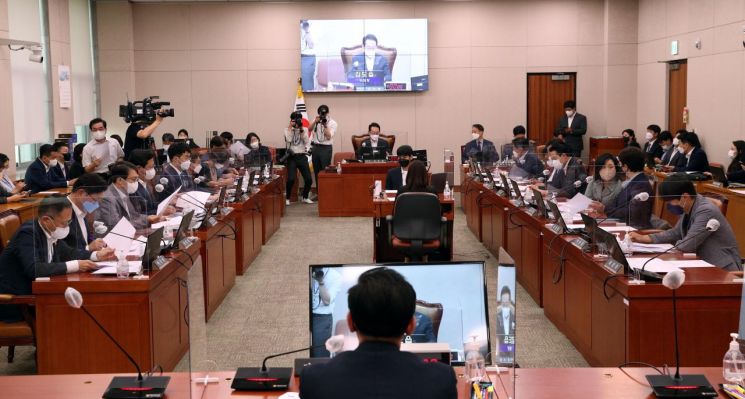
[Asia Economy Reporter Naju-seok] The issue of the National Assembly’s Legislation and Judiciary Committee’s (LJC) authority to review the structure and wording of bills has emerged as a political reform task. While there is consensus on the problem among politicians and academia, a concrete solution has yet to be found. Although reform of the LJC is scheduled to be discussed in the National Assembly, difficulties seem inevitable.
On the 29th of last month, the National Assembly’s Special Committee on Political Reform held a public hearing on the LJC’s system and wording review system. Most experts who participated as witnesses pointed out problems with the current LJC’s authority to review the structure and wording of bills.
The biggest issue identified by experts was legislative delays. Professor Lim Ji-bong of Sogang University Law School said, "As it has become customary for the chairperson of the LJC to be from the main opposition party, the procedure for reviewing the structure and wording has become a gatekeeper role that delays the processing of contentious bills opposed by the opposition." He added, "For contentious bills that have barely passed the relevant standing committee, the LJC’s review procedure becomes another veto point."
Another problem pointed out was that even a single opposing member of the LJC can block legislation. Professor Lim said, "It is customary that if even one member raises an objection at the LJC plenary session, the bill is referred to the Bill Review Subcommittee 2. If consensus is not reached in the subcommittee, the bill remains pending and may be discarded due to the expiration of the legislative term, leading to the subcommittee being called the ‘graveyard of bills.’"
Moreover, the fact that the LJC, which is a standing committee like others, acts as an upper house and dominates other standing committees was also cited as a problem. Professor Lim said, "The LJC’s elevated status through the review of structure and wording violates the principle of equal representation among standing committees," adding, "All standing committees have their own jurisdiction and duties, and they should respect each other according to the ‘committee jurisdiction principle,’ which this practice contradicts."
Professor Jeong Cheol of Kookmin University Law School said, "There have been actual delays in legislation, and criticism has focused on the LJC conducting policy reviews and modifying the content of bills," warning, "Such actions could undermine the operation of the National Assembly, which is based on standing committees formed by legislative areas to complete bills." Lawyer Choi Chang-ho also pointed out dysfunction, saying, "There is criticism that the LJC, acting as an upper house, tries to alter the essential content."
Professor Hwang Do-su of Konkuk University Law School said, "Through the authority to review structure and wording, the LJC can effectively act as an upper house over the relevant committees," and warned, "Party leadership can control the LJC and thereby gain dominance over the entire committee system, potentially reducing the National Assembly and party politics to factional politics."
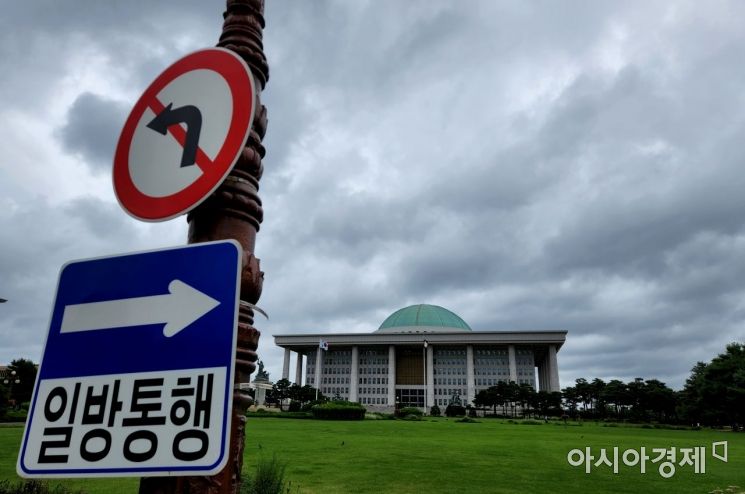 On the 28th, as the National Assembly remains deadlocked for the fourth consecutive week over the appointment of the Chairman of the Legislation and Judiciary Committee, dark clouds gather heavily over the roof of the National Assembly building. The Democratic Party of Korea has warned that if negotiations fail within this week, it will convene a solo extraordinary session in July. Photo by Yoon Dong-ju doso7@
Despite consensus on these issues, solutions are hard to find. Among the proposed amendments currently under discussion are measures to replace the LJC’s functions through separate organizations or reinforcement of National Assembly personnel, such as establishing a specialized review body for structure and wording under the National Assembly Secretariat (National Assembly Legislative Office) or rules, creating a dedicated organization (National Assembly Legislative Office, National Assembly Legislative Support Office), or adding one specialized committee member per standing committee for structure and wording review. Other proposals include increasing effectiveness by requiring the relevant standing committee to receive a review opinion from a specialized body or mandating submission of results from inter-committee discussions or government department coordination through bodies defined by the National Assembly Act, such as joint meetings or plenary meetings.
The problem is that there is a significant difference in perspectives on these solutions. The ruling party opposes establishing a separate specialized organization within the National Assembly. Since the current Speaker of the National Assembly is from the opposition party, they argue that if a body directly under the Speaker is created, the Speaker could dominate the review authority over structure and wording. Kim Sang-hoon, a member of the People Power Party, said, "There is a specialized organization with authority over structure and wording above the standing committees, and above that is the Speaker," adding, "Because the appointment and supervisory authority over the head of this specialized review body lies with the Speaker, it is difficult to form consensus."
Criticism that joint meetings or plenary committees are unrealistic also continues. Jo Hae-jin, a member of the People Power Party, said, "The plenary committee is actually the plenary session, but the plenary session is not a place for debate but for speeches, so it is doubtful whether members can reach conclusions through speeches or debates."
The bigger problem is that the issue with the LJC is not ultimately institutional but political, as the review of structure and wording by the LJC has become controversial for political reasons, meaning the essence lies in politics rather than the system.
Lawyer Choi said, "These problems continue to arise because the LJC has lost cooperative governance," adding, "If the LJC could properly cooperate, these issues would not arise."
© The Asia Business Daily(www.asiae.co.kr). All rights reserved.
![User Who Sold Erroneously Deposited Bitcoins to Repay Debt and Fund Entertainment... What Did the Supreme Court Decide in 2021? [Legal Issue Check]](https://cwcontent.asiae.co.kr/asiaresize/183/2026020910431234020_1770601391.png)
















