[Asia Economy Honam Reporting Headquarters, Reporter Shin Dong-ho] It has been revealed that a majority of Gwangju citizens avoid physical activities due to lack of time.
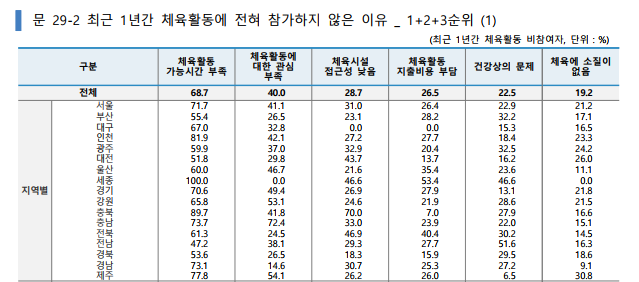
Kim Tae-jin, a member of the Gwangju Metropolitan City Seo-gu Council, announced on the 1st that according to a recent analysis of the Gwangju citizens' sports participation survey, 59.9% cited "lack of available time for physical activities" as the top reason for not participating in any physical activities over the past year.
Following that were lack of interest in physical activities (37%), low accessibility to sports facilities (32.9%), health issues (32.5%), absence of companions (32.3%), lack of athletic aptitude (24.2%), financial burden of expenses (20.4%), and lack of sports programs (16.5%), in that order.
Councilman Kim stated, "Various policies such as mobile gym programs that office workers can easily participate in during lunch breaks should be established." He also emphasized, "A social atmosphere ensuring proper lunch breaks and reduction of working hours must be created."
Meanwhile, the regular participation score of Gwangju citizens in physical activities was 2.98 out of 5, ranking 11th among the 17 metropolitan cities and provinces, which is relatively low.
This falls short of the national average of 3.14 across the 17 cities and provinces. Particularly, the percentage of those not participating at all was 20.5%, significantly higher than the national average of 8.9% by 11.6%.
However, awareness of sports facilities near major living areas (home, school, workplace, etc.) was 95.1%, 4.7% higher than the national average of 90.4%, ranking 4th among the 17 metropolitan cities and provinces, showing a result opposite to that of regular physical activity participation.
Additionally, the frequently used sports facilities were private sports facilities (31.2%), other sports facilities (16.5%), public sports facilities (15.4%), private facilities (5.2%), school sports facilities (3.5%), and workplace sports facilities (0.9%), in that order.
This contrasts with the national pattern of sports facility usage, where public sports facilities (22.1%) were the highest, followed by private sports facilities (20.6%) and other sports facilities (14.9%).
The main sports participated in were walking at 36.1% (combined 1st to 3rd choices), followed by hiking (12.5%), bodybuilding (12.5%), golf (including ground and park) (12.2%), yoga and Pilates (9.2%), cycling (7.1%), gymnastics (6.4%), swimming (5.7%), badminton (5.0%), table tennis (4.5%), and soccer (4.3%).
Councilman Kim said, "We will expand various policies to increase Gwangju citizens' participation in physical activities and take the lead in creating a healthier and more vibrant city for working people."
Honam Reporting Headquarters, Reporter Shin Dong-ho bless4ya@asiae.co.kr
© The Asia Business Daily(www.asiae.co.kr). All rights reserved.

















