[Asia Economy Reporter Kwon Jae-hee] China abstained once again in the United Nations Security Council (UNSC) vote opposing Russia's annexation of Ukrainian territory, following its abstention during the 2014 annexation of the Crimean Peninsula.
On September 30 (local time), at the UNSC meeting held at the UN Headquarters in New York, China, along with India, Brazil, and others, cast abstention votes. This UNSC vote was initiated by the United States and Albania.
The resolution defined the Russian annexation referendums held in four occupied territories?Donetsk People's Republic (DPR) and Luhansk People's Republic (LPR) in eastern Ukraine, as well as the southern Zaporizhzhia and Kherson regions?as "illegal and invalid," urging all UN member states not to recognize the referendum results or any territorial changes in those areas.
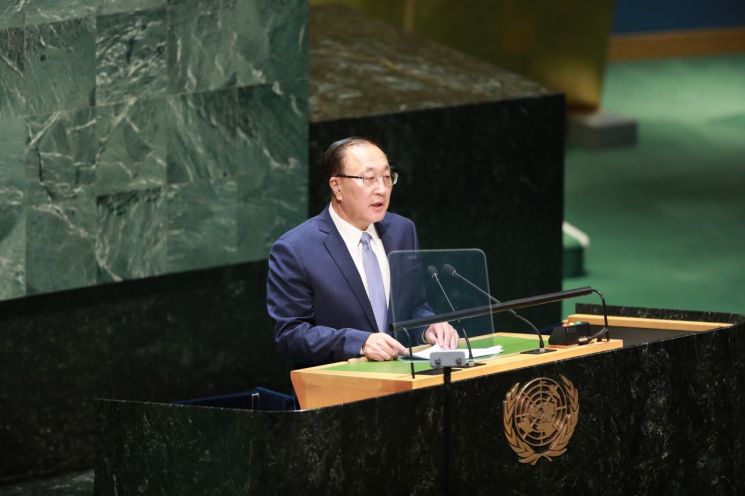
Zhang Jun, China's Ambassador to the UN, explained China's abstention during the meeting, reiterating the Chinese government's existing stance on the Ukraine war, which emphasizes respect for each country's sovereignty and territorial integrity, adherence to the purposes and principles of the UN Charter, consideration of all parties' legitimate security concerns, and support for all efforts conducive to peaceful crisis resolution.
He cited early ceasefire, tension reduction, and securing space for negotiations as justifications for this abstention.
Previously, in March 2014, China also abstained during the UNSC vote on a resolution invalidating the referendum that annexed Crimea to Russia.
At that time, China abstained citing reasons such as opposition to escalating confrontation and concerns that passing the resolution would complicate the situation further.
China's current abstention is interpreted as taking into account its relationship with Russia, with whom it is strengthening anti-US strategic cooperation, as well as the potential impact on its own border ethnic minorities in Xinjiang and Xizang (Tibet), and the Taiwan issue.
It is understood that China chose to abstain considering that supporting the resolution could damage its carefully cultivated relationship with Russia, while opposing it could undermine its justification to block similar referendums if Taiwan or ethnic minorities seek independence through such votes.
Although the resolution could not be adopted regardless of China's position due to Russia, a permanent UNSC member with veto power, exercising its veto (negative vote), China is also expected to face some political burden from its abstention.
As seen in Wang Yi, China's State Councilor and Foreign Minister, holding talks last month during the UN General Assembly with foreign ministers or senior diplomatic and security officials from over ten European countries including France, the UK, and Germany, China has been making efforts to restore relations with Europe, which have worsened since the outbreak of the Ukraine war.
Given that the UNSC vote took place amid heightened confrontation between the West and Russia triggered by the referendums, the West may perceive China's abstention as a continuation of its existing stance on the Ukraine war and Russia issue, potentially making it difficult for China’s efforts to improve relations with Europe to gain momentum.
© The Asia Business Daily(www.asiae.co.kr). All rights reserved.

















