September Trade Deficit $3.77 Billion
Exports Up 2.8% Year-on-Year
Energy Imports Account for 30% of Total
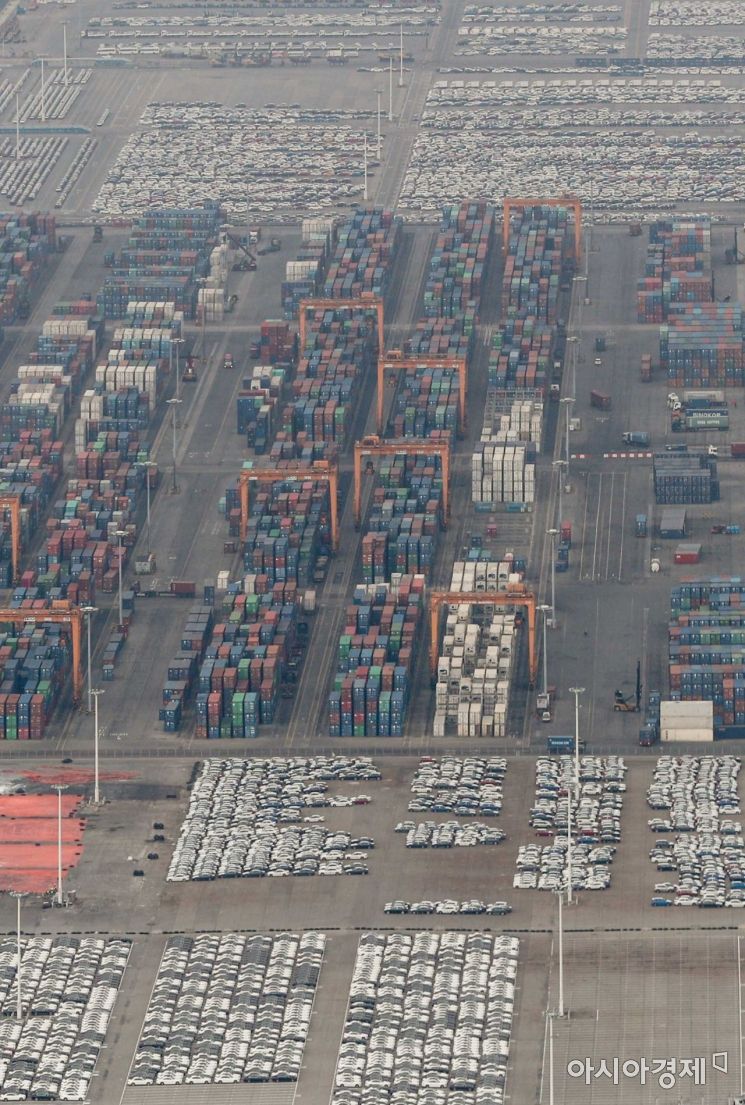 On the 10th, one day before the Lunar New Year holiday, export and import containers are stacked at Pyeongtaek Port as seen from a Seoul Metropolitan Police Agency helicopter. Photo by Jinhyung Kang aymsdream@
[Asia Economy Sejong=Reporter Dongwoo Lee] South Korea's trade balance has recorded a deficit for six consecutive months for the first time in 25 years. The export growth rate has slowed, and soaring energy prices have significantly increased import costs. The cumulative trade deficit this year is approaching $30 billion, raising warning signs for exports.
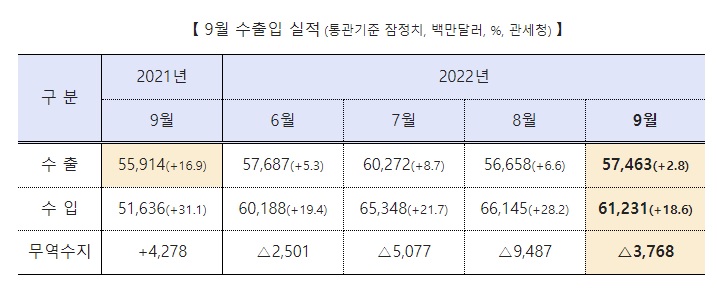
According to the "September 2022 Export-Import Trends" released by the Ministry of Trade, Industry and Energy on the 1st, last month's trade balance showed a deficit of $3.77 billion. Exports amounted to $57.46 billion, up 2.8% compared to the same period last year, while imports increased by 18.6% to $61.23 billion. The trade balance has been in deficit for six consecutive months since April this year. This is the first time in about 25 years since May 1997 that the trade balance has recorded a deficit for six consecutive months.
The accumulated trade deficit from the beginning of this year through last month is approximately $28.9 billion, the largest since trade statistics began in 1956. At this pace, the cumulative trade deficit could exceed $30 billion within this month. There is growing expectation that the annual trade deficit could surpass $30 billion. The previous annual record was $20.6 billion, set just before the foreign exchange crisis in 1996.
The export growth rate has gradually slowed. The export growth rates were ▲5.4% in June ▲9.4% in July ▲6.6% in August ▲2.8% in September, all falling into single digits. Among the 15 major items, five led the export performance in September. Exports of petroleum products (52.7%), automobiles (34.7%), and secondary batteries (30.4%) achieved the highest September records ever. Exports of auto parts and ships also increased.
On the other hand, semiconductor exports decreased by 5.7% due to the global economic slowdown and reduced demand. Exports of petrochemicals (-15.1%) and steel (-21.1%) also declined. Markets such as ASEAN (7.6%) and the United States (16%) maintained export growth, but exports to China decreased by 6.5%. Exports to the European Union (EU) also fell by 0.7%.
The continued trade deficit is mainly due to increased imports driven by rising energy prices. South Korea's imports have remained above $60 billion for seven consecutive months. In September, imports of crude oil, gas, and coal increased by $8.05 billion compared to the same month last year ($9.91 billion), reaching $17.96 billion (an 81.2% increase), which was identified as the main cause of the trade deficit.
Additionally, imports of key intermediate goods essential for domestic industrial production, such as semiconductors (up 19.8%) and precision chemical raw materials (up 51.8%) including battery materials and raw materials like lithium hydroxide and nickel-cobalt hydroxide, also increased significantly.
Lee Chang-yang, Minister of Trade, Industry and Energy, stated, "The government is taking the trade deficit occurring for six consecutive months and the slowdown in export growth since June very seriously," and emphasized, "We will fully support export revitalization and improvement of the trade balance through public-private cooperation."
© The Asia Business Daily(www.asiae.co.kr). All rights reserved.
![Clutching a Stolen Dior Bag, Saying "I Hate Being Poor but Real"... The Grotesque Con of a "Human Knockoff" [Slate]](https://cwcontent.asiae.co.kr/asiaresize/183/2026021902243444107_1771435474.jpg)












