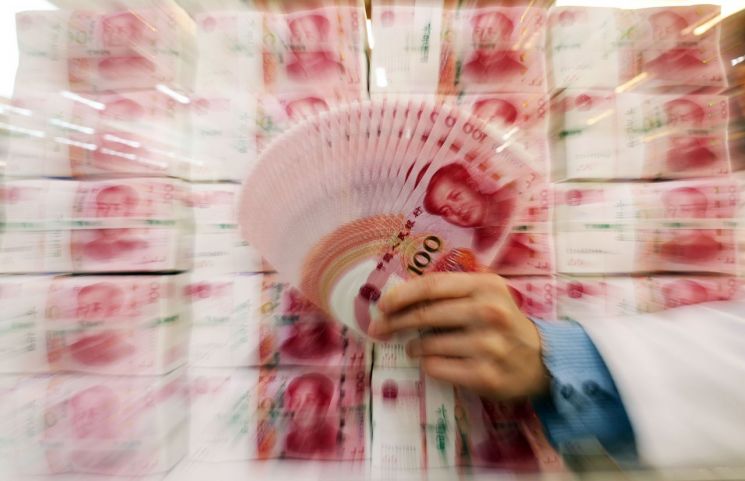
The People's Bank of China, the country's central bank, appears to be responding by slowing the pace of the yuan's decline against the US dollar rather than preventing the yuan's value from falling altogether, the Wall Street Journal (WSJ) diagnosed on the 29th (local time).
Amid this year's global trend of a super-strong dollar, the yuan's value has fallen more than 10% against the dollar so far.
Earlier, since August, the People's Bank of China set the reference exchange rate at a higher level than market expectations in response to the yuan's weakness. Recently, it also lowered the foreign currency reserve requirement ratio for domestic financial institutions.
Experts see the purpose of such Chinese authorities' measures as "slowing down the pace of the yuan's depreciation."
If it is impossible to completely stop the yuan's decline, the best approach from the authorities' perspective is to allow it to fall slowly and steadily.
Harron Lim, an economist at Moody's Analytics, said, "They (Chinese authorities) do not mind a gradual depreciation of the yuan. What they are concerned about is the speed of the decline."
He Wei, an economist at economic research firm GabeCal Dragonomics, explained, "Since the People's Bank of China has little room to change the fundamental drivers causing the dollar's strength, attempting to reverse the market trend would likely fail and damage the People's Bank's credibility."
He added, "(From the People's Bank's perspective) a better path is probably to let the current (strong dollar) trend continue while limiting volatility and waiting for an inevitable turning point."
The People's Bank of China is pursuing additional measures to limit yuan sales in the future, such as raising foreign exchange transaction costs or expanding discretionary judgment by including a 'counter-cyclical adjustment factor' when determining the yuan's reference exchange rate.
Meanwhile, on the 28th, the yuan exchange rate broke through the 7.2 yuan per dollar level in the offshore market, reaching the highest level since 2010 when onshore and offshore rates began to be separately calculated.
In response, the People's Bank of China verbally intervened on the same day, emphasizing, "Do not bet solely on the yuan's rise or fall. If you gamble for a long time, you will definitely lose."
© The Asia Business Daily(www.asiae.co.kr). All rights reserved.
![Clutching a Stolen Dior Bag, Saying "I Hate Being Poor but Real"... The Grotesque Con of a "Human Knockoff" [Slate]](https://cwcontent.asiae.co.kr/asiaresize/183/2026021902243444107_1771435474.jpg)
















