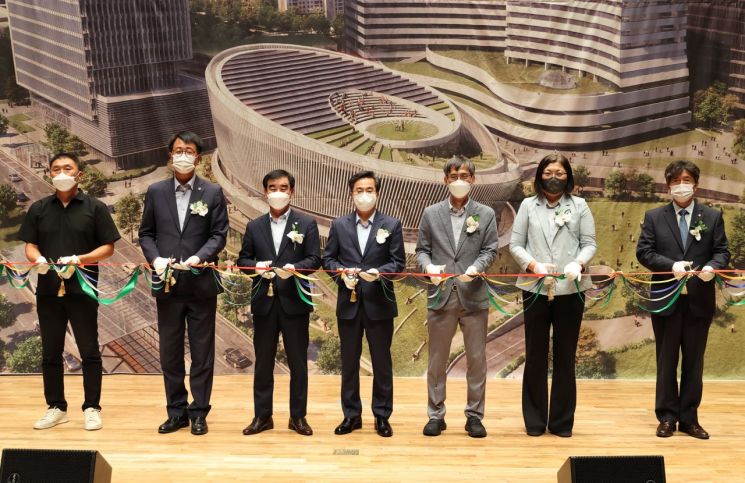
 Kim Dong-yeon, Governor of Gyeonggi Province (center), is attending the groundbreaking ceremony of the Gyeonggi Provincial Library held at the new Gyeonggi Provincial Government Office in Gwanggyo New Town, Suwon, on the 30th, cutting the tape with officials.
[Asia Economy (Suwon) = Reporter Lee Young-gyu] The 'Gyeonggi-do Library,' the representative library of Gyeonggi Province, broke ground on the 30th. The goal is to complete it by December 2024.
On this day, Gyeonggi Province announced that it held a groundbreaking ceremony for the Gyeonggi-do Library at the main auditorium of the new Gyeonggi Provincial Government building in Gwanggyo New Town, Suwon, with about 200 people including Governor Kim Dong-yeon of Gyeonggi Province, Yeom Jong-hyun, Chairman of the Gyeonggi Provincial Council, Nam Jong-seop, Democratic Party representative member of the Gyeonggi Provincial Council, Nam Young-jun, President of the Korea Library Association, related organizations, and residents.
Governor Kim Dong-yeon recalled his childhood when he used to walk for more than an hour to visit the library and said, "Today, when we break ground on the representative library, it is truly a joyful day for me, who was a boy thirsty for books," reflecting on his childhood.
He continued, "Since I was young, I have had a special affection for books, and although insufficient, I believe I gained great strength through reading to stand here today," adding, "I will do my best so that countless students, youth, seniors, and all residents of Gyeonggi Province can connect their lives to happiness and prosperity through the Gyeonggi-do Library."
Governor Kim quoted Steve Jobs, who after dropping out of college studied calligraphy and applied it to the development of the iPhone, saying, "The dots I connected without knowing anything then connected to the future," and expressed his expectations for the library by saying, "I hope the Gyeonggi-do Library will not simply be a place to come and read books, but a place where people read books, have various experiences, and connect many dots that link their future and the future of our society."
He also said, "I hope the Gyeonggi-do Library will be operated centered on the demand side, considering what residents want rather than being supplier-oriented," and added, "In particular, I hope the Gyeonggi-do Library pays attention to playing a role in creating a community that coexists and is inclusive with marginalized groups, people with disabilities, seniors, and youth."
The groundbreaking ceremony proceeded in the order of a project progress report, the 'Wishes for Gyeonggi-do Library' program to hear residents' voices, tape cutting, and an on-site inspection.
The Gyeonggi-do Library will serve as a policy control tower that researches and develops library policies of Gyeonggi Province and as a metropolitan representative library aiming to lead the era of knowledge management by sharing knowledge, information, and culture.
Located in Gyeonggi Convergence Town, Gwanggyo New Town, Iui-dong, Yeongtong-gu, Suwon City, it has a total floor area of 27,775 square meters with four basement floors and five above-ground floors. A total project cost of 110 billion KRW, including 80.1 billion KRW from the provincial budget, will be invested.
The Gyeonggi-do Library adopted a scroll-shaped design, symbolizing the collection of the vision and knowledge of Gyeonggi Province preparing for a new 100 years.
It is designed to accommodate 900,000 volumes (200,000 volumes at opening), the largest scale nationwide, with 500,000 volumes in the preservation stacks on the second basement floor and 400,000 volumes in the reading rooms on each floor.
The spatial configuration considers residents' usage flow: the first and second floors will house public service areas such as open reading rooms and media rooms, while the third and fourth floors will contain administrative and policy reading rooms and research rooms for policy work.
The first basement floor, connected to Gwanggyo Jungang Station and expected to attract many users, will be composed of a public forum where residents and experts can meet and discuss, as well as exhibition and cultural spaces, creating a venue for reading culture festivals.
© The Asia Business Daily(www.asiae.co.kr). All rights reserved.

















