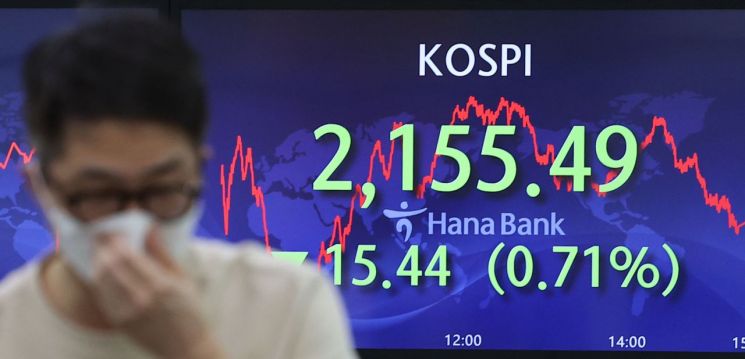
[Asia Economy Reporter Lee Seon-ae] The KOSPI fell into the 2150 range on the 30th, marking a new yearly closing low. During the session, it hit its lowest point in two years. Individual investors, terrified by the seemingly bottomless fear, were busy offloading their holdings throughout the day. Meanwhile, institutions and foreigners stepped in to buy, helping to somewhat defend against the index's decline.
On the day, the KOSPI closed at 2155.49, down 15.44 points (0.71%) from the previous day. The index opened at 2161.11, 9.82 points (0.45%) lower than the previous day, and dropped to 2134.77 during the session. This was the lowest level since April 4, 2017 (2134.88) and June 26, 2020 (2134.65). It also broke the intraday yearly low of 2151.60 recorded on the 28th. Although the decline narrowed afterward and the index recovered to the 2150 range, it still set a new yearly closing low since the 28th (2169.29).
The KOSDAQ index closed at 672.65, down 2.42 points (0.36%) from the previous session. The KOSDAQ also hit a new yearly low during the session, dropping to 661.65.
The sharp decline in the U.S. stock market had a significant impact. On the 29th (local time), the Dow Jones Industrial Average, which tracks blue-chip stocks, closed at 29,225.61, down 1.54% from the previous trading day at the New York Stock Exchange. The large-cap focused Standard & Poor's (S&P) 500 index fell 2.11% to 3,640.47, marking a yearly low. The tech-heavy Nasdaq index plunged 2.84% to close at 10,737.51. Additionally, the Russell 2000 index, which tracks small- and mid-cap stocks, dropped 2.35% to 1,674.93. The decline was led by plummeting stock prices of the largest market cap company Apple and electric vehicle maker Tesla. The unexpectedly strong employment data also influenced expectations that the Federal Reserve's monetary tightening policy would continue unabated.
However, in the afternoon, the decline narrowed due to some positive factors such as the strengthening of the Korean won and Korea being added to the watchlist of the World Government Bond Index. In particular, as the exchange rate fell compared to the previous day, foreigners shifted from net selling to net buying, defending the index decline alongside institutions. On the day, foreigners and institutions bought 169.3 billion KRW and 107 billion KRW respectively in the KOSPI market. In contrast, individuals sold off 281.4 billion KRW, limiting the index's rise.
Park Gwang-nam, a researcher at Mirae Asset Securities, explained, "The Asian stock markets started lower due to the impact of the previous day's decline in the U.S. stock market caused by negative news from individual companies like Apple and Tesla. However, the KOSPI saw inflows of bargain buying from foreigners and institutions as the dollar's strength eased, and the representative stocks in the electric and electronics sector rebounded, reducing the index's decline."
Among the top 10 KOSPI market cap stocks, Samsung Electronics (0.95%) and SK Hynix (2.85%) rose. Overnight in New York, Micron's earnings fell short of expectations, raising concerns about weakening semiconductor demand. Indeed, Samsung Electronics' stock price fell to 51,800 KRW during the session, setting a new 52-week low. However, after Micron announced cuts to its 2023 capital expenditure and purchasing budget and mentioned that the industry outlook would improve from the second half of next year, bargain buying by foreigners and institutions flowed into large-cap stocks such as Samsung Electronics and SK Hynix, leading to gains.
Other stocks such as LG Energy Solution (-3.07%), Samsung Biologics (-0.74%), LG Chem (-2.01%), Hyundai Motor (-2.75%), Samsung SDI (-3.53%), NAVER (-1.53%), and Kia (-3.49%) declined. Among the top 10 KOSDAQ market cap stocks, Celltrion Healthcare (1.80%), HLB (2.51%), Kakao Games (3.39%), Pearl Abyss (0.11%), EcoPro (0.78%), Celltrion Pharm (1.26%), JYP Ent. (1.20%), and Studio Dragon (0.61%) rose. EcoPro BM (-2.97%) and L&F (-2.79%) fell.
Lee Kyung-min, a researcher at Daishin Securities, said, "The KOSPI reversed to an upward trend, supported by a sharp rebound in semiconductor stocks and Kakao, which were at the center of the plunge. However, although the KOSPI attempted to recover to the 2170 level, it turned down again in the afternoon. Uncertainty factors such as tightening burdens and recession concerns continue to suppress the market, resulting in only limited rebounds."
© The Asia Business Daily(www.asiae.co.kr). All rights reserved.

















