Portrait Direction Changed Since Charles II
Tradition Broken During Edward VIII
Queen Elizabeth Coins Circulated Simultaneously
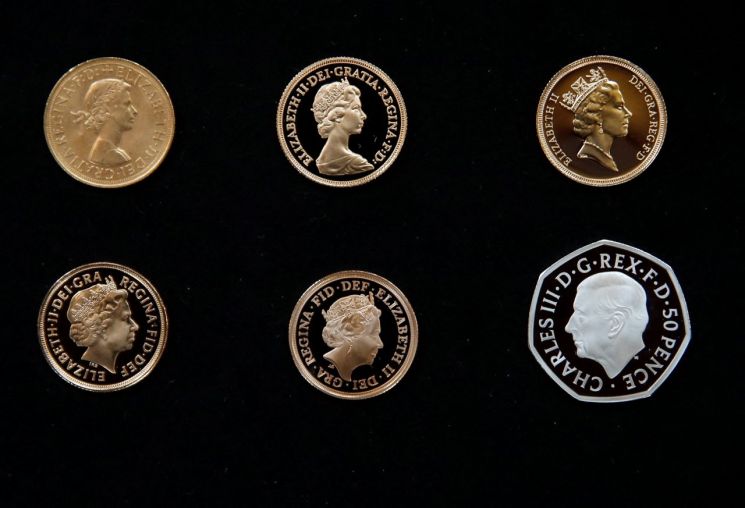 On the 29th (local time), the Royal Mint of the United Kingdom unveiled a 50 pence coin featuring the portrait of King Charles III. While the coins minted during Queen Elizabeth II's reign showed her portrait facing right, King Charles III's portrait is notable for facing left. London, UK = Reuters·Yonhap [Image source = Yonhap News]
[Asia Economy Reporter Lee Ji-eun] With Charles III succeeding Queen Elizabeth II to the throne, new changes have occurred in British coins. On the 29th of last month (local time), the Royal Mint of the United Kingdom unveiled coins engraved with the portrait of King Charles III. Unlike Queen Elizabeth, the portrait features a face looking to the left.
The Royal Mint announced that it introduced a 50-pence coin engraved with Charles III and plans to circulate it in the market starting this December. Special commemorative coins of 5 pounds and 50 pence, made to honor Queen Elizabeth, will also feature the portrait of Charles III.
The portrait engraved on the coin is the work of sculptor Martin Jennings and faces left. Since the reign of Charles II, who ascended the throne in 1660, the UK has traditionally depicted the new monarch facing the opposite direction from the previous monarch on coins.
Charles II is known to have refused to have coins minted in the same manner as Oliver Cromwell, who led the republic for five years after executing Charles I, his father. Therefore, he had his portrait facing left, opposite to Cromwell’s, engraved on the coins. This tradition, which started with Charles II, was exceptionally broken during the reign of Edward VIII in 1936. Edward VIII minted coins with a portrait facing the same direction as his predecessor to emphasize his dignified image.
The portraits engraved on coins have served to inform the public of the monarch’s actual appearance. Chris Barker, an employee of the Mint Museum, explained, "In times without social media and television, coins were the only way for people to recognize the monarch’s appearance," adding, "The Royal Mint has captured the faces of the British royal family on coins for 1,100 years."
The use of the monarch’s portrait on coins also helped instill trust in the currency and elevate the king’s authority. Dominic Choi, a British coin expert, told CNBC, "Since Roman times, the clearest symbol of a nation was the king," and "Currency bearing the king’s image meant it was issued by the state, so people could trust and use it."
Coins featuring Charles III are expected to circulate alongside coins minted during Queen Elizabeth’s reign for the time being. Currently, about 27 billion coins bearing Queen Elizabeth’s portrait are in circulation throughout the UK. Pound coins are thick and resistant to wear, allowing them to be used for up to 30 years. When coins are withdrawn after 30 years, those bearing Queen Elizabeth’s image will remain legal tender.
Dominic Choi said, "It is rare in modern history for currency featuring two monarchs to circulate simultaneously," noting that the simultaneous market release of coins with Charles III and Queen Elizabeth is an extremely rare event."
© The Asia Business Daily(www.asiae.co.kr). All rights reserved.

















