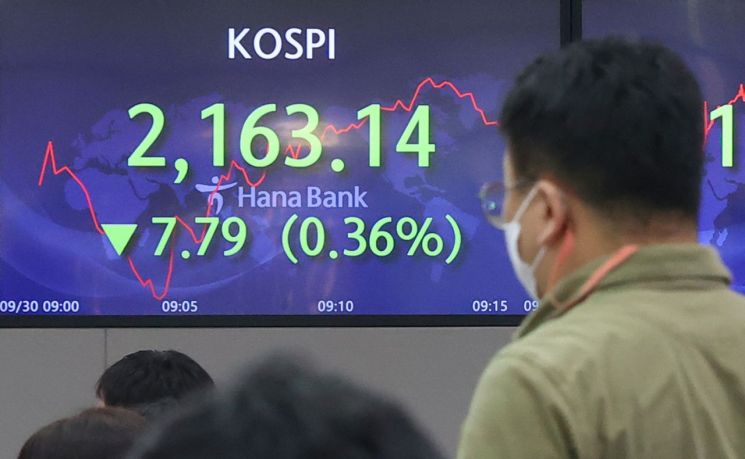
[Asia Economy Reporter Lee Seon-ae] On the morning of the 30th, the KOSPI, which hit a new yearly low during the session, is narrowing its losses in the afternoon. This is because foreigners have switched to net buying, defending the index decline along with institutions.
As of 1:48 PM, the KOSPI is recording 2162.89.
On this day, the KOSPI index started down at 2161.11 and expanded its losses during the session, falling to the yearly low of around 2143. It further declined to 2134, the lowest level since April 4, 2017 (2134.88) and June 26, 2020 (2134.65). Then, supported by net buying from foreigners and institutions, it reached an intraday high of 2177 at 12:04 PM and has since remained around the 2160 level.
Institutions have consistently recorded buying pressure since the morning. Foreigners also contributed to reducing the losses by switching from net selling in the early session to net buying later.
The rebound in major KOSPI stocks such as the semiconductor sector also helped the index recovery. Samsung Electronics and SK Hynix are currently up 1.52% and 3.34%, respectively, compared to the previous session. Although Micron announced disappointing earnings the day before, the semiconductor sector’s rebound was supported by expectations of market improvement starting in the second half of 2023.
However, strong selling pressure from individuals is preventing the index from escaping the downward trend. A panic selling atmosphere is even forming. Individuals have sold about 299.8 billion KRW in the KOSPI market alone. In the KOSDAQ market, they are also net sellers by about 5.3 billion KRW.
Lee Kyung-min, a researcher at Daishin Securities, said, "Although the market showed instability in the early session, the semiconductor and internet sectors reversed and reduced the losses," adding, "The stabilization of the exchange rate also helped from a supply-demand perspective, recovering the parts that were technically pushed down early on." He continued, "Micron’s earnings were announced the day before, and although the guidance was weak, the CEO mentioned that IT semiconductor demand will revive early next year and earnings will improve in the second half, which psychologically provided a reassuring factor."
© The Asia Business Daily(www.asiae.co.kr). All rights reserved.
![Clutching a Stolen Dior Bag, Saying "I Hate Being Poor but Real"... The Grotesque Con of a "Human Knockoff" [Slate]](https://cwcontent.asiae.co.kr/asiaresize/183/2026021902243444107_1771435474.jpg)
















