Broadcasting Commission Announces Spam Distribution Status Survey Results
95% Abuse Cases of Bulk Messaging Services
Domestic Sending Accounts for 85%
Chairman Hansanghyuk: "Will Expedite Spam System Improvement"
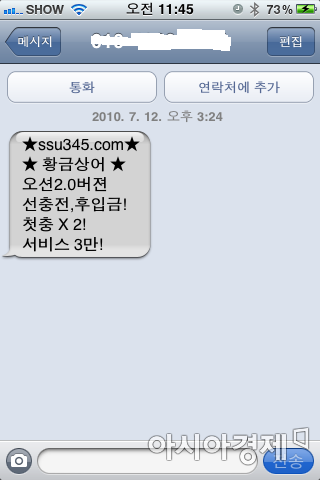 Example of spam text message. Source=Asia Economy DB
[Asia Economy Reporter Cha Min-young] In the first half of this year, the number of spam text messages on mobile phones abusing bulk messaging services reached 7.99 million, an increase of 1.65 million (26.5%) compared to the previous half-year period. Among these, spam messages sent using bulk messaging services surged sharply over the past five years, reaching 1.6 times the volume from four years ago.
According to the "2022 First Half Spam Distribution Status" announced on the 30th by the Korea Communications Commission and the Korea Internet & Security Agency, the total number of spam cases on mobile phones and emails in the first half of this year was 28.18 million, a 0.45% decrease compared to the previous period (28.31 million).
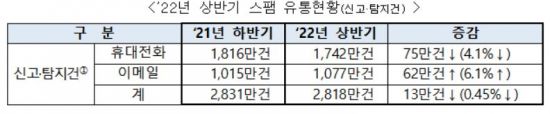
The total number of reported and detected mobile phone spam cases was 17.42 million, a 4.1% (750,000 cases) decrease compared to the previous half-year. Among these, voice spam messages numbered 9.42 million, down 20.3% (2.4 million cases), but text message spam increased by 26% (1.65 million cases) to 7.99 million.
Breaking down text message spam by type, gambling accounted for the largest share at 39.9%, followed by finance such as stock investment solicitations (23.5%), illegal loans (15.8%), and adult advertisements (8.4%). By transmission route, bulk messaging services accounted for 95.1% of the total, with domestic bulk messaging services making up 85.1% of that.
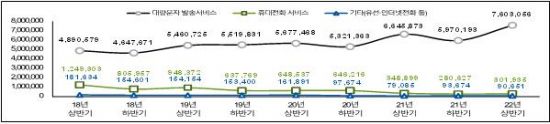
In particular, cases abusing bulk messaging services exceeded 7.6 million, indicating a serious problem. This is 1.55 times the number from the first half of 2018 (4.89 million). During the same period, transmission types via mobile phone services or others (landline and internet phone) decreased to about one-quarter and one-half, respectively, over the past four years.
Voice spam by type was led by illegal loans (79.0%), followed by adult advertisements (6.5%), finance (4.3%), and gambling (2.1%). By transmission route, landline phones accounted for the highest share at 48.2%, followed by internet phones (34.8%), mobile phones (14.7%), and international calls (2.3%).
Email spam totaled 10.77 million cases, with 230,000 sent domestically and 10.54 million originating from abroad. This represents a 6.1% (620,000 cases) increase compared to the second half of last year. Among the countries sending email spam from overseas, China accounted for the largest share at 78.1%, followed by the United States (4.4%) and Brazil (1.3%).
A survey conducted by the Korea Communications Commission targeting 3,000 mobile phone and email users aged 12 to under 69 found that the average daily spam reception across mobile phones and emails was 0.41 messages, equivalent to about 2 messages every 5 days. This is a decrease of 0.01 messages compared to the previous period.
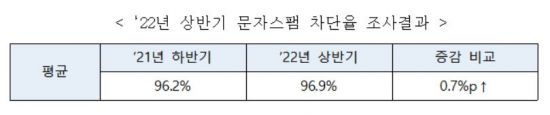
Results of the spam text blocking rate survey by the three major mobile carriers were also released. The average text spam blocking rate of the "Intelligent Spam Blocking Service," which the three carriers provide free of charge, was 96.9% in the first half of this year, up 0.7 percentage points from the previous period. The blocking rate is measured by sending 200 test messages weekly using illegal text spam reported to the Korea Internet & Security Agency.
Han Sang-hyuk, chairman of the Korea Communications Commission, said, "Although we have strengthened responses to illegal spam, including preparing 'Measures to Prevent Illegal Spam Impersonating Banks' last October, public harm remains a concern. We will promptly pursue institutional improvements to strengthen penalties for illegal spam senders and the responsibilities of telecommunications companies."
© The Asia Business Daily(www.asiae.co.kr). All rights reserved.



















