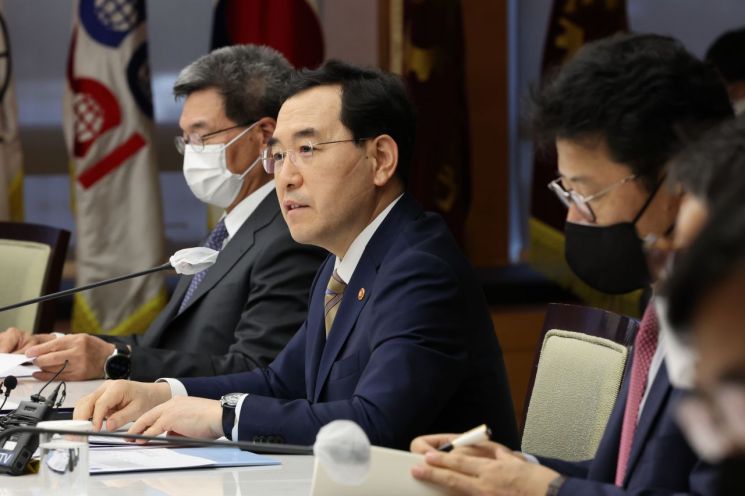
[Asia Economy Sejong=Reporter Dongwoo Lee] Lee Chang-yang, Minister of Trade, Industry and Energy, emphasized on the 30th that "normalizing the price function of tariffs is essential to prevent the deterioration of the stable supply base caused by the worsening financial soundness of (energy) public enterprises."
Minister Lee stated at the joint emergency economic ministers' meeting of related ministries held at the Government Seoul Office in the morning, "Currently, the world is facing a severe energy crisis comparable to the oil shock of the 1970s."
He explained, "Since Korea has a high dependence on overseas energy, a huge trade deficit is occurring, and due to the previous government's nuclear phase-out policy, it has become vulnerable to fuel cost risks. So far, the financial situation of energy public enterprises has deteriorated extremely due to the suppression of tariff increases and the global surge in energy prices, making it time to transform the economy and industry into a low-consumption, high-efficiency structure."
He added, "Along with the energy public enterprises' strong cost-cutting efforts, a portion of the increased fuel costs will be reflected in tariffs, and for large-volume users, additional adjustments will be made considering their ability to pay and the effects of consumption efficiency." However, energy welfare will be expanded so that vulnerable energy groups do not suffer difficulties.
The meeting addressed three agenda items: ▲establishing a nationwide energy-saving culture ▲strengthening investment in efficiency innovation ▲gradual normalization of the price function of tariffs and expansion of energy welfare.
The government plans to carry out a nationwide energy-saving campaign aiming to reduce energy usage by 10% this winter.
The ‘Energy Cashback’ program, which returns cash equivalent to the amount of energy saved, will be expanded, and voluntary efficiency innovation agreements will be signed with high energy-consuming companies.
Additionally, to support private sector energy efficiency innovation, tax support will be expanded for investments in energy-saving facilities and development of core efficiency improvement technologies, and financial support will be promoted for improving energy efficiency in small and medium-sized enterprises.
Minister Lee said, "Since the crisis we face is also an opportunity to fundamentally improve the energy consumption structure, I ask for the active participation of all citizens."
© The Asia Business Daily(www.asiae.co.kr). All rights reserved.
![Clutching a Stolen Dior Bag, Saying "I Hate Being Poor but Real"... The Grotesque Con of a "Human Knockoff" [Slate]](https://cwcontent.asiae.co.kr/asiaresize/183/2026021902243444107_1771435474.jpg)
















