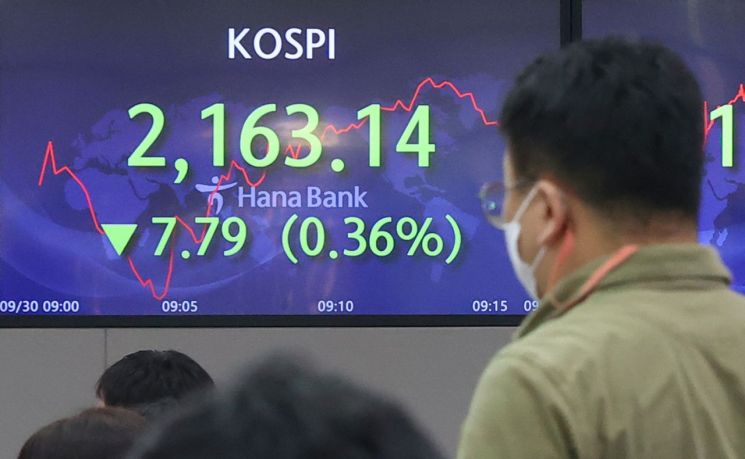
[Asia Economy Reporter Lee Seon-ae] The KOSPI index recorded 2134.77 at 9:52 a.m. on the 30th, hitting its lowest point in two years. The KOSDAQ index also hit a yearly low amid selling pressure from individuals and institutions. Amid an endless bottom, individuals showed a selling dominance from the early trading hours, creating a panic selling atmosphere.
On this day, the KOSPI index started down from 2161.11 and widened its losses during the session, falling to the yearly low of around 2143. It continued to decline further, sliding to 2134. This is the lowest level since April 4, 2017 (2134.88) and June 26, 2020 (2134.65). The KOSDAQ also hit a yearly low. At 9:53 a.m., the KOSDAQ index recorded 661.65.
Individual selling widened the losses. As of 10:48 a.m., individuals sold 227.2 billion KRW in the KOSPI market. Foreigners switched to buying, showing a buying dominance of about 4.1 billion KRW at this time. Institutions also bought about 220 billion KRW. In the KOSDAQ market, individuals showed a selling dominance of 32.6 billion KRW. Institutions sold about 75.1 billion KRW. Only foreigners showed a buying dominance of 75.1 billion KRW.
Most sectors are also in decline. Large-cap, mid-cap, and small-cap stocks all showed losses exceeding 1%. In particular, the textile and apparel sector plunged over 4%. Non-metallic minerals, machinery, and transportation equipment also fell by around 2%.
The sharp drop in the New York stock market the previous day had a significant impact. On the 29th (local time), the Dow Jones Industrial Average, which gathers blue-chip stocks, closed at 29,225.61, down 1.54% from the previous trading day at the New York Stock Exchange. The large-cap-focused Standard & Poor's (S&P) 500 index recorded 3,640.47, down 2.11%, marking a yearly low. The tech-heavy Nasdaq index plunged 2.84% to close at 10,737.51. Additionally, the Russell 2000 index, which focuses on small and mid-cap stocks, fell 2.35% to 1,674.93. The plunge in shares of the largest market cap company Apple and electric vehicle maker Tesla led the index declines. The unexpectedly strong employment data also influenced expectations that the Federal Reserve's monetary tightening policy would continue unwaveringly.
As semiconductor stocks faltered in the New York stock market, related domestic stocks also underperformed. Microsoft (-1.48%), Amazon (-2.72%), Tesla (-6.81%), and Nvidia (-4.05%) saw significant declines. According to financial information provider FactSet, nearly one-fifth of the companies in the S&P index recorded new 52-week lows on this day. Samsung Electronics fell to 51,800 KRW during the session. SK Hynix also dropped to 80,400 KRW.
Han Ji-young, a researcher at Kiwoom Securities, noted, "Although there are upward factors such as exchange rate decline, U.S. interest rate decline, and anticipation of bad news being priced in advance, the existing downward factors such as the U.S. stock market plunge triggered by tightening, and domestic individuals' margin call selling volumes caused the market to start down. The poor after-hours stock prices of major U.S. semiconductor and consumer goods companies will constrain the investment sentiment of related domestic stocks."
© The Asia Business Daily(www.asiae.co.kr). All rights reserved.

















