[Asia Economy Reporter Ji Yeon-jin] A survey found that 70% of those with experience in remote work and online classes prefer remote work methods.
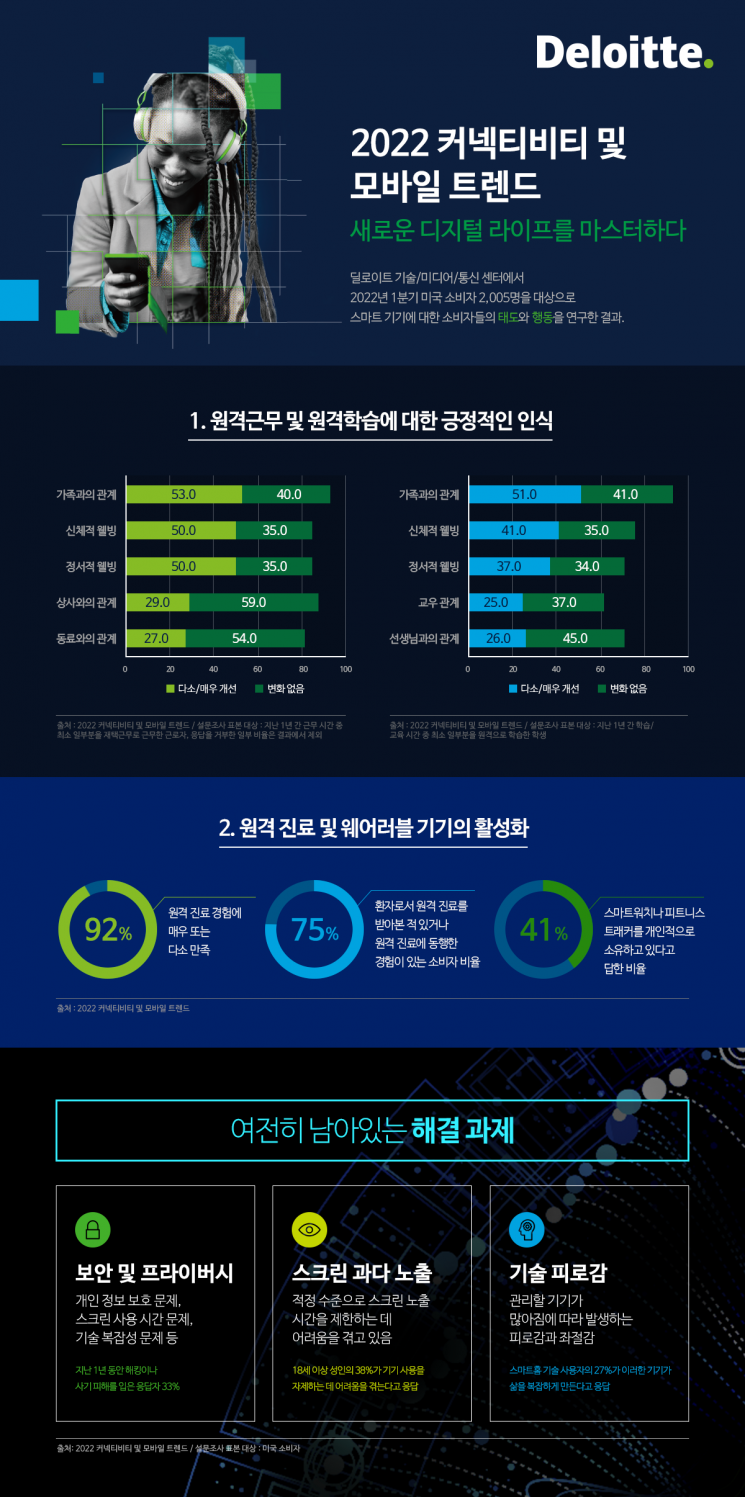
According to the ‘2022 Connectivity and Mobile Trends’ report published on the 1st by Deloitte Korea Group (Global CEO Hong Jong-seong), nearly half (43%) of those with remote work experience preferred fully remote or partially remote work, and 32% wanted a hybrid form combining remote work and commuting. More than 70% preferred remote work.
The report was conducted in the first quarter of this year with 2,005 U.S. consumers and analyzed consumers’ use of smart devices and digital life situations.
According to the report, 47% of workers answered that they worked remotely for at least some portion of their working hours in the past year. Although remote classes decreased more than remote work, 23% of consumers responded that at least one household member attended some portion of their learning time remotely from home.
97% of Parents and Students "Highly Evaluate Remote Learning"
97% of parents and students highly evaluated remote learning. Especially, as technology improved and students and teachers became accustomed to remote classes, difficulties with remote classes significantly decreased over the past year.
Teenagers and adults who studied remotely showed very positive outlooks on remote learning. More than half (51%) of students who took remote classes felt that family relationships improved thanks to remote learning, and more than 7 out of 10 said their emotional and physical well-being and relationships with teachers improved or were maintained.
Seventy-five percent of consumers answered that they had experienced remote medical consultations as patients or accompanied someone for remote medical care in the past year. Among millennials, 59% said they had experienced remote medical consultations at least once, indicating that they are leading the trend in remote medical care. Satisfaction with remote medical care also greatly increased over the past year, with 92% of consumers reporting they were very or somewhat satisfied with their remote medical experience. This is a 10% increase compared to the 2021 survey.
Smartphone usage was also high in health and fitness. At least one-third of smartphone users said they monitor their health or track fitness using their smartphones. Three out of ten use exercise apps, and one in five use meditation or mental health apps. In addition to smartphones, the number of consumers purchasing wearable devices increased, with 41% of respondents owning smartwatches or fitness trackers.
32% of Respondents Plan to Buy a New Smartphone by Next Year
Also, over the past year, 15% of consumers upgraded their internet service speed, and 44% purchased Wi-Fi extenders or network amplifiers to improve communication performance. In mobile, more than one-third of consumers bought a new smartphone last year, and 32% said they plan to buy a new smartphone by next year. Most consumers upgraded their phones on a 2-3 year cycle.
Sixty percent of survey respondents control smart home devices with their smartphones, and 70% enjoy shopping and making payments using their smartphones. Especially among early adopters in Generation Z, this rate rises to 90%.
5G service is also becoming widespread. Among consumers who changed smartphones in 2021, 56% chose 5G, and this year the rate reached 68%. Among smartphone users, 93% reported satisfaction with 5G service. As video streaming service usage increases, 5G is expected to become the mainstream, and future smartphone replacement demand is expected to focus mostly on 5G.
On the other hand, there were side effects. One-third of respondents said they experienced hacking or fraud in the past year, and 17% said they were victimized more than twice. Especially, Generation Z consumers were found to be much more vulnerable to fraud than previous generations, which is analyzed to be due to the large number of Generation Z users active online and their relatively limited knowledge of information security.
Park Hyung-gon, leader of the Telecommunications, Media, and Entertainment Industry at Deloitte Korea Group, pointed out, “Consumers are becoming accustomed to smart devices, remote work, and remote classes, and have positive perceptions of virtual life, but at the same time, they show a tendency to seek a balance between the digital world and the physical world.”
© The Asia Business Daily(www.asiae.co.kr). All rights reserved.

















