Monthly Average Increase of 5,400 KRW per Household
Electricity Rate Increase of 9.9 KRW Under Review
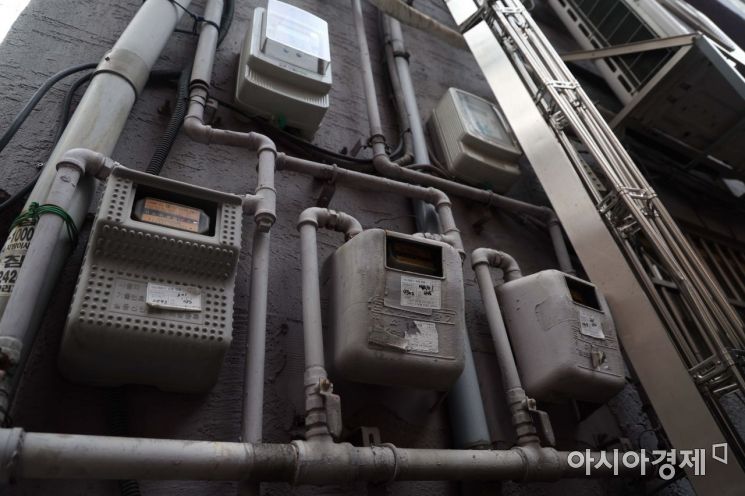 On the 4th, electric meters and gas meters were installed in a residential area in Seoul. Photo by Mun Ho-nam munonam@
From the 1st of next month, the residential (housing and general use) city gas price will increase by 2.7 KRW per MJ (megajoule, a unit of gas heat energy). Gas bills per household are expected to rise by about 5,400 KRW on average per month. The government also plans to raise electricity rates next month, which is likely to increase the financial burden on low-income households amid high inflation.
The Ministry of Trade, Industry and Energy announced on the 30th that from October 1st, the city gas price for residential use will be raised by 2.7 KRW per MJ. This reflects the increase in the settlement unit price confirmed last December due to the revision of natural gas supply regulations (0.4 KRW per MJ) and the current increase in the standard raw material cost (2.3 KRW per MJ).
The ministry explained, "Due to the rising import prices, the Korea Gas Corporation's accumulated unpaid receivables this year are expected to reach a record high," adding, "Due to concerns over natural gas supply disruptions, the price increase was inevitably decided at the minimum necessary level." As of the second quarter of this year, the Korea Gas Corporation's accumulated unpaid receivables stand at 5.1 trillion KRW, the highest ever.
Following this price increase, the residential gas price will be adjusted from the current 16.99 KRW per MJ to 19.69 KRW, and the general use (commercial use 1) price will be adjusted to 19.32 KRW per MJ.
The rate of increase is 15.9% for residential use, 16.4% for general use (commercial use 1) applied to restaurants, cafeterias, beauty salons, lodging facilities, swimming pools, etc., and 17.4% for general use (commercial use 2) applied to bathhouses and waste incineration plants. Based on Seoul standards, the average annual household gas bill will rise from 33,980 KRW per month to 39,380 KRW per month, an increase of about 5,400 KRW monthly.
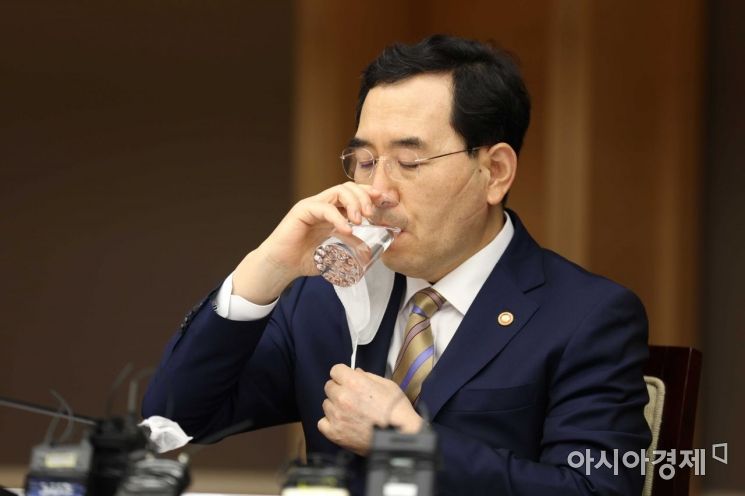 Minister Lee Chang-yang of the Ministry of Trade, Industry and Energy is drinking water at the meeting of CEOs from the top 10 groups to respond to the global energy crisis held at the Korea Chamber of Commerce and Industry in Jung-gu, Seoul on the 26th. Photo by Moon Ho-nam munonam@
Along with the gas price increase, electricity rates will also rise starting next month. Lee Chang-yang, Minister of Trade, Industry and Energy, said at the emergency economic ministers' meeting on energy crisis response that "normalizing the price function of rates is essential to prevent the deterioration of the financial soundness of public enterprises and to maintain a stable supply base," adding, "We will consider additional adjustments based on the high-intensity cost-cutting efforts of energy public enterprises and the burden capacity of large-volume users, while expanding welfare for energy-vulnerable groups."
Residential electricity rates are likely to increase by up to 9.9 KRW per kWh starting from the fourth quarter. This includes the already announced increase of 4.9 KRW in the standard fuel cost and an additional increase of up to 5 KRW due to the surge in fuel costs. In this case, the electricity bill for a four-person household is expected to increase by about 3,000 KRW per month on average.
Korea Electric Power Corporation (KEPCO) recorded an operating loss of about 14 trillion KRW in the first half of this year alone, and the annual operating deficit is expected to reach 30 trillion KRW. According to KEPCO's estimates, to offset this large-scale deficit, electricity rates would need to be raised by 260 KRW per kWh, and to break even in the fourth quarter, a 50 KRW increase is necessary. Accordingly, the government plans to reform the industrial electricity rate system for large-volume electricity users, where the possibility of rate hikes has been continuously raised.
In addition, the government will launch a nationwide energy-saving campaign aiming to reduce energy consumption by 10% this winter. The 'Energy Cashback' program, which returns cash equivalent to the amount of energy saved, will be expanded, and energy efficiency improvements for high-energy-consuming buildings will be promoted in cooperation with local governments.
© The Asia Business Daily(www.asiae.co.kr). All rights reserved.
![Clutching a Stolen Dior Bag, Saying "I Hate Being Poor but Real"... The Grotesque Con of a "Human Knockoff" [Slate]](https://cwcontent.asiae.co.kr/asiaresize/183/2026021902243444107_1771435474.jpg)

















