Europe's Diesel Imports Surge as Natural Gas Alternative, Expanded Up to 15 Million Tons in October
Average Daily Freight Rate for 50,000 DWT Tankers Soars 60%
[Asia Economy Senior Reporter Cho Young-shin] There is a forecast that China will expand its refined oil export quota by up to 15 million tons. This measure aims to increase exports of Chinese refined oil as energy shortages, including natural gas in Europe, become a reality.
Some argue that China is gaining economic benefits from Western sanctions against Russia, such as the price cap on Russian crude oil.
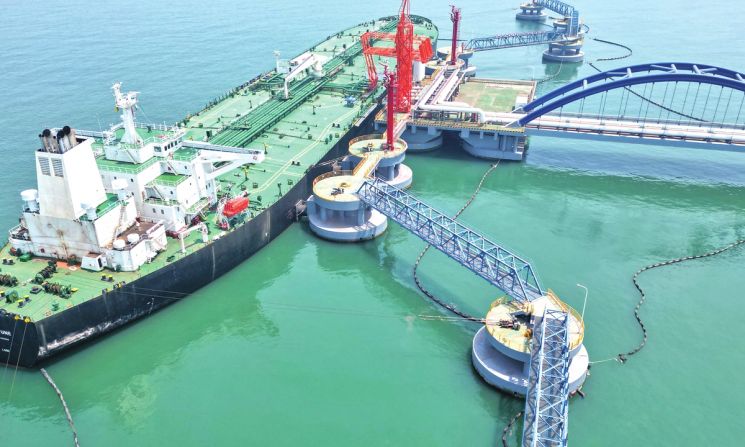
Chinese economic media Caixin reported on the 30th, citing reports from Chinese energy specialist institutions such as Changjiang Securities, that China's Ministry of Commerce will increase the refined oil export quota by 10 to 15 million tons next month.
China's Ministry of Commerce raised the refined oil export quota three times this year?4.5 million tons in June and 5 million tons in July?after international crude oil prices surged. China has introduced a quota system (allocation system) to restrict exports to stabilize the supply and demand of refined oil products.
Chinese shipping company COSCO said, "European countries expected to face energy shortages in winter are looking forward to expanding refined oil imports from China, which has surplus production capacity."
China's maximum crude oil refining capacity is estimated at 910 million tons. Caixin, citing data from China's National Bureau of Statistics, added that China's crude oil consumption last year was about 700 million tons, of which refined oil consumption was 341.48 million tons. This indicates a surplus capacity of about 500 million tons as of last year. Caixin also reported that the operating rate of China's refined oil plants was only 71% in the first half of this year.
The International Energy Agency (IEA) estimated that Europe's heating oil demand will surge this winter, requiring an additional 300,000 to 500,000 barrels of refined oil.
In fact, European countries are rushing to import heating oil (diesel). According to data from energy analytics firm Vortexa, heating oil imports in Europe averaged 1.65 million barrels per day in September, an increase of 200,000 barrels compared to August. Meanwhile, the share of Russian diesel imports in Europe has been decreasing monthly: 60% in July, 51% in August, and 44% in September.
As European countries increase heating oil reserves in preparation for winter, maritime freight rates have also soared. According to Clarkson, a UK shipbuilding and shipping analysis firm, the average daily freight rate for medium-sized tankers (50,000 DWT class) reached $47,000 in September, a rise of more than 60% compared to the beginning of the month. The Baltic Clean Tanker Index (BCTI) also surged over 80% from the beginning of the year, reaching 1,231 as of the 27th.
China Zhongxin Futures explained in a recent report that the Dutch TTF natural gas price in mid-September more than doubled compared to Brent crude oil prices, indicating that Europe has no choice but to turn to energy sources other than natural gas.
Caixin pointed out that Europe, facing an emergency for winter heating, is in a difficult position to seek help from the United States. The U.S. exported an average of 6 million barrels of refined oil per day in the first half of this year, marking the highest level since 1981.
Moreover, Caixin noted that U.S. Energy Secretary Jennifer Granholm urged seven U.S. refiners, including ExxonMobil and Chevron, to secure inventories of natural gas and petroleum products, making it difficult for Europe to rely on the U.S. for heating oil.
Tian Feiyue, a researcher at Shanghai Jiao Tong University Industrial Research Institute, said, "Due to the pandemic and carbon neutrality efforts, the refining capacity of major countries has shrunk compared to the past," adding, "Europe has no choice but to seek the necessary heating oil from the Middle East and Asian countries."
Caixin added that as of 2021, China's refining production capacity accounted for 18% of the global total, while the Middle East and India accounted for 11% and 5%, respectively.
© The Asia Business Daily(www.asiae.co.kr). All rights reserved.

















