"Investors Lose Money, Citizens Inconvenienced, Colleagues Lose Jobs, Junior Entrepreneurs Fearful"
"Political Circles Must Apologize to Those Who Lost Jobs Even If They Can't Reflect After the Ruling"
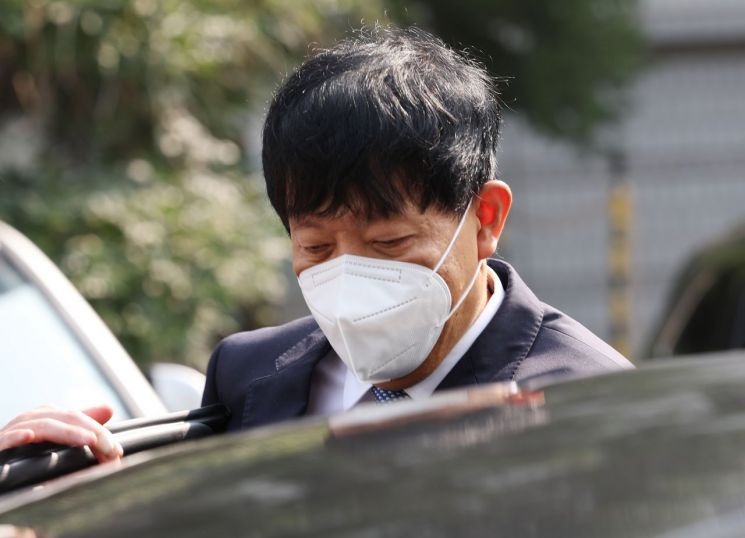
[Asia Economy Reporter Kang Nahum] The former and current executives of the vehicle-hailing service "Tada," which was embroiled in controversy over "illegal call taxi operations," were acquitted again in the second trial following the first trial. As the Seoul city taxi fare increase coincided, criticism toward the existing taxi industry and political circles, which blocked innovative services like ride-sharing, is intensifying.
According to the Seoul Central District Court on the 30th, the Criminal Appeal Division 1-1 (Presiding Judges Jang Chan, Maeng Hyun-moo, Kim Hyung-jak) acquitted former Socar CEO Lee Jae-woong, VCNC CEO Park Jae-wook (a subsidiary of Socar and operator of Tada), and the corporations Socar and VCNC of charges of violating the Passenger Transport Service Act, just as in the first trial.
Immediately after the verdict, former CEO Lee said on Facebook, "After more than three years of trial, the court's wise judgment ruled that dreaming of innovation is not a crime and that we are not punished, and we were acquitted because it is not a crime," adding, "It is a natural result."
He said, "Investors suffered losses, the public became inconvenienced, colleagues lost their jobs, and junior entrepreneurs hesitated to boldly innovate out of fear and anxiety," adding, "The new era that seemed to come right after the first trial acquittal has almost come to a halt." This is interpreted as referring to the difficulty in conducting business even after the first trial acquittal due to the passage of the "Tada Ban Act."
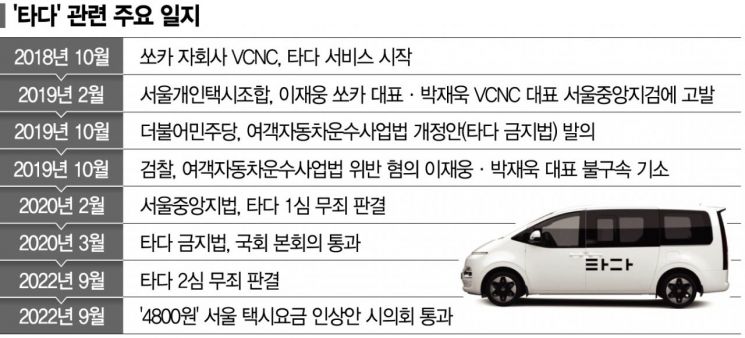
As former CEO Lee claimed, the platform and venture industries also view the suspension of Tada's ride-sharing business as a trigger for the recent taxi crisis and the basic fare increase. Launched in 2018, Tada received great response, surpassing one million users within nine months of service, but it had to shut down due to opposition from the taxi industry and political regulations such as the "Tada Ban Act."
About 12,000 Tada drivers immediately lost their jobs, and the government promised to improve treatment by introducing measures such as the corporate taxi salary system to help Tada drivers return to the taxi industry, but the drivers chose other jobs like delivery instead of returning to the taxi industry.
One of the chronic problems in the taxi industry, "selective picking," was fundamentally impossible with Tada, which is also cited as a regrettable aspect of the suspension of the ride-sharing business. Tada assigned calls to the nearest driver without revealing the passenger's destination, and the driver only learned the destination after the passenger boarded. Drivers had to accept a call within 15 seconds, and penalties were imposed if they failed to accept calls beyond a certain number. It was effectively a forced dispatch system. Analysts say that if this system had been maintained, the current ride shortage would have been less severe.
On the 28th, the Seoul Metropolitan Council passed a taxi basic fare adjustment plan to resolve the "late-night taxi crisis" that worsened after COVID-19. The fare will increase by 1,000 won from the existing 3,800 won to 4,800 won.
Former CEO Lee criticized, "Politicians who relentlessly proceeded to close services by creating laws that violate the constitutionally guaranteed 'economic freedom and respect for creativity,' rather than trying to solve social problems through innovation, will they reflect upon this verdict?" He added, "At the very least, shouldn't they apologize to the public inconvenienced and those who lost jobs due to the faulty laws they created?"
© The Asia Business Daily(www.asiae.co.kr). All rights reserved.


















