From LCD to OLED, China May Take the Lead
Korea Strives to Widen the Technology Gap
"Display Must Be Designated as a National Advanced Strategic Technology"
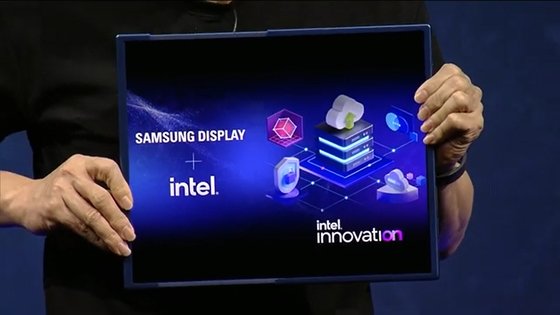 Choi Joo-sun, President of Samsung Display, attended the '2022 Intel Innovation' event held on the 27th (local time) in San Jose, USA, and unveiled the world's first 17-inch PC slidable display.
 [Photo by Intel Newsroom YouTube capture]
[Asia Economy Reporter Han Yeju] Samsung Display has stepped up efforts to strengthen 'patent management.' As China, which holds the world's number one position in display sales, is enhancing its research and development (R&D) capabilities to solidify its 'display rise,' Samsung Display is adopting a strategy to maintain competitiveness through fundamental patents.
According to the United States Patent and Trademark Office on the 30th, Samsung Display has filed a total of 1,079 patents in the U.S. from early this year to the present. This is the highest number of patent applications compared to the same period. Last year, it filed 2,905 patents, marking an increase of nearly 18% compared to the previous year.
Currently, Samsung Display is the industry leader in the small and medium-sized organic light-emitting diode (OLED) market, including mobile applications. While the technological barriers of domestic companies are still considered strong, recent Chinese display companies, which had been increasing market share based on price competitiveness, are focusing on narrowing the technology gap beyond liquid crystal displays (LCD) to OLEDs, raising concerns. In fact, there are growing worries that the technology gap with China has rapidly narrowed recently. BOE filed 3,624 patents in the U.S. last year, an increase of nearly 70% compared to the previous year. BOE has shown an average annual patent application growth rate of nearly 50% over the past decade, the fastest growth rate in the industry.
Industry experts point out that in the past LCD market, market share reversals followed a certain period after surpassing patent applications. According to the patent office, China began to surpass Korea in the number of LCD patent applications starting in 2011.
If the rule of 'market share surpassing seven years after patent application surpassing' also applies to OLED, there is speculation that Korea could lose its leading position in the OLED market to China within 3 to 4 years. In this regard, market research firm Display Supply Chain Consultants (DSCC) has predicted that by 2025, China will hold a 47% share of the entire OLED market, including TVs and smartphones, competing closely with Korea's 51% for first place.
Samsung Display is accelerating the acquisition of core patents under the judgment that it must widen the technology gap. Choi Kwon-young, Vice President of Samsung Display, personally stated, "We will make great efforts to protect the accumulated IP," and added, "We will take various measures to protect OLED technology and receive fair value."
Recently, the company has been focusing all efforts on form factor innovations such as foldable and slidable displays. Earlier, on the 27th (local time), Samsung Display surprised the public by unveiling a slidable display at the 'Intel Innovation' event in the U.S., where Intel shared new products and business directions. The structure allows the display to extend in the direction pulled from the left side. The maximum extended size is 17 inches. Named 'Flex Slidable,' this product does not fold the OLED but opens and closes horizontally. Since this is the first time the display's extension was demonstrated directly, industry expectations for commercialization are growing. Samsung Display has also filed two trademarks named 'Slidable Flex Solo' and 'Slidable Flex Duet.'
This year, the company acquired the German OLED startup Cynora for $300 million, securing various display-related intellectual property (IP) from Cynora in the process. Recently, it acquired Cynora's thermally activated delayed fluorescence (TADF) patent technology. Lee Chang-hee, Vice President of Samsung Display, said, "We acquired Cynora's technology to enhance our blue material development capabilities," adding, "We are putting all our efforts into applying blue materials for QD displays."
Meanwhile, the display industry continues to advocate for designating displays as a national advanced strategic technology. In March, the Display Association submitted a proposal to the government requesting that four next-generation technologies, including OLED, be designated as national advanced strategic technologies. If selected as an advanced strategic technology, the industry can receive comprehensive support from the government, including R&D funding, workforce training, shortened permits and approvals, and exemption from preliminary feasibility studies.
© The Asia Business Daily(www.asiae.co.kr). All rights reserved.
![User Who Sold Erroneously Deposited Bitcoins to Repay Debt and Fund Entertainment... What Did the Supreme Court Decide in 2021? [Legal Issue Check]](https://cwcontent.asiae.co.kr/asiaresize/183/2026020910431234020_1770601391.png)
















