[Asia Economy Reporter Ji Yeon-jin] The proportion of female directors in listed companies this year has doubled compared to last year.
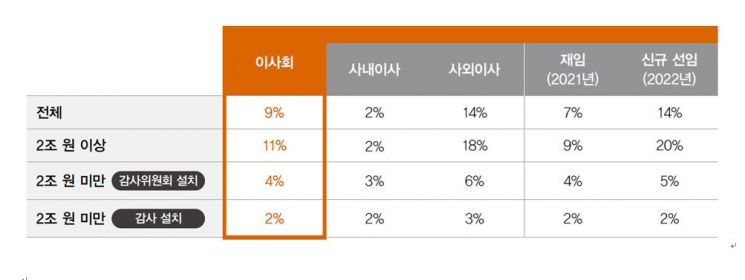
According to the '2022 Board of Directors Trend Report' published on the 30th by the Governance Center of Samil Accounting Corporation (CEO Yoon Hoon-soo), the proportion of newly appointed female directors in KOSPI-listed companies with total assets of over 1 trillion won was 14%, doubling from the 7% female participation rate last year. For listed companies with total assets exceeding 2 trillion won, the proportion of female directors was 20%. According to the amendment of the Capital Market Act, this is interpreted as an effect of the restriction that companies with total assets over 2 trillion won cannot compose their entire board of directors with a single gender.
A representative from the Governance Center stated, "Although this increasing trend is positive, the proportion of female directors still remains at a low level," and pointed out that 51% of the analyzed companies had no female directors at all, and only 17% of companies with less than 2 trillion won in assets had female directors on their boards.
The proportion of outside directors on the boards of KOSDAQ-listed companies averaged 50%, with companies having total assets over 2 trillion won showing 55%, and those with assets between 1 trillion and 2 trillion won showing 41%, indicating differences according to asset size. These differences appear to be influenced by the minimum ratios required by the Commercial Act.
One of the representative measures to enhance board independence and strengthen management supervision is the separation of the roles of board chairperson and CEO, which was found to be 38%. Looking at the separation rates by asset size, companies with over 2 trillion won showed a separation rate of 43%, while those with assets between 1 trillion and 2 trillion won showed 30%, indicating a difference.
Meanwhile, only 14% of companies had an outside director as the board chairperson, suggesting that even when separated from the CEO, there remains a possibility of weakened independence.
© The Asia Business Daily(www.asiae.co.kr). All rights reserved.

















