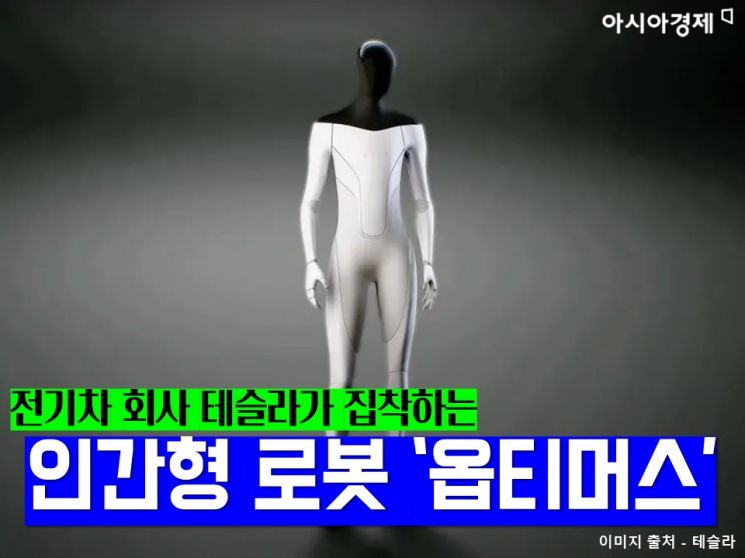
 Tesla is scheduled to unveil its humanoid robot at the 'AI Day' event held in California, USA, on the 30th (local time). / Photo by Song Hyundo, Asia Economy intern reporter
[Asia Economy Reporter Lim Juhyung] Electric vehicle manufacturer Tesla held an 'AI Day' on the 30th of last month (local time) in California, USA, unveiling its self-developed robot 'Optimus' for the first time. Optimus is a humanoid robot being developed to perform various labor tasks on behalf of humans, and Tesla is putting great effort into its development by even involving its autonomous driving research personnel. CEO Elon Musk has mentioned that completing Optimus is the "company's top priority." Why is an automobile company like Tesla putting so much at stake on humanoid robot technology?
AI Day is Tesla's annual technology disclosure event held every fall in the United States. Through this event, CEO Musk has unveiled Tesla's next-generation car batteries, progress in autonomous driving software (FSD) development, and the self-developed computer chip 'Dojo.' This year's AI Day is known to be the first occasion to reveal the actual Optimus robot, drawing significant attention from consumers and investors.
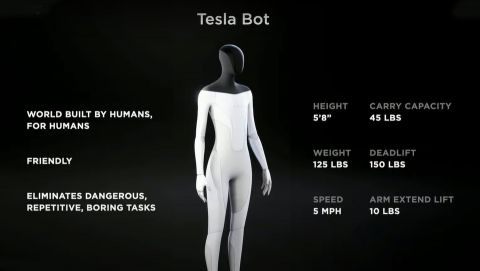
The Optimus development plan was first officially announced at last year's AI Day. At that time, CEO Musk introduced computer graphics predicting Optimus's completed form along with detailed specifications. Optimus, which has the same body shape as a human, stands 176 cm tall and weighs 56 kg, capable of lifting objects weighing 1.5 kg with one hand. Its head is equipped with a curved OLED module that allows interaction with people, and it can be deployed in factories or hazardous sites to perform heavy labor tasks instead of humans.
However, Optimus faced strong criticism from the start. Critics argued that an automobile company has no serious reason to engage in robot development, and that developing humanoids that move like real humans is premature. Renowned technology writer Nabil Aliwar pointed out on his blog last year, "Truly useful robots do not resemble humans. Rather, they are similar to industrial robots installed on production lines or in factories." Some investors expressed skepticism, claiming that Optimus is merely a 'promotional event' for Tesla.
Humanoids are considered one of the most challenging fields in robotics. It has been over 20 years since Japan's Honda unveiled the walking robot 'ASIMO' in 2000, yet a true humanoid has still not been born. Boston Dynamics, acquired by Hyundai Motor Group last year, has created robots that can run or jump, but their activity range is greatly limited, and actual commercial products remain general industrial robots. This is why doubts arise about the success potential of Tesla's Optimus.
Nevertheless, Tesla is putting all its efforts into Optimus development. CEO Musk emphasized during the Q4 earnings announcement last year, "The Optimus humanoid robot is our most important product development." Earlier this month, foreign media such as Electrek reported that Tesla is focusing on Optimus development even by pulling in FSD research personnel. Considering that completing autonomous driving through FSD was Tesla's 'corporate goal,' this is an unexpected U-turn.
So why is Tesla, an automobile company, suddenly putting its life on robot development? Some experts focus on the core technology shared by Tesla's FSD and Optimus: computer vision (a computer system that mimics human vision).
The biggest challenge in humanoid development lies in the robot's difficulty in properly recognizing objects. In this regard, Ayonga Hurley, an assistant professor at Ohio State University, explained in a recent article for the academic media 'The Conversation,' "Unlike humans, robots struggle to recognize and respond to irregularly shaped objects." Because of this, robots hesitate when performing tasks in reality, sometimes making strange movements or tripping over obstacles.
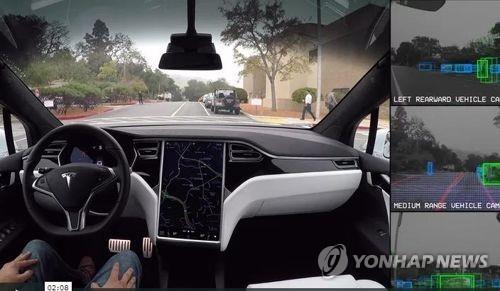 Tesla's autonomous driving software 'FSD' also applies computer vision technology that enables AI to recognize objects captured through camera lenses. / Photo by Tesla
Robots can see objects through computer vision. That is, they first simulate the surrounding environment using camera lenses or radar, then compare the object information pre-recorded in memory devices one by one against the simulation environment to finally recognize the object. However, unlike precise and static digital simulations, real-world environments are fluid and change rapidly. Because of this, robot computer vision takes a long time to properly recognize objects, and its accuracy is inevitably much lower than that of humans.
The computer vision problem also appears in Tesla's FSD. The currently beta-tested FSD has occasionally accelerated toward obstacles or mistaken yellow traffic lights for the moon or sun, causing controversy. This is because the AI controlling computer vision struggles to properly recognize surrounding objects.
Factories, homes, and other environments where Optimus is expected to be deployed could be ideal settings to train and improve computer vision functions. Additionally, the computer vision technology used in Optimus could be transplanted into FSD, or vice versa. From this perspective, Optimus is closer to another product derived from the same technology as FSD.
This perception is also reflected in CEO Musk's outlook. In an article contributed to the Chinese science media 'China Cyberspace,' he claimed that Optimus would surpass electric vehicles to become Tesla's main product in a few years. Musk stated, "Today, cars are already closer to wheeled smart robots controlled by communication technology. The realization of humanoid robots is the next step," emphasizing, "Just as our 'four-wheeled robot' changed the way humanity travels, Tesla aims to extend AI beyond automobiles."
© The Asia Business Daily(www.asiae.co.kr). All rights reserved.














