"Progress Unlikely Until November Midterm Elections"
"Emphasize FTA... Must Actively Express Opinions from Now"
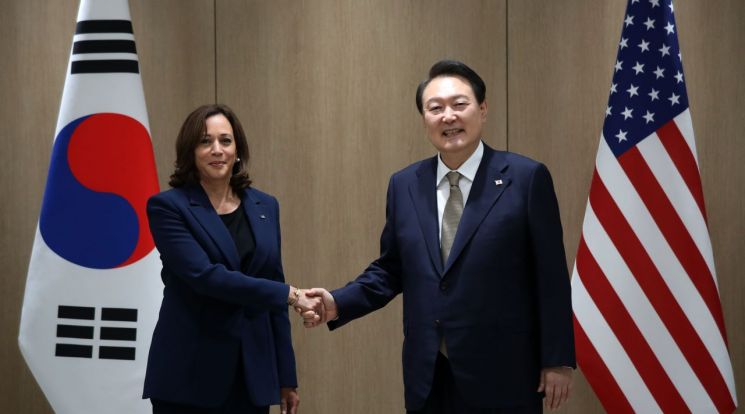 President Yoon Suk-yeol is taking a commemorative photo with U.S. Vice President Kamala Harris, who visited Korea, at the Presidential Office building in Yongsan, Seoul on the 29th.
 [Image source=Yonhap News]
[Asia Economy Reporter Kiho Sung] President Yoon Suk-yeol met with U.S. Vice President Kamala Harris to discuss the Inflation Reduction Act (IRA). However, despite the South Korean government's recent active expression of concerns, the U.S. has yet to provide a definitive response regarding the IRA. The automotive industry says it is difficult to obtain a clear answer given the current U.S. political situation and advises that active advocacy is necessary to bring about changes related to the IRA after the U.S. midterm elections in November.
According to political circles and the automotive industry on the 1st, President Yoon held an 85-minute meeting with Vice President Harris, who was visiting Korea, at the Yongsan Presidential Office on the 29th of last month. At the meeting, President Yoon stated, "I hope the two countries will closely cooperate to reach a mutually satisfactory agreement based on the spirit of the Korea-U.S. Free Trade Agreement (FTA)." Vice President Harris responded, "I will look into ways to address Korea's concerns," but it is reported that no concrete measures were discussed.
Previously, during President Yoon's visit to the U.S. and Prime Minister Han Duck-soo's visit to Japan, concerns about the IRA were conveyed to the U.S., but the U.S. has only reiterated its general stance.
The automotive industry explains that such a response from the U.S. was expected, judging that it is unlikely the U.S. will make any promises before the midterm elections in November.
Research Fellow Lee Hang-gu of the Korea Automotive Research Institute said, "Because the U.S. is preparing for the midterm elections, it is uncertain how the political composition of Congress will be reorganized after the elections," adding, "In a situation where congressional power is about to be reshuffled, it is difficult for Vice President Harris to promise any advanced matters."
However, he noted, "We should remember that Vice President Harris, who also serves as the Senate President, cast the deciding vote to pass the IRA in a tie situation in the U.S. Senate," and added, "There are signs of change in the U.S."
For this reason, it is advised to start preparations now for discussions after November. Currently, the U.S. Treasury Department is drafting guidelines related to the electric vehicle tax credit benefits included in the IRA. This is akin to creating enforcement ordinances and rules in Korea. The Treasury plans to complete these guidelines by the end of the year.
An automotive industry official said, "If discussions on the IRA start after November, it is too late because we cannot predict when a conclusion will be reached," and added, "We must continuously express our opinions from now on to minimize damage to our companies."
Experts say it is difficult to amend the law at this point, so focus should be on coordinating the implementation process. In particular, drafting enforcement ordinances that exempt countries with FTAs with the U.S. from the IRA application is crucial. The U.S. has FTAs with 20 countries, and among them, Korea is the only country producing electric vehicles.
Professor Kim Pil-soo of the Department of Automotive Studies at Daelim University said, "We must actively appeal that the IRA is a narrow policy that undermines the FTA framework," and explained, "Emphasizing that Korea is already an FTA partner country and creating a grace period for subsidy payments until our companies build dedicated electric vehicle plants in the U.S. is the best approach."
Along with this, there is also criticism that showing a more yielding stance in negotiations out of urgency could worsen future problems. Professor Lee Ho-geun of the Department of Automotive Studies at Daeduk College emphasized, "Low-profile diplomacy, such as promising additional investments during the law's discussion process, could cause greater confusion," and stressed, "We must highlight that executing previously promised investments may become difficult and actively appeal that we are an FTA partner country."
© The Asia Business Daily(www.asiae.co.kr). All rights reserved.

















