Trilateral Anti-Submarine Warfare Exercise by Korea, US, and Japan to be Held in East Sea on 30th
US Nuclear Submarine Detection Drill Simulating North Korean Submarine
Three Countries Shared Intelligence but Also Engaged in Submarine Detection Mind Games
[Asia Economy Yang Nak-gyu, Military Specialist Reporter] As the navies of South Korea, the United States, and the Japan Maritime Self-Defense Force conduct joint anti-submarine warfare exercises, there are speculations that North Korea may launch submarine-launched ballistic missiles (SLBMs). It is believed that North Korea could respond in kind with a "an eye for an eye, a tooth for a tooth" approach to showcase their military capabilities.
According to the Navy on the 1st, the maritime forces of the three countries, including a U.S. nuclear-powered aircraft carrier, conducted anti-submarine warfare exercises in international waters of the East Sea more than 150 km away from Dokdo. This is the first time in five years since April 3, 2017, when South Korea, the U.S., and Japan held exercises in international waters between Jeju and the southern waters between Korea and Japan in response to North Korea's SLBM threat. It is also unusual for Japanese warships to come this far into international waters near Dokdo for training.
The exercise involved the U.S. Los Angeles-class nuclear submarine USS Annapolis (6,000 tons) simulating a North Korean submarine equipped with SLBMs, focusing on detection and tracking. While the three countries shared intelligence, there was also an invisible pride contest to be the first to detect the submarine.
The South Korean Navy participated with the Korean Destroyer Munmu the Great (4,400 tons). The U.S. deployed the nuclear-powered aircraft carrier USS Ronald Reagan (CVN-76, 103,000 tons), guided missile cruiser USS Chancellorsville (9,800 tons), and Aegis destroyers USS Barry (DDG 52, 6,900 tons) and USS Benfold (DDG 65, 6,900 tons) as part of the carrier strike group. The Japan Maritime Self-Defense Force participated with the Asahi-class lead ship, the new Jun Aegis-class destroyer JS Asahi (DD 119, 5,100 tons).
As the trilateral anti-submarine exercises proceed, there are forecasts that North Korea will boldly launch SLBMs to demonstrate its military strength.
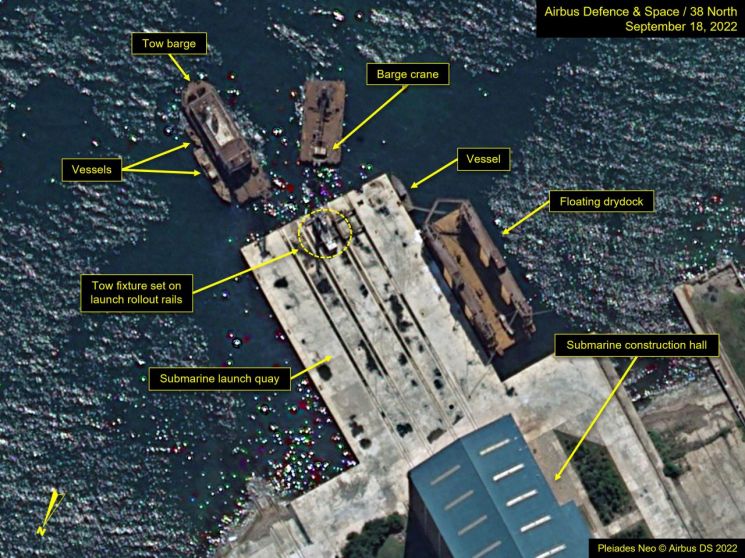
The military reported signs related to North Korea's SLBM launch to President Yoon Suk-yeol on the 24th. The presidential office stated that President Yoon held a security situation briefing with his aides on board his plane before it took off for his return after completing his overseas trip. If North Korea launches SLBMs, the timing is likely to be around October 10, the founding day of the Workers' Party of Korea, one of North Korea's four major holidays. It is also speculated that North Korea will test-fire SLBMs and publicize them to emphasize deterrence against South Korea and the U.S. while fostering internal unity.
It is unusual that the presidential office, rather than the military, disclosed North Korea's SLBM launch preparations first. This is interpreted as the presidential office proactively releasing related intelligence to send a message of restraint against North Korean provocations. Additionally, even if North Korea actually fires SLBMs, this is seen as a "deflating" strategy to diminish the impact of the provocation.
© The Asia Business Daily(www.asiae.co.kr). All rights reserved.

















