Payment of Insurance Money on Condition of Withdrawal of Civil Lawsuit
HUG "Internal Regulations Changed for Active Protection"
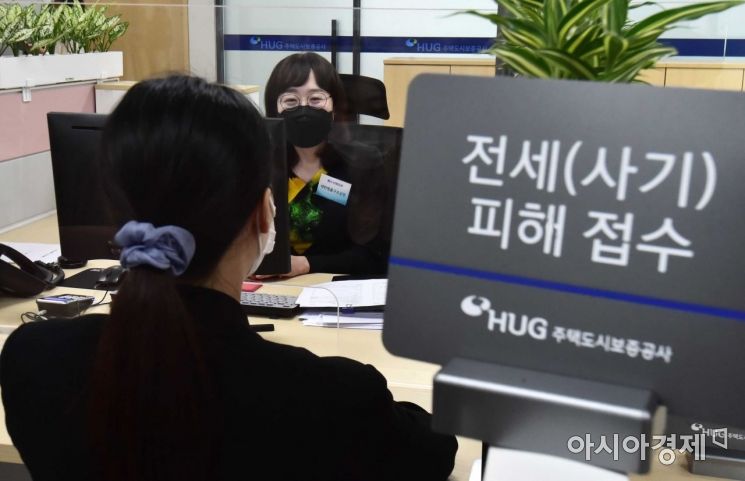 On the 28th, a citizen is receiving consultation from the Korea Legal Aid Corporation regarding the reporting of jeonse fraud damage at the Jeonse Damage Support Center located inside the Korea Chamber of Commerce and Industry on Hwagok-ro, Gangseo-gu, Seoul. Photo by Jinhyung Kang aymsdream@
[Asia Economy Reporter Yoo Byung-don] Mr. A, who lives in the Seoul metropolitan area, was shocked when he checked the real estate registry before his one-room lease contract expired earlier this year. There was a provisional seizure worth tens of billions of won placed on the one-room apartment he was renting under a jeonse (long-term deposit lease). It turned out that the seizure was due to the landlord’s tax delinquency. As Mr. A was preparing to move out, he notified the landlord to vacate, but the landlord insisted that returning the deposit was difficult. Consequently, Mr. A immediately applied for the Jeonse Safety Loan Guarantee payment from the Housing and Urban Guarantee Corporation (HUG).
However, HUG refused to pay, citing a violation of the terms and conditions. The reason was that Mr. A had registered his move-in one day after moving. Mr. A hired a lawyer and reapplied for the deposit payment, but HUG responded, “Since the landlord changed, the rights and obligations differ from those at the time of insurance subscription,” and “Because this is a violation of the terms, payment of the deposit is impossible.”
Ultimately, after consulting with his lawyer, Mr. A filed a civil lawsuit against HUG. The situation changed rapidly from there. Shortly after the lawsuit was filed, HUG promised to pay the deposit on the condition that the lawsuit be withdrawn. Only after withdrawing the lawsuit was Mr. A able to recover several hundred million won of his deposit.
As the Housing and Urban Guarantee Corporation has been refusing to pay insurance money to tenants who have been victims of jeonse fraud, citing violations of terms and conditions, it has drawn criticism for only reimbursing insurance money to some tenants who filed lawsuits.
According to HUG on the 30th, the number of cases where guarantee insurance was not paid due to non-occurrence of guarantee effect increased from 1 case (1.7 billion won) in 2020 to 8 cases (1.737 billion won) in 2021. This year, 6 cases (970 million won) were recorded in the first quarter alone. These figures only include cases where claims were actually filed and reviewed; when including cases where applicants gave up during consultation, the number of unpaid cases is estimated to be much higher than the revealed statistics.
Mr. A’s case is similar. The violated term was “Article 13 concerning the establishment conditions of guarantee obligations (move-in registration and fixed date must be obtained on the loan execution date).” At the time, HUG explained, “This occurred because Mr. A did not fully understand the terms.” Mr. A, who received the insurance money after nearly going to court, said, “I don’t know about victims who couldn’t afford to hire a lawyer,” and added bitterly, “They are tenants who suffered the same damage, but some receive insurance money while others do not, which is hard to understand.”
According to the legal community, regardless of HUG’s terms, there are ways to receive insurance money through legal disputes even if one is notified of non-payment. A lawyer who requested anonymity explained, “There are cases where insurance money is paid based on the purpose of HUG’s establishment and legal interpretations of the Lease Protection Act.”
Meanwhile, regarding the payment of insurance money after lawsuit withdrawal, HUG stated, “We changed internal regulations to actively protect tenants by including guarantee performance when the lease contract succession between the parties is proven and there is no infringement of rights such as mortgages before move-in registration.”
However, when asked whether there are other cases that have been remedied by this internal regulation change and how many, HUG avoided a direct answer, saying, “The guarantee performance after lawsuit withdrawal was carried out for the cases where lawsuits were filed following previous exemption decisions, and similar cases will be judged individually based on specific facts.”
According to Asia Economy’s comprehensive investigation, a total of four tenants have been compensated under this regulation change, with insurance amounts around 900 million to 1 billion won. It is known that some of these tenants had filed lawsuits. HUG plans to notify tenants who had previously been denied payment about the regulation change and sequentially pay the insurance money.
© The Asia Business Daily(www.asiae.co.kr). All rights reserved.


















