Budget Phones "Abolish 3-Year Sunset Rule... Permanent Mandatory Provision Needed"
SKT "Wholesale Provision for 12 Years... Mandatory Requirement Should Be Abolished"
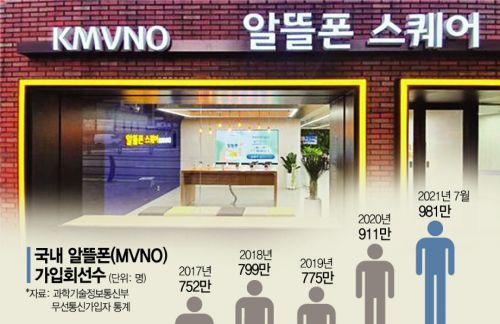
[Asia Economy Reporter Minyoung Cha] Voices from the MVNO (Mobile Virtual Network Operator) industry, which has long awaited the abolition of the three-year temporary wholesale provision sunset clause, are calling for the complete elimination of the sunset clause itself. On the other hand, SK Telecom, the country's top mobile carrier and the designated wholesale provider, stated, "The system has been maintained for 12 years, which has strengthened the self-sustainability of MVNOs," and argued that the mandatory wholesale provision obligations borne by operators should be revised.
Hwang Seong-wook, Executive Vice President of the Korea MVNO Association, held a briefing near Gwanghwamun, Seoul, on the 27th, pointing out "the problems and improvement measures related to MVNO policies," emphasizing that "with policy improvements, a self-sustaining fourth carrier like in Japan could emerge, and the market could expand."
Conflicting Views on the Three-Year Temporary Sunset Clause
The association highlights issues with the wholesale provision sunset clause, which has been extended every three years through legal amendments. Currently, SK Telecom, the number one player in the mobile market, is the only designated mandatory wholesale provider. Although KT and LG Uplus also provide network access, they are not obligated providers. The law has been extended three times since 2013, with the current expiration date on September 22 of this year.
Upon expiration, the wholesale provision obligation will sunset, causing the minister's authority to designate mandatory wholesale providers, revoke such designations, and regulate procedures and pricing notices related to wholesale provision obligations to lose effect.
The association argues for permanent wholesale provision instead of a sunset clause. Vice President Hwang appealed, "If the mandatory wholesale provider system disappears, MVNO businesses will struggle to survive in the market," adding, "Even with extensions every three years, long-term investment in MVNOs is difficult."
SKT: "MVNO Subscribers Surpass 10 Million"
Meanwhile, SK Telecom, the mandatory wholesale provider, opposes abolishing the sunset clause and legislating wholesale provision obligations. An SK Telecom official stated, "Over the past 12 years, the mandatory wholesale provision system has been maintained, and MVNO subscribers have surpassed 10 million, capturing about 15% of the mobile market share," asserting that "the competitive environment in the mobile market has greatly improved, enhancing MVNOs' self-sustainability."
They added, "More than 70% of MVNO subscribers use KT and LG Uplus networks, which are not mandatory providers, indicating that the MVNO market is already functioning well regardless of the mandatory wholesale provision system," and cautioned, "Extending the mandatory wholesale provision and preemptive price regulation, which are unprecedented worldwide, requires careful consideration."
KT and LG Uplus are actively engaging in the MVNO market to attract lines. LG Uplus is the most proactive, having expanded the 'U+ MVNO Partners' brand to '+Alpha' in June, increasing programs for coexistence with small and medium MVNO operators. They have provided various supports such as self-activation services, joint marketing, affiliated card discounts, partner discount coupons, and shared SIM cards. KT was the first among the three major carriers to launch an integrated MVNO customer service channel called 'My MVNO.' In contrast, SK Telecom has maintained a passive stance in the MVNO market, stating it would comply with any decision to withdraw amid discussions on a 50% market share cap for MVNO subsidiaries of the three major carriers.
Legislation Proposed in the National Assembly... Government Takes a Passive Stance
In the National Assembly, bills have been proposed to activate the MVNO market by increasing the number of mandatory providers or extending the mandatory provision period. Kim Young-sik, a member of the People Power Party on the Science, Technology, Information and Broadcasting Committee, introduced the 'Telecommunications Business Act Amendment' in December 2020 to promote MVNO activation. This bill includes abolishing the sunset clause on wholesale price mandatory provision and expanding mandatory providers to the three major carriers. Park Wan-joo, also on the committee, urged policy improvements on the 28th, stating, "Despite the wholesale provision obligation clause being extended three times over 12 years, the Ministry of Science and ICT has yet to conclude the policy direction." On the 29th, Kim Young-joo of the Democratic Party proposed an amendment to the Telecommunications Business Act to remove the sunset clause on the MVNO mandatory provision system.
The Ministry of Science and ICT, the relevant authority, sympathizes with the intent to abolish the sunset clause but remains passive regarding improvements to the current system or preparing government proposals. Vice President Hwang said, "The government agrees that improvements are needed regarding wholesale prices and the sunset clause, but since it is stipulated by law, they seem to agree with the amendment," adding, "Who would invest knowing that the law is revised every three years?"
© The Asia Business Daily(www.asiae.co.kr). All rights reserved.

















