Apartment and Commercial Buildings Should Be Viewed Differently
Supreme Court Plenary Decision on Trespassing Crime from Last March
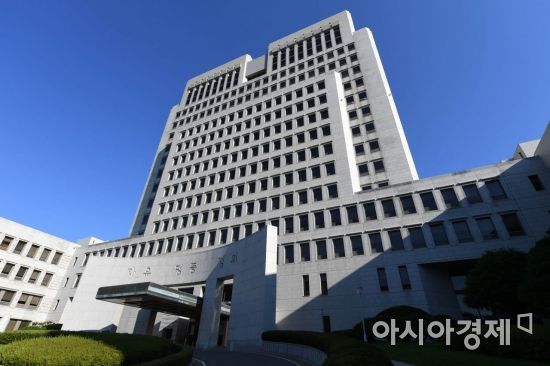
[Asia Economy Reporter Choi Seok-jin, Legal Affairs Specialist] The Supreme Court has ruled that when a perpetrator follows a victim into a commercial building open to the public and commits sexual harassment, the crime of forced sexual molestation by trespassing, which is subject to aggravated punishment under a special law, does not apply.
Even if a person enters a building or structure open to the public with criminal intent, if there is no specific conduct that disrupts the actual peacefulness of the residence, trespassing cannot be established solely on the grounds that it goes against the subjective will of the resident, according to a Supreme Court plenary session precedent from March.
The Supreme Court's Second Division (Presiding Justice Cho Jae-yeon) announced on the 29th that it overturned the lower court's ruling sentencing defendant A to 3 years and 8 months in prison in the appeal trial for violations of the Sexual Violence Punishment Act (forced sexual molestation by trespassing, filming and distribution using a camera, etc.) and public obscenity charges, and remanded the case to the Seoul High Court.
The court stated, "The lower court's ruling, which found defendant A guilty of the charges against victim C, erred in its legal interpretation regarding the establishment of the crime of forced sexual molestation by trespassing under the Sexual Violence Punishment Act and failed to conduct necessary investigations," adding, "The grounds for appeal pointing out this issue are valid," explaining the reason for overturning and remanding the case.
According to the court, in April last year, defendant A secretly filmed the leg area of victim B (then 17 years old) at a PC room in Deogyang-gu, Goyang-si, Gyeonggi Province, and committed obscene acts. An hour later, he followed B as she was returning home and forcibly molested her by putting his hand inside her school uniform skirt on the stairs of the first floor of an apartment building.
On the same night, defendant A molested victim C (16 years old) while she was waiting for an elevator on the first floor of a nearby commercial building, and similarly molested victim D (17 years old) on the first floor of another apartment building.
The first and second trials found defendant A guilty on all charges and sentenced him to 3 years and 8 months in prison.
However, the Supreme Court found a problem with the second trial's judgment that classified the forced sexual molestation of victim C, which occurred on the first floor of the commercial building, as forced sexual molestation by trespassing under the Sexual Violence Punishment Act, punishable by life imprisonment or imprisonment of seven years or more.
Defendant A argued on appeal against the first trial's guilty verdict that the "apartment first-floor stairs," "space in front of the elevator on the first floor of the apartment," and "space in front of the elevator on the first floor of the commercial building" are all "public places," so trespassing charges cannot be established. The Supreme Court accepted defendant A's argument regarding the first floor of the commercial building.
The crime of forced sexual molestation by trespassing under the Sexual Violence Punishment Act is a compound crime requiring both trespassing and forced sexual molestation to be established. Since trespassing was not established, the act should be considered simple forced sexual molestation.
The court pointed out, "Even if the defendant followed victim C into the commercial building in question, considering the building's use and nature, the condition of the entrance, and the appearances of the victim and defendant at the time of entry, there is insufficient evidence to prove that the entry was for criminal purposes and constituted trespassing."
Previously, the Supreme Court changed the precedent from the 'Chowon Bokjip incident' through a plenary session ruling.
At that time, the court stated, "Trespassing in the crime of trespass means entering a residence in a manner that disrupts the actual peaceful state of the residence, and whether it constitutes trespassing should be judged based on the objective and external conduct at the time of entry. While entering a residence in a way that disrupts the actual peaceful state generally goes against the resident's will, simply entering the residence itself cannot be considered trespassing based solely on the subjective intention that it goes against the resident's will."
It added, "Whether it goes against the resident's will is one of the factors to consider when evaluating conduct that disrupts the actual peaceful state, but it cannot be the main factor. Therefore, whether an act constitutes trespassing should be judged based on whether it disrupts the actual peaceful state, not on whether it goes against the resident's will."
However, unlike commercial buildings freely accessible to the public, the Supreme Court presented different standards for apartments and other multi-family residences.
The court stated, "The staircases or elevator areas inside the common entrances of the apartments in question, which the defendant followed victims B and D into, are not spaces freely accessible to outsiders but are essential parts attached exclusively to each household, places where the actual peacefulness of residents needs to be protected."
It continued, "CCTV was installed in the common entrances of the apartments, presumably to control and monitor outsiders' access. The defendant followed the victims late at night into the common entrances of the apartments and entered the staircases or elevator areas there. Considering the residential use and nature of the apartments and the usual control and management of access by outsiders, it can be seen that the defendant intended to enter the common entrances without the knowledge of the residents or managers."
Based on these grounds, the Supreme Court upheld the lower court's recognition of forced sexual molestation by trespassing under the Sexual Violence Punishment Act against victims B and D.
A Supreme Court official explained the significance of this ruling, saying, "This ruling means that whether an act constitutes trespassing can be evaluated differently depending on the use and nature of the residence, and the methods and conditions of access control and management for outsiders, distinguishing between commercial buildings freely accessible to the public and residences where the freedom of residence needs stronger protection."
© The Asia Business Daily(www.asiae.co.kr). All rights reserved.

















