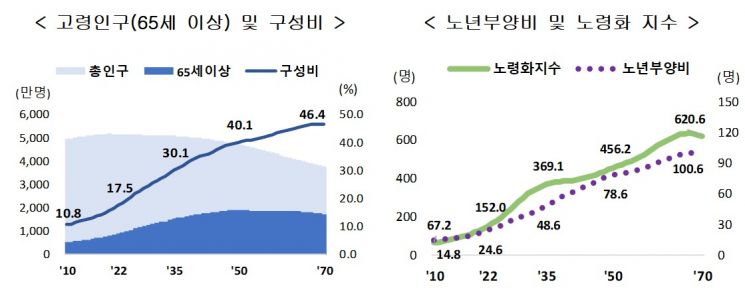
[Asia Economy Sejong=Reporter Kim Hyewon] The elderly population aged 65 and over is expected to exceed 9 million for the first time this year. This accounts for 17.5% of the total population of South Korea. By 2025, this proportion is expected to surpass 20%, marking South Korea's entry into a super-aged society.
Statistics Korea announced these details in the "2022 Elderly Statistics" report on the 29th.
As of this year, the elderly population aged 65 and over was counted at 9,018,000, exceeding 9 million for the first time in history.
In 2025, three years from now, the proportion of the elderly population aged 65 and over is expected to reach 20.6%, entering a super-aged society, and it is projected to reach 30.1% in 2035 and exceed 40% by 2050, according to Statistics Korea.
The time it takes for South Korea to transition from an aged society to a super-aged society is 7 years, which is much faster compared to Austria's 53 years, the United Kingdom's 50 years, the United States' 15 years, and Japan's 10 years.
The old-age dependency ratio, which indicates the number of elderly people supported by 100 working-age people, is 24.6 this year, and it is expected to reach 48.6 in 2035 and 78.6 in 2050.
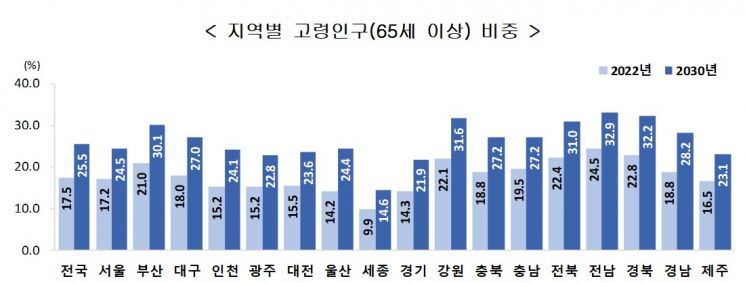
By region, the area with the highest proportion of elderly population is Jeonnam (24.5%), and the lowest is Sejong (9.9%). By 2028, all regions in South Korea except Sejong will become super-aged societies.
Households with a head aged 65 or older number 5,195,000, accounting for 24.1% of all households. By 2050, about half (49.8%) of all households in South Korea are expected to be elderly households.
Despite the COVID-19 pandemic, twilight divorces are gradually increasing. Last year, the total number of divorces decreased by 4.5% compared to the previous year, but divorces among men and women aged 65 and over increased by 13.4% and 17.5%, respectively. Remarriages decreased across all age groups, but remarriages among men and women aged 65 and over increased by 6.4% and 14.7%, respectively.
The awareness of the elderly regarding family and retirement preparation is gradually changing. Over the past 10 years, the view that family should support parents has decreased from 38.3% to 27.3%. Instead, the proportion of those who believe that family, government, and society should share responsibility has increased from 37.8% to 49.9%. This means that elderly people expecting support from their children are gradually decreasing.
The proportion of elderly people who directly provide living expenses themselves or with their spouse was 65.0%. Two out of three people secure their living expenses independently. Additionally, 54.7% of elderly people aged 65 to 79 responded that they have the intention to work. The most common reason for wanting to work was to supplement living expenses, at 53.3%.
As of 2021, the net assets of households with elderly members aged 65 and over amounted to 401.048 million KRW, an increase of 60.94 million KRW compared to the previous year. Real estate accounted for the largest share of assets at 80.9%, while savings accounted for 13.8%, which is lower than other age groups.
Income distribution indicators for the retired population aged 66 and over have improved since 2016, but the poverty rate remains high. As of 2019, the relative poverty rate of elderly people aged 66 and over was 43.2%, the highest among OECD member countries.
The public pension coverage rate for elderly people aged 65 and over is 55.1% and is increasing annually. The public pension coverage rate for women is 40.6%, about half that of men (74.1%).
© The Asia Business Daily(www.asiae.co.kr). All rights reserved.


















