[Asia Economy Reporter Changhwan Lee] Despite some non-life insurance companies recording record-high earnings this year, they are facing a capital soundness crisis. Even with solid performance continuing, some are reluctantly raising funds due to accounting standards and other issues.
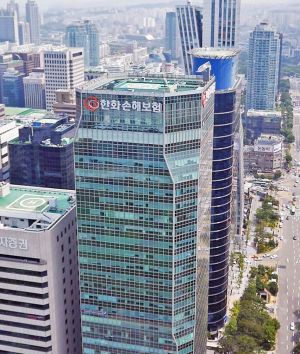
According to the insurance industry on the 30th, Hanwha General Insurance is currently pursuing the sale of its headquarters building located in the heart of Yeouido, Seoul. They plan to complete the sale within the year to raise around 100 billion KRW.
Recently, Hanwha General Insurance conducted a paid-in capital increase of 190 billion KRW targeting its major shareholder Hanwha Life Insurance, and in mid-month, also issued 85 billion KRW worth of hybrid capital securities.
The reason Hanwha General Insurance is raising large-scale funds is due to concerns over capital soundness. According to the Financial Supervisory Service, Hanwha General Insurance’s RBC (Risk-Based Capital) ratio for Q2 was 135.9%, falling short of the recommended 150%.
Although financial authorities have prepared supplementary measures such as recognizing LAT (Liability Adequacy Test) surplus as available capital in RBC, the RBC ratio has not significantly increased.
Hanwha General Insurance expects that with funds coming in from asset sales and capital increases, the RBC ratio will significantly exceed 150% in Q3.
They also plan to resolve concerns about capital erosion through fund raising. At the end of Q2, Hanwha General Insurance’s equity capital stood at around 270 billion KRW, a sharp decrease of 1.2 trillion KRW compared to the same period last year. This was due to a significant decline in the valuation gains and losses of available-for-sale securities caused by a rapid rise in interest rates.
However, this issue has been pointed out as a problem arising from current accounting standards that reflect interest rate changes only on assets, not liabilities. Under the new accounting standard IFRS17, which will be introduced next year, the impact of interest rates is expected to decrease, significantly reducing concerns about capital erosion. According to Hanwha General Insurance, equity capital based on IFRS17 at the end of Q2 reaches 3 trillion KRW.
Ultimately, it is said that Hanwha General Insurance has no choice but to raise funds more aggressively due to accounting standard issues rather than fundamental corporate problems. In fact, Hanwha General Insurance recorded an operating profit of 219.3 billion KRW in the first half of this year, marking the highest half-year profit ever. This is a 58% increase compared to 139 billion KRW recorded in the same period last year.
Following last year, the loss ratios of its core businesses, automobile insurance and long-term insurance, improved this year as well, and the business ratio declined, leading to a sharp increase in profits. In particular, the automobile insurance loss ratio in Q2 was 74.5%, down 5.7 percentage points from the same period last year, driving performance improvement.
Heungkuk Fire & Marine Insurance also had an RBC ratio of 154% in Q2, which is significantly lower than the industry average. Despite operating profits nearly tripling to 87 billion KRW in the first half compared to 30 billion KRW last year, the RBC ratio remained low, leading them to issue 70 billion KRW worth of hybrid capital securities last month targeting affiliates of the parent company Taekwang Group.
Lotte Insurance’s RBC ratio was also relatively low at 168.6% in Q2, down from 175.4% in Q1. Lotte Insurance is also working to raise its RBC ratio by conducting an additional capital increase of 140 billion KRW through a public subordinated bond issuance earlier this month.
© The Asia Business Daily(www.asiae.co.kr). All rights reserved.

















