95 Gijichon Women Sue... Court Orders State Compensation of 3 to 7 Million Won
Judges: "State's Illegal Acts Violated Personal Rights, Caused Mental Harm"
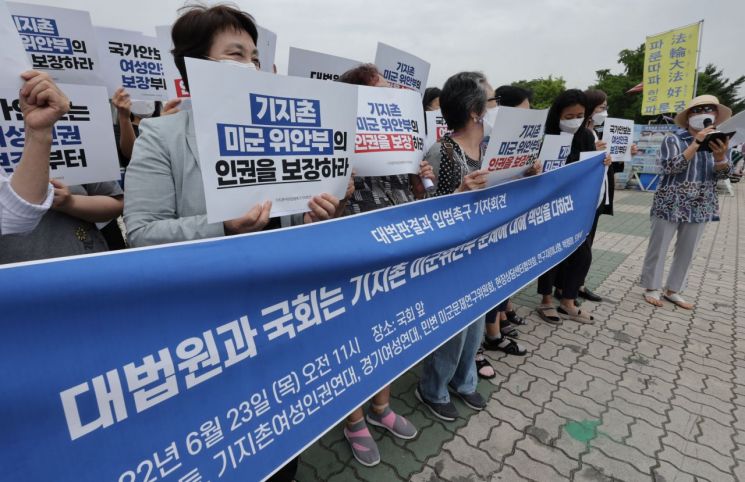
[Asia Economy Reporter Heo Kyung-jun] The Supreme Court has ruled that the state must compensate women who provided prostitution services in military base villages to U.S. troops stationed in Korea since the 1950s.
The Supreme Court's 2nd Division (Presiding Justice Lee Dong-won) on the 29th upheld the appellate court's ruling partially in favor of the plaintiffs in the final appeal of a damages lawsuit filed by 95 plaintiffs, including Lee, against the state.
Lee and others engaged in prostitution targeting U.S. troops in base villages, commercial districts around U.S. military bases, starting from 1957. At that time, the Korean government's Ministry of Home Affairs designated 10 locations in Seoul, 12 in Incheon, and 2 in Busan as U.S. military comfort facilities by gathering women working in prostitution establishments frequented by UN troops into specific areas, citing issues such as venereal disease control related to UN troop movements.
The government at the time is understood to have systematically managed the women's venereal diseases. The enforcement decree of the Infectious Disease Prevention Act enacted the same year explicitly listed comfort women as subjects required to undergo venereal disease examinations.
Accordingly, they filed a lawsuit claiming that the state either supported or at least tolerated prostitution. Lee and others argued that government officials at the time colluded with prostitution brokers, and that comfort women in the base villages suffered crimes such as murder, assault, and confinement by U.S. troops, and that even when these incidents were reported, the police did not investigate, constituting illegal acts.
They also claimed that the government mandated registered comfort women to undergo regular venereal disease examinations at public health centers and venereal disease clinics, and if they failed these examinations, they were forcibly quarantined in detention centers by health officials until they were declared cured. Furthermore, they alleged that penicillin, which has side effects including 'shock death,' was forcibly injected into comfort women infected with venereal diseases.
The first trial court recognized only the illegal acts related to forced quarantine among Lee’s claims and ordered the state to pay 5 million won in consolation damages to those proven to have experienced forced quarantine. All other claims by the women were dismissed.
The appellate court accepted both the illegal acts related to forced quarantine and the claims that the state supported or at least tolerated and mediated prostitution, ordering the state to compensate 7 million won per person for those who experienced forced quarantine and 3 million won per person for those who did not.
Additionally, the state argued during the first and second trials that the statute of limitations (5 years) had expired since Lee and others filed the lawsuit more than five years after the illegal acts, thus negating liability for compensation. However, the court rejected this, stating that the state had rather made it difficult for the base village women to exercise their rights.
The Supreme Court also agreed with the appellate court’s judgment. The bench stated, "The acts of creating, managing, and operating the base villages and justifying and encouraging prostitution violated not only the former Anti-Prostitution Act but also rules and norms that should have been observed, such as the obligation to respect human rights, lacking objective legitimacy and thus being unlawful," adding, "(The base village women) suffered mental damages as their personality rights and human dignity were violated due to the state's unlawful acts."
Furthermore, the court ruled that the state-led adjustment, management, and operation of U.S. military base villages and the active justification and encouragement of prostitution under past authoritarian governments constitute serious human rights violations under the Past Records Act, and thus the application of the long-term statute of limitations is excluded.
© The Asia Business Daily(www.asiae.co.kr). All rights reserved.

















