Ballistic Missile Fired Targeting US Aircraft Carrier Conducting Joint Exercises in East Sea
High Possibility of Continued Provocations During US Vice President Harris's Visit to Korea
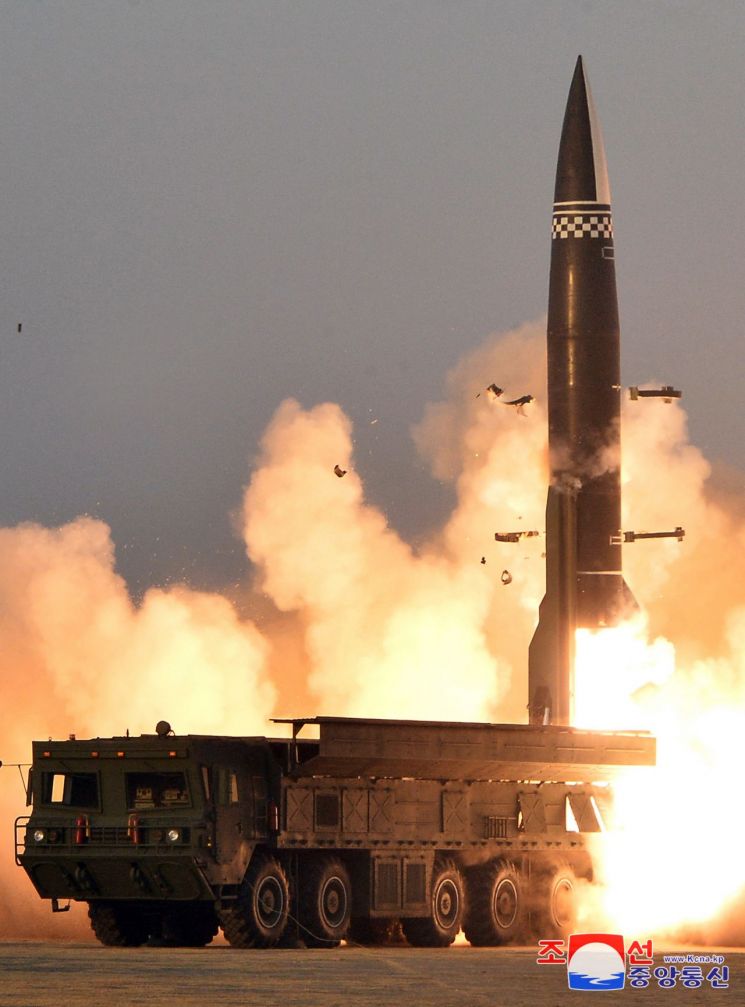
[Asia Economy Yang Nak-gyu, Military Specialist Reporter] North Korea fired two short-range ballistic missiles into the East Sea where a U.S. aircraft carrier is stationed. This is the first time missiles have been launched while an aircraft carrier was inside the Korean Theater of Operations (KTO). Analysts suggest this indicates that fear of U.S. strategic assets has diminished.
According to the military on the 29th, the two short-range ballistic missiles (SRBMs) launched by North Korea around 6:10?6:20 p.m. the previous day from the Sunan area in Pyongyang fell near Al Island (an uninhabited island) off Musudan-ri, North Hamgyong Province.
This provocation is considered different from past incidents as it was carried out after the U.S. Nimitz-class nuclear-powered aircraft carrier Ronald Reagan (approximately 100,000 tons) entered the East Sea for the South Korea-U.S. joint exercises.
North Korea previously conducted missile provocations only after U.S. Navy aircraft carriers Carl Vinson and Ronald Reagan, which participated in joint military exercises in the East Sea in 2017, had left the Korean Peninsula. Additionally, the missile North Korea launched on the 25th was fired one day before the South Korea-U.S. joint exercises began.
The military expects North Korea to continue high-intensity provocations. The fact that North Korea launched provocations against prominent U.S. strategic assets deployed close by suggests that this reflects the intentions of North Korean State Affairs Commission Chairman Kim Jong-un and is therefore quite possible.
In particular, despite U.S. Vice President Kamala Harris’s visit to South Korea on the 29th, there is a high possibility of provocations or unexpected actions in the frontline areas. North Korea launched ballistic missiles on the day then-Vice President Pence visited South Korea in April 2017. This was a reaction to Pence’s planned visit to the Demilitarized Zone (DMZ), the site of confrontation between North and South Korea, where he intended to send a strong warning message to North Korea.
North Korea may also fire short-range anti-ship missiles into the East Sea targeting the South Korea-U.S.-Japan trilateral anti-submarine warfare exercises being held for the first time in five years. The Ministry of National Defense announced that joint anti-submarine exercises among South Korea, the U.S., and Japan will be conducted starting on the 30th. It explained, "This exercise is part of the Ministry of National Defense’s efforts to restore trilateral military cooperation among South Korea, the U.S., and Japan to pre-2017 levels in response to North Korea’s nuclear and missile threats, especially to improve detection, identification, and tracking capabilities against North Korean submarines equipped with submarine-launched ballistic missile (SLBM) launch capabilities." The Ministry emphasized that the exercise area was selected in the East Sea international waters considering the threat of North Korean SLBMs and the expected main operational areas of North Korean submarines.
Furthermore, with the U.S. deploying the latest stealth destroyer Zumwalt to Japan, the possibility of its deployment to the Korean Peninsula in case of emergency appears to be increasing. In April 2017, North Korea fired short-range anti-ship missiles consecutively when the U.S. Navy’s Ohio-class submarine Michigan and Los Angeles-class submarine Cheyenne entered Busan Port.
Yang Wook, Associate Research Fellow at the Asan Institute for Policy Studies, said, "As North Korea’s military provocations are becoming bolder, the U.S. is likely troubled as well," adding, "The U.S. is probably considering additional deployment of strategic assets to deliver a strong message to North Korea."
© The Asia Business Daily(www.asiae.co.kr). All rights reserved.

















