Seoul National University Hospital Cardiology Professors Kim Hyung-kwan and Lee Hyun-jung
Soongsil University Professor Han Kyung-do Joint Research Team
 From the left, Professor Hyungkwan Kim and Professor Hyunjung Lee from the Department of Cardiology at Seoul National University Hospital, and Professor Hangyungdo from Soongsil University.
[Asia Economy Reporter Kim Young-won] A study has found that the impact of body mass index (BMI), a measure of obesity, on cardiovascular risk varies by age. In particular, while obesity poses a greater cardiovascular risk for younger individuals, underweight status increases cardiovascular risk in the elderly, suggesting that maintaining a slightly overweight condition may be beneficial in old age.
A joint research team led by Professors Kim Hyung-kwan and Lee Hyun-jung from the Department of Cardiology at Seoul National University Hospital and Professor Han Kyung-do from Soongsil University conducted a nationwide population-based cohort study using the National Health Insurance Service database. They analyzed 9,278,433 individuals without cardiovascular disease and confirmed on the 29th that the risk posed by obesity to cardiovascular health differs according to age.
Until now, it was not well known whether cardiovascular risk associated with obesity is consistent across all age groups. Therefore, the researchers tracked the incidence risk of myocardial infarction, heart failure, and death according to obesity levels among 9,278,433 people without cardiovascular disease who underwent health checkups in 2009, using the National Health Insurance Service database, to see if these risks vary by age group.
The research team analyzed the impact of BMI based on the reference range for normal weight (18.5?22.9 kg/m²) across the entire population and by age groups: ▲young adults (20?39 years), ▲middle-aged adults (40?64 years), and ▲elderly (65 years and older). The results showed a U-shaped association between obesity and the risk of myocardial infarction, heart failure, and death in the overall population. Specifically, both obesity and underweight status were linked to increased risks of cardiovascular disease and death. However, the BMI ranges associated with the lowest risk varied by condition: for myocardial infarction, the lowest risk was in the 'normal weight' range (18.5?22.9 kg/m²); for heart failure, it was in the 'pre-obesity' range (23?24.9 kg/m²); and for death, it was in the 'mild obesity' range (25?29.9 kg/m²).
The study team explained that the association between obesity and cardiovascular risk showed clear differences when classified by age group, with particularly distinct differences observed in myocardial infarction, which is closely related to atherosclerosis. The risk of myocardial infarction increased proportionally with higher BMI in young adults (20?39 years). In contrast, middle-aged adults (40?64 years) showed a U-shaped relationship, and in the elderly (age ≥65 years), the relationship was inverse, with increased risk observed in underweight individuals.
Regarding the relationship between obesity and heart failure risk, a U-shaped association was observed across all age groups. However, the impact of obesity was stronger in young adults, while the effect of being underweight was more pronounced in middle-aged and elderly groups. The BMI range associated with the lowest risk of heart failure was 'normal weight' for young adults, 'normal weight' or 'pre-obesity' for middle-aged adults, and 'pre-obesity' for the elderly.
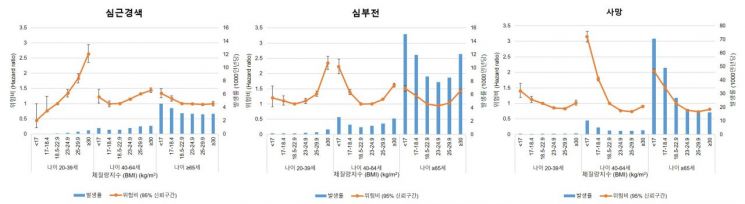 The risk of obesity, myocardial infarction, heart failure, and death according to body mass index showed different patterns among young adults, middle-aged adults, and the elderly.
Meanwhile, the risk of death was lowest in the 'mild obesity' range across all age groups and increased with severe underweight status. The association between underweight and death was stronger in middle-aged and elderly groups than in young adults. Notably, when analyzed by decade of age, the differences in the relationship between obesity and cardiovascular risk became even more pronounced. In individuals in their 20s, being underweight did not increase cardiovascular risk, and the risk increased as BMI exceeded the normal range. Conversely, in elderly individuals aged 70 and above, the increase in myocardial infarction and death associated with underweight status was more evident than the increase in cardiovascular risk due to obesity. In other words, the research team explained that obesity poses a greater cardiovascular risk in younger people, whereas underweight status poses a greater cardiovascular risk in the elderly.
Professors Kim Hyung-kwan and Lee Hyun-jung stated, "Based on these findings, it is important for young adults to control their weight to avoid obesity and for obese young individuals to lose weight. On the other hand, for the elderly, since becoming underweight due to sarcopenia increases the risk of cardiovascular disease and death, it is recommended to engage in appropriate exercise and diet to prevent weight loss."
This study was published in the latest issue of the 'European Journal of Preventive Cardiology,' an international journal published by the European Society of Cardiology.
© The Asia Business Daily(www.asiae.co.kr). All rights reserved.


















