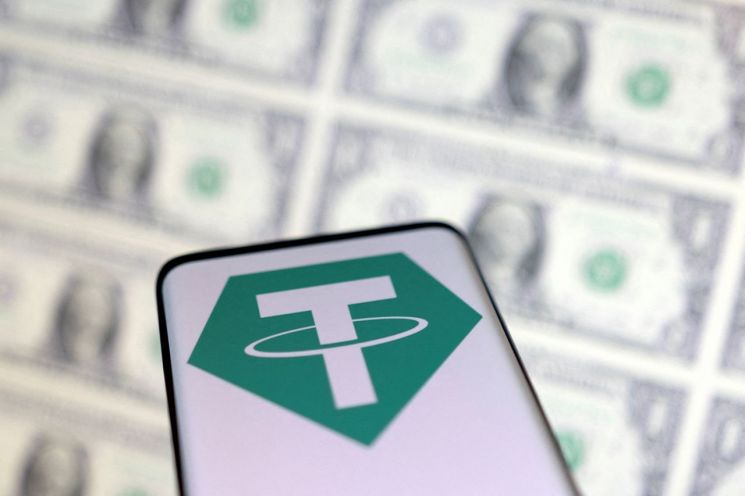
[Asia Economy Reporter Lee Jung-yoon] As the cryptocurrency market downturn prolongs, the amount of stablecoins held by cryptocurrency exchanges is showing a declining trend. Considering that the primary function of stablecoins is to serve as a means of coin trading, the decrease in exchange holdings is expected to act as a negative factor for the cryptocurrency market.
According to cryptocurrency data firm CryptoQuant on the 29th, as of the previous day, the total stablecoin holdings of exchanges were approximately 27.03334 billion, down by about 365.14 million (1.33%) from the previous day's 27.39848 billion. The total stablecoin holdings of exchanges began to decline after reaching approximately 29.48259 billion on the 17th of last month.
Among stablecoins, Tether (USDT), which holds the largest market share, had exchange holdings of about 8.19459 billion as of the previous day, marking the lowest level since May 22, when the Luna incident's aftermath was ongoing. At that time, stablecoins suffered a significant blow to their credibility. When the price of TerraUSD (UST), a stablecoin pegged to 1 dollar, dropped, its sister coin Luna also plummeted sharply.
Stablecoins are designed to be pegged to fiat currencies and are used as a hedge to avoid volatility or as a means to purchase other coins. Since they effectively serve as the base currency in the cryptocurrency market, a decrease in the amount of stablecoins held by exchanges generally means a lower frequency of coin trading. Furthermore, if trading activity diminishes, the likelihood of coin prices falling increases.
Since the decline in exchange-held stablecoins after the 17th of last month, the representative cryptocurrency Bitcoin also recorded a downward trend. Bitcoin prices, which had been maintaining the $23,000 to $24,000 range, fell to the $21,000 range by the 20th of last month.
Additionally, Federal Reserve Chair Jerome Powell's indication of regulations on private stablecoin issuers is another negative factor. On the 27th (local time), at a conference on digital finance, Chair Powell stated, "If there is private money being created nationwide, I believe the federal government’s role is truly necessary." He added, "(In the case of stablecoins) they create money, and I think the Fed should have a role in this sector."
Currently, the U.S. Congress is preparing regulatory legislation related to stablecoins. According to the draft, banking regulators will oversee stablecoins issued by banks, while state governments and the Fed will regulate non-bank stablecoins such as Tether.
Following Chair Powell’s remarks, stablecoin trading volumes decreased. According to data from the global cryptocurrency market tracking site CoinMarketCap, Tether’s trading volume on the 27th was $71.6816 billion (approximately 102.7484 trillion KRW), which dropped to $65.73829 billion (approximately 94.2293 trillion KRW) the next day.
© The Asia Business Daily(www.asiae.co.kr). All rights reserved.

















