Google Moves to Block 'Network Usage Fee Act'
Outdoor Ads Highlight Economic Impact at Yeouido IFC Mall and The Hyundai Seoul
"Creator Ecosystem Economic Effect 2 Trillion Won"
Simultaneous Public Campaign Using SNS and YouTubers
National Assembly Science and ICT Committee Requests Testimony from Executive Vice President
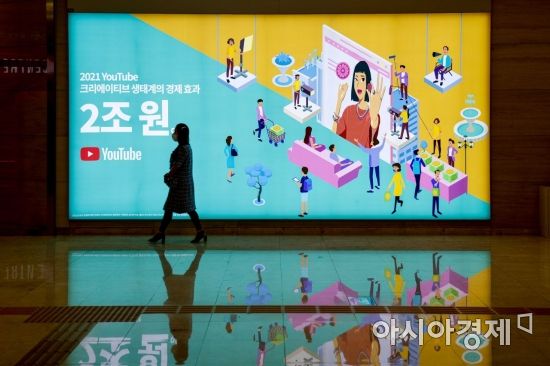 On the 28th, a Google YouTube advertisement opposing the recent Network Usage Fee Act was displayed at a large shopping mall and the subway connecting passage in Yeouido, Seoul. Photo by Kang Jin-hyung aymsdream@
[Asia Economy Reporter Cha Min-young] Google (YouTube) has escalated its efforts to block legislative discussions on the 'Network Usage Fee Act (Amendment to the Telecommunications Business Act)' by the National Assembly's Science, Technology, Information and Broadcasting and Communications Committee. Following online campaigns on its official blog, Instagram, and Twitter, it has now covered the entire connecting passage of a large shopping mall in Yeouido with advertisements. This is similar to last year's Netflix wrapping advertisement at the National Assembly Station, which highlighted the 'co-growth effect with the Korean content industry' just before the national audit.
On the 29th, Google posted outdoor advertisements with phrases such as 'YouTube Creative Ecosystem Economic Impact of 2 trillion won in 2021' and '86,000 jobs created by the YouTube Creative Ecosystem' along the 200-meter-long Yeouido Panorama Road connecting IFC Mall, The Hyundai Seoul, and the Park One building. IFC Mall and The Hyundai Seoul are considered playgrounds for the MZ generation (Millennials + Generation Z).
The background behind Google's massive spending on corporate image enhancement advertisements, rather than promoting YouTube content, is interpreted as a power struggle with the National Assembly over the Network Usage Fee Act. Lawmakers from both ruling and opposition parties in the Science and Technology Information and Broadcasting and Communications Committee have requested the attendance of YouTube Asia-Pacific Vice President Gautam Anand as a witness at the upcoming national audit starting early next month. In case of refusal, Nancy Mable Walker, CEO of Google Korea, who was nominated as Google's local representative, has also been requested as a witness.
Google is using domestic YouTubers as leverage to block legislation. Moving away from conflicts with Internet Service Providers (ISPs) over massive internet network costs caused by traffic overload, Google has put relatively weaker Korean creators at the forefront. Vice President Anand hinted at the possibility of halting investments by stating in a blog post right after the legislative public hearing on the 20th, "Internet service providers imposing double burdens on content companies will ultimately disadvantage content companies and creators," and "If the law is amended, we may have to consider difficult decisions such as changing our business operations in Korea."
 On the 28th, a YouTube advertisement by Google, which has recently been generating public opposition to the Network Usage Fee Act, was displayed at a large shopping mall and the subway connecting passage in Yeouido, Seoul. Photo by Jinhyung Kang aymsdream@
Google is also conducting a public opinion campaign using social media (SNS) such as Instagram and Twitter. Through the official Instagram account of 'YouTube Creators Korea,' operated by YouTube, a post was published stating, "The Network Usage Fee Act could have a significant negative impact on the domestic internet ecosystem, the Korean creator community, and YouTube operations." Paid promotional advertisements were also run via the official Twitter account.
As the situation unfolds, YouTubers are posting video content supporting Google's claims one after another. The economic YouTube channel 'Sampro TV' recently argued in a broadcast that "While it is true that telecommunications costs increase due to large overseas content providers like YouTube and Netflix, demanding fees violates the rules of the international internet network." At a Network Usage Fee Act opposition debate hosted by the office of Lee Sang-heon, a member of the National Assembly's Culture, Sports and Tourism Committee, on the 20th, famous IT YouTuber 'Itsseop' appeared as the moderator.
However, the ICT industry views Google's strategy of putting Korean creators forward as potentially backfiring. Google does not pay revenue for all YouTube content. The publicly known criteria are '1,000 subscribers and 4,000 hours of annual cumulative watch time'; if these are not met, no payment is made. Even then, the revenue generated from advertisements is split 45 to 55, with YouTube taking 45%. In the service terms change last June, it was included that YouTube may place ads on videos that do not meet these criteria, with all revenue going to YouTube rather than the creators. Ultimately, many creators work for YouTube, but only a small portion receive revenue, leading to speculation that Google may find itself in a predicament.
© The Asia Business Daily(www.asiae.co.kr). All rights reserved.
![Clutching a Stolen Dior Bag, Saying "I Hate Being Poor but Real"... The Grotesque Con of a "Human Knockoff" [Slate]](https://cwcontent.asiae.co.kr/asiaresize/183/2026021902243444107_1771435474.jpg)

















