[Asia Economy New York=Special Correspondent Joselgina] Local media have also highlighted the issues surrounding the United States' Inflation Reduction Act (IRA), which has sparked controversy over discriminatory electric vehicle (EV) subsidy payments in South Korea.
On the 28th (local time), The Wall Street Journal (WSJ) analyzed the problems of the Inflation Reduction Act in an article titled "President Joe Biden Faces Backlash from South Korea over EV Subsidy Issues."
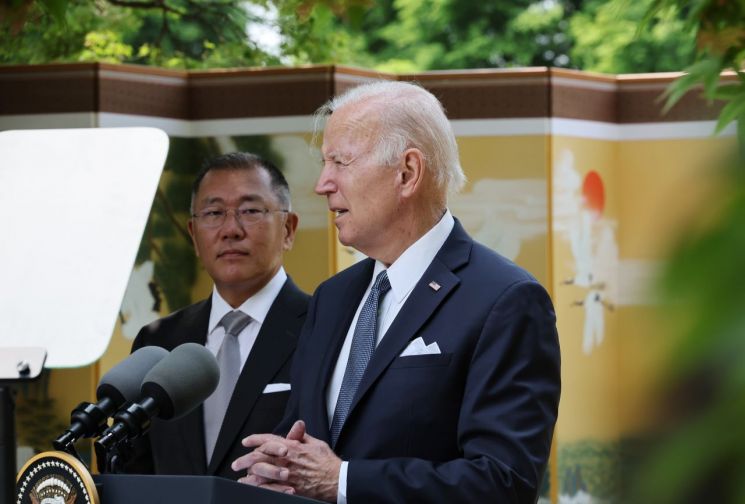
WSJ reported that during President Biden's visit to South Korea last May, he met with Chung Euisun, Chairman of Hyundai Motor Group, who pledged more than $10 billion in investment to the U.S., and said, "We will never disappoint you." However, four months later, many Koreans, including Chairman Chung and Hyundai, are feeling disappointed.
The Inflation Reduction Act, which provides up to $7,500 in tax credits to EV buyers, limits eligibility to North American-made vehicles. As a result, EVs manufactured by Korean companies such as Hyundai and Kia and exported to the U.S. are not eligible for subsidies. The Automobile Industry Association estimates that this will disrupt the export of approximately 100,000 EVs annually.
WSJ pointed out that while vehicles from the European Union (EU) and Japan are also excluded from the subsidy, South Korea's backlash is particularly strong. The newspaper noted that this coincides with ongoing efforts to strengthen the South Korea-U.S. alliance since the inauguration of the Yoon Suk-yeol administration.
Recently, despite China's overt opposition, the Yoon administration decided to participate in Chip4 (Korea, U.S., Japan, Taiwan), a U.S.-led initiative, and has actively cooperated with various Biden administration policies. Announcements of U.S. investments by Korean companies, including Hyundai Motor Group, have followed one after another. However, the response has not been commensurate. South Korea created 35,000 jobs in the U.S. in the first half of this year, mainly in the EV battery industry, making it the country that created the most jobs in the U.S.
WSJ described this situation as a "headwind," explaining it as "friction that can arise when President Biden pursues close security alliances abroad while seeking to revive domestic manufacturing." Wendy Cutler, former Deputy U.S. Trade Representative (USTR), said, "There is a lack of balance. The EV-related provisions highlight that," adding, "I can understand why Koreans are angry and disappointed."
On the same day, The New York Times (NYT) also covered Vice President Kamala Harris's visit to South Korea and Japan, reporting that high-ranking U.S. officials have expressed considerable concern about the Inflation Reduction Act in South Korea. NYT noted, "In South Korea, there is a feeling that Hyundai Motor Group, which announced large-scale investments during President Biden's visit, has been betrayed." Citing experts, the paper evaluated that the exclusion of Korean-made EVs from the IRA subsidies is one of the issues causing tension between the two countries.
The South Korean government has already conveyed its concerns to the U.S. administration multiple times through delegations visiting the U.S. The government views such discrimination as likely violating the principles of national treatment and most-favored-nation treatment under the Korea-U.S. Free Trade Agreement (FTA) and the World Trade Organization (WTO). WSJ also mentioned that during a recent visit to New York, President Yoon Suk-yeol briefly greeted President Biden and raised the issue of EV subsidies. Additionally, the White House message noted that the two leaders pledged to continue cooperation on current issues, including supply chain recovery and economic security.
Vice President Harris, too, met with Prime Minister Han Duck-soo in Tokyo on the 27th and said, "We understand South Korea's concerns regarding the EV tax benefits under the Inflation Reduction Act," promising to consult with each other going forward.
© The Asia Business Daily(www.asiae.co.kr). All rights reserved.

















