Assemblyman Park Wanju "Mid-term Review Needed to Achieve Policy Goals"
[Asia Economy Reporter Oh Su-yeon] Although terrestrial UHD was introduced for high-quality broadcasting, the direct reception rate has been the lowest since its introduction. The mandatory UHD content programming ratio is also barely meeting the minimum programming ratio.
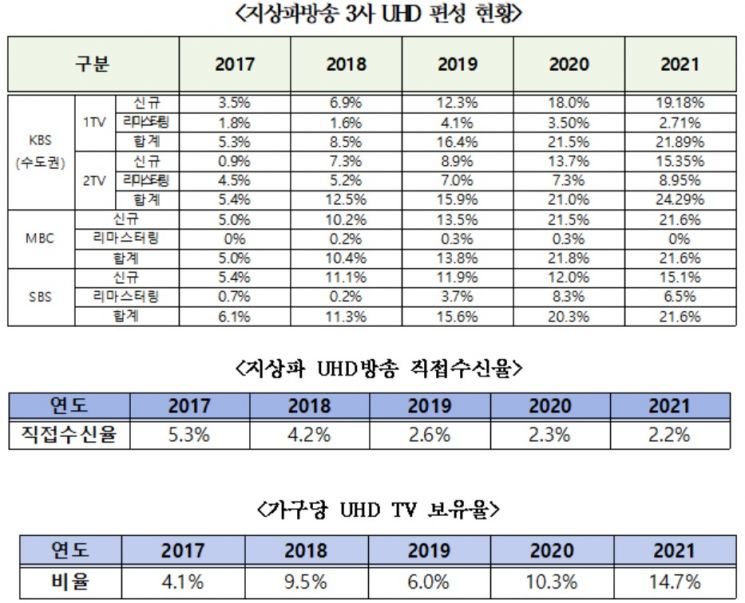
According to Park Wan-joo, a member of the National Assembly's Science, Technology, Information and Broadcasting and Communications Committee, as of the end of last year, the direct reception rate of terrestrial UHD broadcasting was 2.2%, the lowest since its introduction.
The household UHD TV ownership rate was 14.7% last year, up 4.4 percentage points from 10.3% the previous year. However, to watch terrestrial UHD broadcasting, viewers must install a separate set-top box or watch through paid services such as Internet TV (IPTV) or cable broadcasting that retransmit the signal. Due to this inconvenience, the direct reception rate of terrestrial UHD appears to be declining annually, independent of UHD TV penetration.
The Korea Communications Commission planned to build a nationwide broadcasting network since the introduction of terrestrial UHD in 2017 until last year, but postponed it to next year citing the worsening financial conditions of local broadcasters.
Looking at the UHD content programming ratio of the three terrestrial broadcasters, they are barely meeting the minimum programming ratio of 20% set by the KCC. Based on the metropolitan area, as of last year, KBS 1TV had 21.9%, 2TV had 21.6%, and MBC and SBS also remained at 21.6%.
However, these figures include remastered content converted from existing content to UHD, which is recognized as programming. Excluding this, the actual new UHD content programming performance was only 19.2% for KBS 1TV, 15.4% for 2TV, and 15.1% for SBS.
The KCC plans to increase the mandatory UHD programming ratio to 25% next year, 35% in 2024, and 50% by 2026. However, starting next year, the recognition rate for remastered content programming will be lowered from 100% to 50%, making it uncertain whether broadcasters can meet this ratio.
Assemblyman Park Wan-joo said, “The KCC and the Ministry of Science and ICT promoted the introduction of UHD broadcasting as a next-generation terrestrial broadcasting service policy, but due to financial factors such as weakened investment capacity of broadcasters, the implementation targets are being lowered compared to the original plan. As the broadcasting and communications environment is rapidly changing and content viewing methods are diversifying, it is time for a mid-term review to achieve policy goals rather than just delaying the implementation schedule.”
© The Asia Business Daily(www.asiae.co.kr). All rights reserved.
![Clutching a Stolen Dior Bag, Saying "I Hate Being Poor but Real"... The Grotesque Con of a "Human Knockoff" [Slate]](https://cwcontent.asiae.co.kr/asiaresize/183/2026021902243444107_1771435474.jpg)
















