Selection of 30 Consortia, Up to 1.5 Billion KRW Support Over 3 Years
Encouraging Youth Talent Settlement and Expanding Lifelong Vocational Education Coverage
[Asia Economy Reporter Han Jinju] The 'Higher Vocational Education Hub District (HIVE)' project, which fosters specialized local talent and supports regional settlement through cooperation between basic local governments and junior colleges, is set to be fully launched.
On the 29th, the Ministry of Education announced that it will hold the launch ceremony for the 'Higher Vocational Education Hub District (HiVE) Project' at Daegu Health College.
The Higher Vocational Education Hub District refers to a project that supports junior colleges in playing a central role in local-based higher vocational education by selecting regional specialized fields that align with the mid- to long-term development goals of basic local governments and linking and reorganizing the education system accordingly.
A total of 40.5 billion KRW in national funding will be invested in the Higher Vocational Education Hub District project this year. A total of 30 consortia, six per region, have been selected, and each will receive a budget of around 1.5 billion KRW annually for three years starting from 2022. Young talents will be provided with opportunities for on-site training such as vocational education and mentoring, while early retirees and those lacking re-education, such as retirees, will be offered chances to develop vocational competencies.
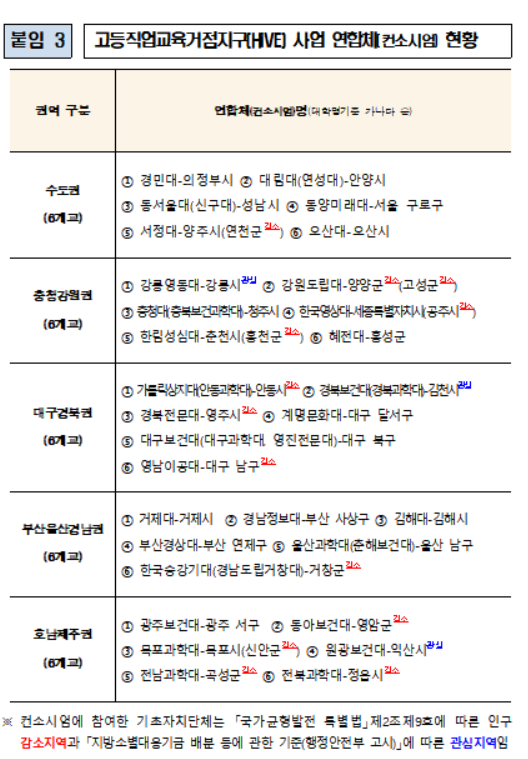
The selected consortia analyze local demand together with junior colleges based on the mid- to long-term development plans of basic local governments and select regional specialized fields. The universities operate customized academic organizational reforms and regular education programs within the quota that correspond to these fields.
To enhance lifelong vocational education in the local community, advanced vocational education courses linked to specialized departments are operated to support talent development such as re-education for industry workers and reemployment training. In addition, cooperation is promoted to carry out problem-solving programs for major local issues.
An 'Higher Vocational Education Innovation Committee' is operated to deliberate and decide on major matters such as the direction of project implementation by each consortium, project plans, and budget execution. The chairpersons are jointly held by the presidents of junior colleges and heads of basic local governments, and members include local education office superintendents, chamber of commerce presidents, and representatives of local industries.
Kim Ilsu, Director of Higher Education Policy at the Ministry of Education, said, "I hope the Higher Vocational Education Hub District project will create a virtuous cycle structure from admission to education, employment, and settlement based on cooperation between junior colleges and basic local governments, serving as a foundation for nurturing local talent and regional development."
© The Asia Business Daily(www.asiae.co.kr). All rights reserved.

















