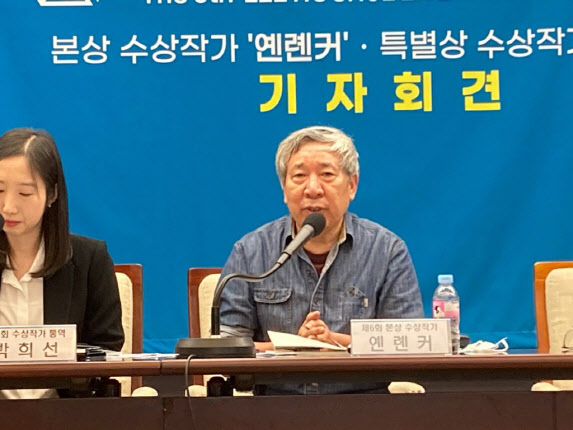
[Asia Economy Reporter Seomideum] "This is the most pleasant and enjoyable award I have ever received."
This is what Chinese writer Yan Lianke said after winning the grand prize at the 6th Lee Ho-cheol Unification Road Literary Award. He expressed, "I am glad to receive this award for my book 'Sasa.' Not simply because it depicts the Great Leap Forward and the Great Famine, but because it involved many artistic attempts," and added, "I hope Korean writers will understand not only the linguistic narration but also the methods of expression."
He continued, "I am happy to breathe the fresh air of a foreign country (Korea) after three years due to COVID-19. I had even forgotten how to board a plane at the airport, but coming here with my wife this time helped me remember," he joked.
His book, Sasa, deals with the human figures during the Cultural Revolution. It restores the memories and records of people whose culture was banned and denied in the name of revolution, using literary language. The judging panel commented that the work most closely aligns with the truth of resistance that writer Lee Ho-cheol sought to reach.
Yan Lianke is a representative resistance writer in China. Known for writing what he wants despite sanctions and disadvantages, he resists the state system and violence. His well-known works in Korea, Sasa and Serve the People, are banned books in mainland China. Regarding this, Yan Lianke explained, "Although banned in the mainland, they are published in Taiwan and Hong Kong, so Chinese-speaking readers can access them."
With the Nobel Prize in Literature announcement approaching in a week, questions were directed at him as he is frequently mentioned as a candidate. However, he avoided answering continuously and only responded after the third question, saying, "(Rather than the award,) writing good works is important. I will be 65 next year, and I believe I can write better works than I have so far. I believe I will write works that readers worldwide have never read."
He added, "The pressure and tension of having less time to create as I age are significant. I still have many things I want to write. It is more important how I write than what story I write," and shared, "In the past two years, I have been reading French and British plays, searching for a breakthrough where novels reach a higher level than plays."
The Lee Ho-cheol Unification Road Literary Award was established in 2017 in Eunpyeong-gu to honor the late writer Lee Ho-cheol, who comforted displaced persons through novels about division such as Departure from Homeland and Panjom. Every year, the award recognizes writers who engage in literary practice to overcome issues such as conflict, women, refugees, and war, presenting grand and special prizes. This year, Yan Lianke was selected for the grand prize, and writer Jang Mari received the special prize. The prize money is 50 million KRW and 20 million KRW respectively, and the award ceremony will be held on the 29th at the Jingwansa Korean Culture Experience Center in Eunpyeong-gu.
© The Asia Business Daily(www.asiae.co.kr). All rights reserved.
![Clutching a Stolen Dior Bag, Saying "I Hate Being Poor but Real"... The Grotesque Con of a "Human Knockoff" [Slate]](https://cwcontent.asiae.co.kr/asiaresize/183/2026021902243444107_1771435474.jpg)
















