41.1 Billion KRW Invested in 'Basic Plan' Service for First Phase of Deep Stormwater Drainage Tunnel Installation
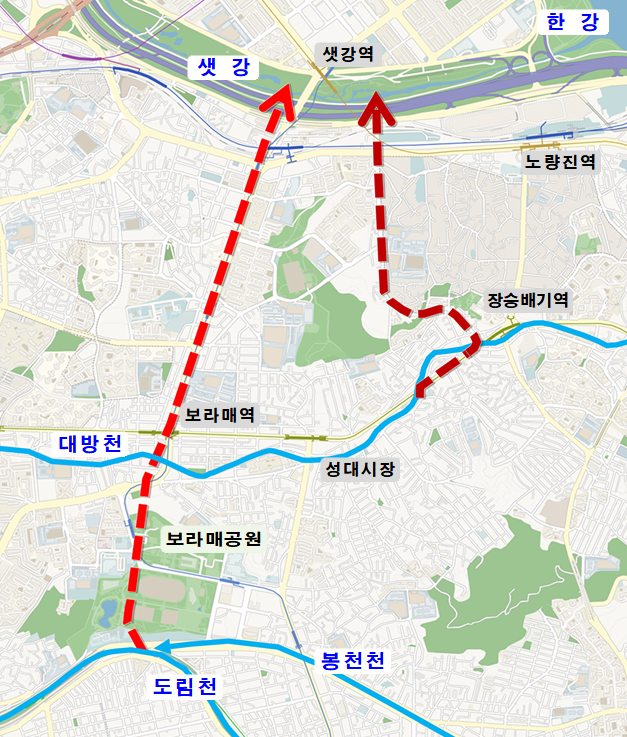
[Asia Economy Reporter Lim Cheol-young] The Seoul Metropolitan Government is set to accelerate the first phase of the "Deep Underground Rainwater Drainage Tunnel" project, announced for installation at three flood-prone areas?Gangnam Station, Gwanghwamun, and Dorimcheon?to prevent large-scale flooding. The deep underground rainwater drainage tunnel is a facility that creates a large tunnel 40 to 50 meters underground to store rainwater during heavy rains and discharge it into rivers.
On the 29th, Seoul announced the public notice for the "basic planning service," the very first step for installing the "Deep Underground Rainwater Drainage Tunnel." A total of 4.11 billion KRW will be invested (1.39 billion KRW for Gangnam Station, 740 million KRW for Gwanghwamun, and 1.98 billion KRW for Dorimcheon).
Through the basic plan, the city will thoroughly review the optimal scale and route of the "Deep Underground Rainwater Drainage Tunnel" for each area, project costs, various utilization methods, and excellent inflow sites that can minimize complaints while completing the project early.
For Gangnam Station, the facility will be designed to prevent flooding damage across the entire Gangnam Station watershed; for Gwanghwamun, it will cover the entire Gwanghwamun watershed; and for Dorimcheon, it will serve as a key facility to prevent flooding damage throughout the Dorimcheon watershed. Since this is a highly challenging task requiring the installation of large-scale disaster prevention facilities 40 to 50 meters underground, the process will include listening to and evaluating engineering firms' directions for the basic plan and their technical proposals.
Seoul will accept technical proposals until the 20th of next month, complete evaluations thereafter, and select the final contractor on November 9. From November to May next year, the city will establish plans for selecting the optimal scale and route. Additionally, to ensure smooth project progress, the city plans to form local "resident councils" in line with the implementation of the basic plan. Residents' opinions will be actively reflected during the basic plan development.
Han Yoo-seok, Director of the Water Circulation Safety Bureau of Seoul, stated, "The 'Deep Underground Rainwater Drainage Tunnel' is one of the essential disaster prevention facilities that must be installed to respond to the climate crisis. Through this basic plan, we will carefully review the facility scale, route, project costs, and utilization methods," adding, "Seoul will continuously communicate with local residents to promote a project that citizens can empathize with and will do its best to complete the project swiftly."
© The Asia Business Daily(www.asiae.co.kr). All rights reserved.

















