Martial Arts, Meeting on Export Issues for the Public Held in Incheon on the 28th
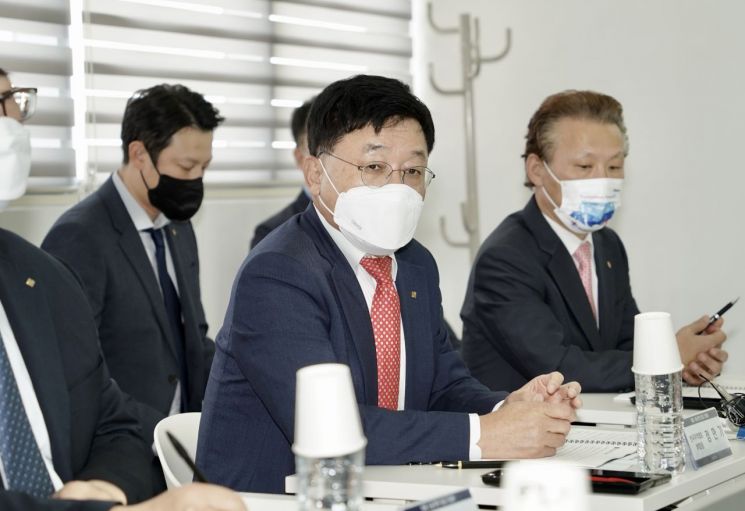 Jung Manki, Vice Chairman of the Korea International Trade Association, is attending a meeting to listen to corporate difficulties and key issues. / Provided by Korea International Trade Association
[Asia Economy Reporter Kim Pyeonghwa] Jung Manki, Vice Chairman of the Korea International Trade Association (KITA), visited a site to discuss measures to address the trade deficit with China as his first field activity after taking office. Vice Chairman Jung pointed out that major sectors experiencing export sluggishness, such as displays, should be designated as national advanced strategic industries and supported by the government. He advised that expanding corporate research and development (R&D) and improving productivity are necessary to maintain a technological gap with China.
On the 28th, KITA held a "Meeting to Review Current Issues in Exports to China" at the headquarters of YG-One Co., Ltd. in Songdo, Incheon. The event was held to analyze the causes of the trade deficit with China, which has continued for four months from April to August this year, and to discuss countermeasures. The meeting was attended by Vice Chairman Jung, representatives from eight Chinese export companies in sectors such as semiconductors, displays, cosmetics, food, and machinery, as well as China experts.
In his opening remarks, Vice Chairman Jung stated, "Although total imports from China excluding energy sources such as crude oil, coal, and natural gas decreased by 0.5% compared to the same period last year until July this year, Korea maintains the second-largest market share in Chinese imports, performing better than Japan (3rd) and Germany (6th),” he diagnosed, “However, due to changes in China’s industrial structure such as the growth of intermediate goods industries, the demand for intermediate goods for third-country exports from China has decreased, affecting our exports, so countermeasures are necessary.”
He also said, “Until July this year, China’s imports of Korean intermediate goods increased by 7.7%, but excluding semiconductors, it fell by 2.7%,” adding, “In particular, exports of displays such as LCD and OLED have significantly decreased.” Vice Chairman Jung explained that support for product advancement, including designating displays as a national advanced strategic industry, is necessary.
Vice Chairman Jung pointed out that to fend off China’s pursuit of Korea’s key domestic industries such as displays, semiconductors, and batteries, companies need to expand R&D and improve productivity. He also argued that productivity must be continuously increased by expanding cash and tax support and closing the support gap between large and small-to-medium enterprises.
He emphasized, "Recently, the Ministry of Trade, Industry and Energy abolished the extra points system for small and medium enterprises when selecting research project performers for the Industrial Technology Innovation Project, which will greatly contribute to improving R&D productivity," adding, "It is important to continuously expand and implement such policies."
© The Asia Business Daily(www.asiae.co.kr). All rights reserved.

















