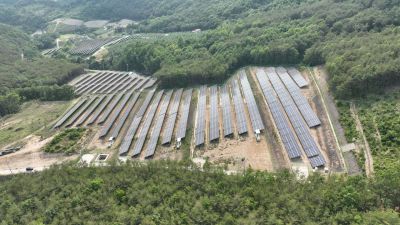
With the expansion of the solar power business, which accounts for the largest share in the renewable energy sector, damage to related facilities has been increasing nationwide every year. There are calls to strengthen safety measures for facilities against natural disasters rather than increasing government benefits to expand the solar power adoption rate.
According to data submitted by the Korea Energy Agency to the office of Yoon Young-seok of the People Power Party on the 2nd, a total of 222 cases of damage to solar power facilities caused by typhoons and heavy rainfalls have been recorded over the past five years from 2018 to September this year.
Due to the impact of Typhoon Hinnamnor, the 11th typhoon last month, the number of reported solar power facility damages this year soared to 78 cases, six times higher than last year (13 cases). This is the highest number since the 95 cases recorded during the passage of super typhoons Maysak and Haishen through the Korean Peninsula in 2020.
The number of damage cases, which was only 8 in 2018 when solar power adoption began in earnest, increased significantly to 28 in 2019 and 95 in 2020, then decreased to 13 last year. The agency analyzed that the overall damage to solar power facilities also decreased as the number of typhoons causing significant damage to the Korean Peninsula declined last year.
During the same period, Jeonnam recorded the highest number of damage cases at 52, followed by Gyeongnam (31), Gyeongbuk (27), Jeju (25), and Jeonbuk (18). Damage was mainly concentrated in areas where solar power facilities were installed by reclaiming mountainous and agricultural lands rather than in the metropolitan area.
Facility damage in mountainous areas accounted for 50 cases, agricultural land 19 cases, and others 153 cases. Among the damage types, partial loss of solar power equipment was the most common with 151 cases, accounting for 68.0%, and there were also 36 cases of soil and equipment washout. There were 15 cases where facilities were completely submerged due to heavy rainfalls.
These figures are based on resident reports collected by the Energy Agency, and experts analyze that the actual scale of damage is larger. Damage to solar power facilities, the main business of renewable energy generation, is repeatedly occurring in dozens of cases every year due to natural disasters.
This has happened as the Moon Jae-in administration strengthened renewable energy projects and significantly increased solar power facilities. The encroachment on agricultural land caused by this is also at a serious level.
According to the Korea Rural Community Corporation, the area of agricultural land converted for the installation of solar power generation facilities from 2017 to May this year reached 10,342 hectares. Over the past five years, agricultural land equivalent to 35 times the size of Yeouido (290 hectares) has disappeared due to solar power facilities. By region, Jeonbuk had the largest area of agricultural land conversion at 3,208 hectares, followed by Jeonnam with 2,138 hectares.
During this period, government exemptions in the form of subsidies for solar power installation also increased significantly. According to the Rural Community Corporation's data, the agricultural land conservation charge exempted due to solar power facility installation over five years amounted to 15.1 billion KRW. The agricultural land conservation charge is a fee imposed when existing agricultural land is converted to other uses for the purpose of agricultural land conservation and management, and it is a major source of funding for the Agricultural Land Management Fund.
Earlier, the Moon Jae-in administration introduced a system in early 2018 that exempts 50% of the agricultural land conservation charge if solar power is installed on farmland owned by farmers and fishermen. As a result, the exemption amount in 2018 surged to 7.22 billion KRW, about 1,310 times higher than the previous year (5.52 million KRW).
© The Asia Business Daily(www.asiae.co.kr). All rights reserved.

















