Current Family Regulations 'Marriage, Blood Relation, Adoption Units'
Ministry of Gender Equality and Family: "Measures to Avoid Exhaustive Debates"
470,000 Non-Relative Households, 1 Million Household Members
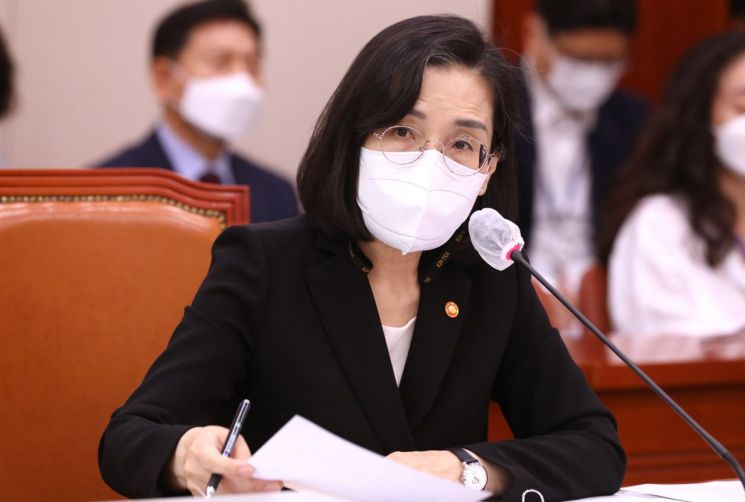 Minister of Gender Equality and Family Kim Hyun-sook is responding to a lawmaker's question during the "Current Issues Report on Reviewing the Protection System for Stalking Victims" at the plenary meeting of the Gender Equality and Family Committee held at the National Assembly on the 20th.
 [Image source=Yonhap News]
[Asia Economy Kim Gun-chan, Intern Reporter] Last year, the number of non-kin household members surpassed 1 million for the first time in history, and the Ministry of Gender Equality and Family (MOGEF) reversed its previous stance of recognizing common-law and cohabiting households as legal families. As the expansion of the family scope becomes a natural trend, there are calls, mainly from women's groups, for MOGEF to take the lead in amending the Framework Act on Healthy Families.
On the 24th, MOGEF reversed its previous position on the "Amendment to the Framework Act on Healthy Families," which proposed deleting the legal definition of family, stating that "maintaining the current law is necessary." The ministry plans to maintain the definition of "family" as defined in the current Framework Act on Healthy Families. According to this law, a family is defined as "the basic unit of society formed through marriage, blood relations, or adoption."
In 2020, MOGEF expressed support for the amendment to the Framework Act on Healthy Families, which was introduced by Democratic Party lawmakers Nam In-soon and Jung Chun-sook. The amendment aimed to expand the definition of family by deleting the existing family provisions in response to changes in family forms and sizes. It also included renaming the law from the Framework Act on Healthy Families to the "Framework Act on Family Policy."
In April last year, MOGEF announced the "4th Basic Plan on Healthy Families (2021?2025)," which recognized cohabiting and common-law couples, as well as foster families caring for abused children, as legal families. On the 27th of the same month, MOGEF also held an "Expert Meeting on Improving Family-Related Legislation" to gather expert opinions on the pending amendment to the Framework Act on Healthy Families in the National Assembly.
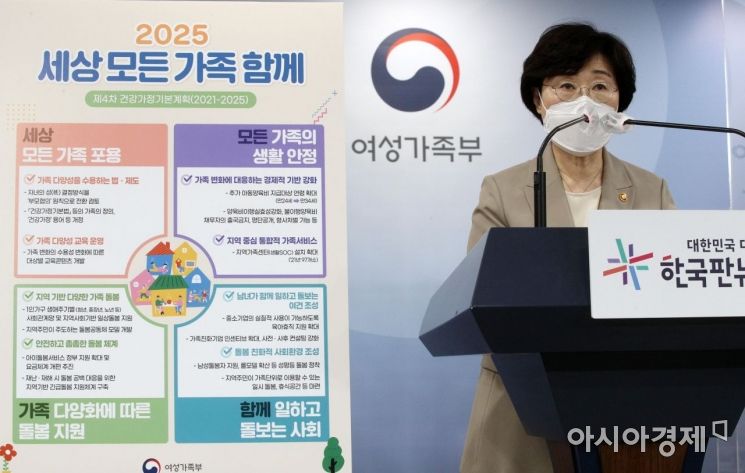 Minister Jung Young-ae of the Ministry of Gender Equality and Family is giving a briefing on the 4th Basic Plan for Healthy Families last April at the Government Seoul Office in Jongno-gu, Seoul. Photo by Kim Hyun-min kimhyun81@
However, MOGEF reversed its stance within a year, submitting an opinion letter to Assemblywoman Jung Kyung-hee's office, citing the need to "stipulate the state's protection and support targets in the law." The ministry explained the change in position as a measure to "avoid futile debates."
In a press reference material, MOGEF stated, "This does not mean that we do not recognize common-law and cohabiting families as policy targets," adding, "Rather, it is to avoid futile debates caused by the amendment to the Framework Act on Healthy Families and to expand practical support to prevent blind spots, considering the rapidly changing social environment of family forms."
Following MOGEF's reversal, backlash arose mainly from women's groups. On the 26th, 36 women's organizations nationwide, including the Korean Women's Associations United, Korean Women's Movement United, and Korea Women's Hotline, issued a statement urging MOGEF to take the lead in amending the Framework Act on Healthy Families.
The women's groups stated, "Is it appropriate for a government agency responsible for legislating and revising laws and planning and executing policies accordingly to dismiss discussions on legal amendments as 'futile debates' in light of changed realities?" They criticized, "We cannot understand how the government intends to provide substantial support to the many citizens who are excluded from welfare, tax systems, and deprived of citizenship rights due to the currently narrowly defined legal concept of family."
 According to the "Public Perception Survey on Family Diversity" conducted by the Ministry of Gender Equality and Family in 2020, 69.7% agreed that people who share livelihood and residence are considered family, even if they are not related by marriage or blood./Photo by Hyunmin Kim kimhyun81@
Non-kin households are on the rise. According to the National Statistical Portal (KOSIS) of Statistics Korea, non-kin households numbered 269,444 in 2016 and exceeded 400,000 households in 2020 (423,459 households). Last year, the number reached 472,660 households, an 11.6% increase from the previous year, marking the highest since statistics began. Non-kin households refer to households of five or fewer members who are not relatives within the eighth degree of kinship.
Last year, the number of non-kin household members also surpassed 1 million for the first time. The number of non-kin household members was 1,015,100 last year, a 74% surge compared to 583,438 in 2016 over five years.
The expansion of the family scope is becoming a natural trend. According to a survey by the Korean Women's Development Institute last year, more than six out of ten respondents (62.7%) agreed with expanding the family scope to include common-law, unmarried, and cohabiting relationships.
In the 2020 "Public Perception Survey on Family Diversity" conducted by MOGEF, 69.7% agreed that people who share livelihood and residence, even without marriage or blood relations, are family. Additionally, 39.9% agreed that people who do not live together or share livelihood but have emotional bonds and intimate relationships are family.
© The Asia Business Daily(www.asiae.co.kr). All rights reserved.



















