"South Korea's Digital Competitiveness to Rank 3rd by 2027"
Implementing 19 Tasks Across 5 Major Strategies
Focus on AI and Data Fields
Leading Talent Development and 6G Advancement
[Asia Economy Reporter Cha Min-young] ‘3rd in digital competitiveness by 2027, 3rd in artificial intelligence (AI) competitiveness, 1st in digital infrastructure’
The Ministry of Science and ICT announced these goals on the 28th at the 8th Emergency Economic and Livelihood Meeting held at the Kim Dae-jung Convention Center in Gwangju, presided over by President Yoon Seok-yeol. The Korea Digital Strategy is a policy roadmap to concretely realize the ‘New York Initiative’ that President Yoon announced in New York, USA, on the 21st.
President Yoon said, "We will raise global AI competitiveness to the world’s 3rd level and expand the data market size to more than 50 trillion won, double the current size." He also stated, "To create a ‘nation where citizens live well together’ based on digital technology, we will protect citizens’ health by utilizing AI medical technology and take more meticulous care of elderly people living alone through care robots and AI telephone services."
Inter-ministerial Joint Effort, Pursuing the US in Digital Technology
The Ministry of Science and ICT plans to implement 19 detailed tasks under 5 major strategies through a joint government strategy with the Ministry of Economy and Finance, Ministry of Trade, Industry and Energy, and Ministry of SMEs and Startups. The goals for 2027, five years from now, include ▲leaping from 12th to 3rd in the ‘IMD Digital Competitiveness Index’ ▲maintaining 1st place globally in the ‘OECD Digital Infrastructure and Digital Government Index’ ▲rising from 5th to 1st in the ‘Global Innovation Index (WIPO)’ ▲increasing competitiveness in six key digital technologies (AI, AI semiconductors, 5G, 6G, quantum, metaverse, cybersecurity) to 93% of the US level.
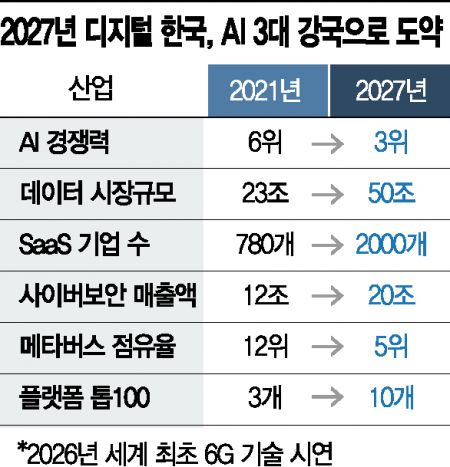
The core focus is on AI and data fields. AI competitiveness is planned to be raised from the current 6th to 3rd by 2027. To this end, 301.8 billion won will be invested over five years until 2026 for next-generation core technology development, and a total of 1.02 trillion won will be invested in core AI semiconductor technologies.
The data market size will be more than doubled from the current 23 trillion won to 50 trillion won. The ‘K-Cloud Project’ will be actively promoted, which organically links ‘AI semiconductors → cloud → AI services’ based on ultra-high-speed, low-power cloud data centers built with domestic AI semiconductors. The number of SaaS (Software as a Service) companies, a future-oriented software (SW) sector, will also increase from the current 780 to about 2,000.
Training 1 Million Digital Talents and 100,000 Cybersecurity Experts
By doubling the hours of information and computer education classes, SW and AI education will be fully implemented from elementary and secondary levels. Through SW-centered universities and expansion of graduate schools in six digital fields, the government will nurture 1 million digital talents. Starting with 1,150 people in 2022, the education-to-employment model linked with companies will be continuously expanded over the next five years. Additionally, 100,000 cybersecurity experts will be trained.
The number of global platform companies is targeted to increase more than threefold from the current three to ten. In the online video service (OTT) sector, the K-OTT content fund will be tripled to 300 billion won. The metaverse (extended virtual world), digital platforms, and blockchain sectors will also be fostered. Digital startups will be supported to increase the number of domestic digital unicorn companies from the current 23 to 100. The metaverse market share is planned to rise from 12th to 5th place.
In the 6G mobile communication field, the government plans to take the lead. The nationwide 5G network will be completed by 2024, and by securing standard patents for the next-generation 6G mobile communication technology, the world’s first pre-6G service demonstration will be pursued in 2026. A ‘Digital Representative Office’ will be newly established to consolidate support capabilities for domestic companies’ overseas expansion, with bases set up in Silicon Valley, USA; Brussels, Europe; and Shanghai, China.
Furthermore, to create an inclusive digital society, a digital safety net will be established and digital welfare strengthened. ‘Green data centers’ will be promoted for digital carbon neutrality. A ‘(tentative name) Digital Bill of Rights’ will also be established to ensure digital accessibility and close the digital divide.
Minister Lee Jong-ho of the Ministry of Science and ICT said, "The Korea Digital Strategy is our country’s national digital blueprint, a strong national-level policy commitment toward leading global digital innovation as outlined in the New York Initiative. We will fully mobilize government capabilities to produce tangible results that citizens can feel and share these achievements with citizens worldwide as a model digital innovation country."
© The Asia Business Daily(www.asiae.co.kr). All rights reserved.
![Clutching a Stolen Dior Bag, Saying "I Hate Being Poor but Real"... The Grotesque Con of a "Human Knockoff" [Slate]](https://cwcontent.asiae.co.kr/asiaresize/183/2026021902243444107_1771435474.jpg)
















