Reconstruction Charges to Be Significantly Reduced
for Provincial, Mid- to Low-Priced Projects and Long-Term Single-Home Owners
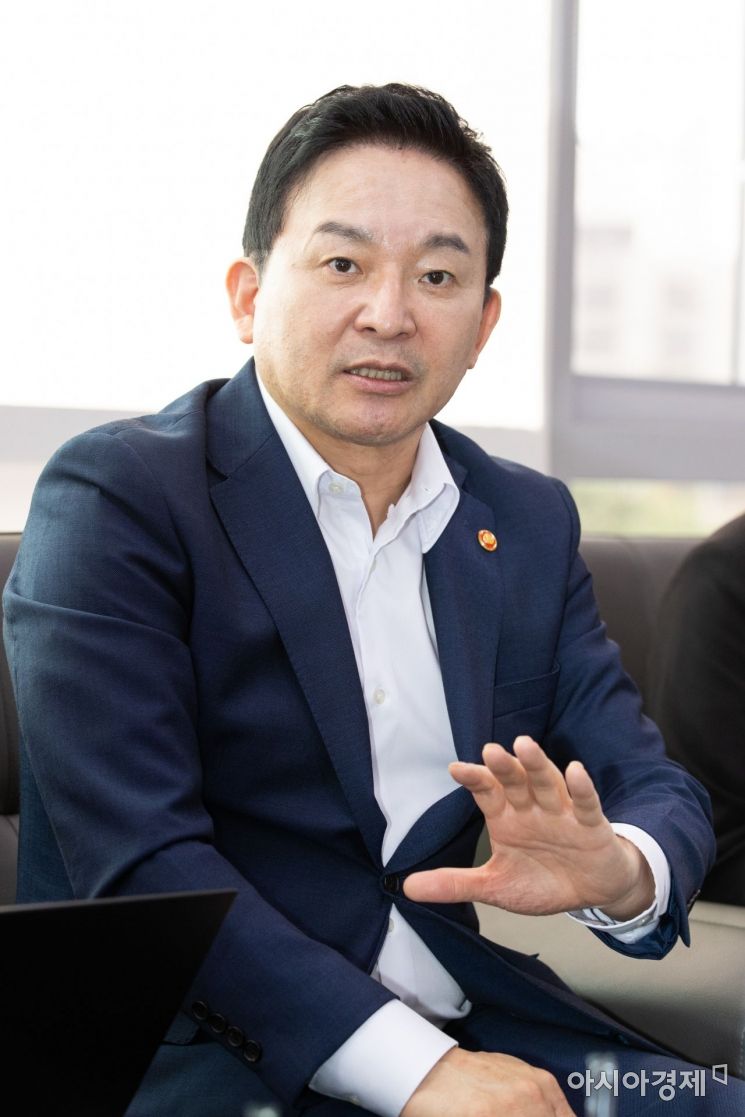
Won Heeryong, Minister of Land, Infrastructure and Transport, announced on September 28 that the government will push to designate leading (pilot) districts for reconstruction in five first-generation new towns, including Bundang and Ilsan, by 2027, within the current administration's term.
In an interview with Yonhap News at the Government Complex Sejong the previous day, Minister Won addressed the controversy over a broken campaign pledge regarding the redevelopment of first-generation new towns, stating, "We will ensure that the government does not cause any delays in the project."
The five first-generation new towns-Bundang, Ilsan, Jungdong, Pyeongchon, and Sanbon-were planned during the Roh Tae-woo administration. Now, more than 30 years after their development, there have been increasing calls for redevelopment due to aging infrastructure.
The Ministry of Land, Infrastructure and Transport and the local governments of the first-generation new towns recently agreed during a meeting to accelerate the redevelopment projects by establishing a master plan by 2024. The ministry will prepare the basic guidelines for redevelopment, while each local government will simultaneously develop its own basic redevelopment plan, following a "two-track" approach.
Minister Won stated, "Within the five-year term, we will push to designate pilot or leading districts for redevelopment, taking into account the unique characteristics of each first-generation new town." He added, "Bundang, where occupancy began the earliest, could be designated, or depending on the circumstances of each local government, areas like Ilsan or Jungdong could also become leading districts."
Minister Won further explained, "While it may not be possible to break ground ('the first shovel') within the Yoon Suk-yeol administration, we do intend to designate leading districts ('the pencil'). Whether we can actually hold that pencil depends on the local governments."
In addition, Minister Won commented on the reconstruction excess profit recovery system and the official price system for apartment complexes.
He emphasized that while the plan to reduce the reconstruction excess profit recovery charges will still allow for the collection of reasonable profits, significant reductions will be provided mainly to reconstruction projects in provincial areas and to long-term single-home owners.
Minister Won said, "Some have called for the abolition of the reconstruction charges altogether, but a reasonable system to recover excessive development profits is essential. There will be substantial reductions for mid- to low-priced and provincial reconstruction projects, as well as for long-term single-home owners."
Regarding the proposal to delay the imposition of charges from the date of project committee approval to the date of union establishment, he indicated that this will not be implemented, stating, "If the project period exceeds 10 years, the starting point becomes meaningless." The period for imposing reconstruction charges is up to 10 years, until the completion date.
On the official price system for apartment complexes, he revealed, "We plan to present fundamental reforms by next year, including the transfer of the appraisal and calculation duties currently performed by the Korea Real Estate Board to local governments."
Regarding the current state of the housing market, he assessed, "This is the early stage of a price decline, and it is too soon to say that housing prices are in a full-fledged downward trend. Rather than demand having disappeared, it appears that a wait-and-see attitude is prevalent."
In response to some calls for easing loan regulations to protect so-called 'Youngkeuljok' (those who have borrowed heavily to buy homes) and to ensure a soft landing for the market, he said, "Easing loan regulations should not be applied uniformly, but can be addressed by lifting restrictions in designated regulated areas. We will pursue regulatory relaxation based on the principle of 'more support for those with less,' starting with young people and non-homeowning low- and middle-income households who need financial assistance to purchase their first home."
Regarding the severe late-night taxi shortage in Seoul and the metropolitan area, he said, "We have our own proposal at the Ministry of Land, Infrastructure and Transport and are conducting urgent consultations with the ruling party and government. We expect to finalize and announce a solution in early October."
© The Asia Business Daily(www.asiae.co.kr). All rights reserved.

















