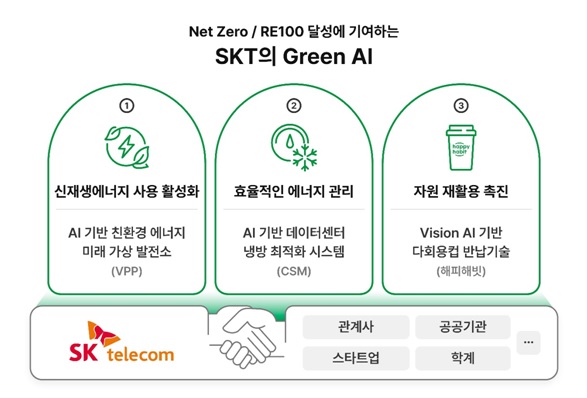
[Asia Economy Reporter Oh Su-yeon] SK Telecom is taking the lead in developing technologies in the green AI sector to achieve net zero (zero carbon emissions). The company is working on developing virtual power plant technology that integrates renewable energy sources such as solar and wind power, energy optimization control technology for telecommunication base stations, and vision AI technology to reduce plastic use and promote reusable cup usage.
SKT announced that on the 28th, it signed a business agreement with SK Energy, Korea Electrotechnology Research Institute, SixtyHertz, and Softberry to develop future virtual power plant (VPP) technology.
Through this agreement, SKT plans to jointly develop core technologies in virtual power plants, including ▲ renewable energy generation and electric vehicle (EV) charging demand forecasting ▲ optimal control of energy storage systems (ESS) ▲ power trading based on energy management systems (EMS).
Integrated Management of Renewable Energy in Virtual Power Plants Using AI
SKT is promoting the development of green AI technologies to achieve SK Group’s net zero goal of making the net greenhouse gas emissions ‘0’.
The virtual power plant being developed connects small-scale renewable energy production such as solar and wind power by individuals or businesses in various regions into a platform to manage them integrally as if they were a single power plant.
Such virtual power plants are gaining attention as future energy management technologies to overcome environmental issues such as depletion of energy resources and reduction of carbon emissions.
Artificial intelligence (AI) technology is essential to properly build and operate virtual power plants. AI improves the accuracy of forecasting the power generation of renewable energy, which is inconsistent, and predicting customers’ power demand such as EV charging. Additionally, AI algorithms optimize charging and discharging when managing generated power through energy storage systems (ESS).
SKT’s plan is to create an optimized virtual power plant that predicts renewable energy generation and power demand scattered across regions using AI and other information and communication technologies (ICT), and produces, stores, and trades power accordingly.
As SK Energy is also transforming its existing gas stations into ‘Energy Superstations’ that produce and sell eco-friendly energy directly, SKT and SK Energy have joined forces to utilize both companies’ technologies and spaces together.
To develop virtual power plant technology, SKT has partnered with startups such as SixtyHertz and Softberry, as well as the Korea Electrotechnology Research Institute. With SixtyHertz, which operates a virtual power plant predicting all renewable energy supply nationwide, SKT plans to develop solar power generation forecasting technology and build a solar power generation map.
With Softberry, which operates Korea’s number one EV charging information app ‘EV Infra,’ SKT will jointly develop technology that predicts power consumption by utilizing EV operation information and charging patterns and applies it to virtual power plant operations. With the Korea Electrotechnology Research Institute, SKT will jointly research optimizing energy storage systems (ESS) and virtual power plant operation technologies.
Accelerating Green ICT Technology Development to Achieve Net Zero
Meanwhile, SKT plans to expand technology development into various green ICT areas to achieve net zero, starting with this virtual power plant.
SKT has been applying green ICT technologies to telecommunication base stations and data centers (IDC) that consume large amounts of power due to the operation of various servers and equipment. These facilities require continuous operation of cooling systems to dissipate heat, and SKT is advancing solutions that use AI to control these cooling systems to improve energy efficiency.
This solution collects and measures various data such as temperature, humidity, and server traffic load from sensors and management systems installed inside the facilities, analyzes them with AI, and manages energy efficiency.
By expanding this solution to telecommunication base stations and data centers, SKT expects to reduce power consumption used for large-scale cooling and the resulting greenhouse gas emissions.
Additionally, SKT’s ‘Happy Habit’ campaign promoting reusable cup usage incorporates SKT-developed ‘Vision AI’ technology in reusable cup return machines. This AI recognizes the cups returned by customers.
When a reusable cup is returned, a camera inside the return machine captures the cup’s exterior, and the vision AI judges foreign substances, damage, and authenticity with about 99% accuracy. The judgment videos are sent to cloud servers to continuously improve AI performance.
Through the ‘Happy Habit’ campaign, SKT is expanding these AI-applied reusable cup return machines to Seoul, Incheon, Jeju, and other areas, actively reducing carbon emissions by cutting about 4.6 million disposable cups so far.
To achieve the net zero goal, SKT has formed a related task force (TF) under the ICT Committee within SK Group to lead cooperation among affiliates and is contributing to creating an eco-friendly energy ecosystem through collaboration with various companies and institutions using green ICT technologies externally.
Jong-min Lee, head of SKT’s Future R&D, said, “To solve future energy problems, we will promote cooperation with various partners based on SKT’s ICT technology capabilities. Through this, we will strengthen ESG management practices and take the lead in building a future technology ecosystem.”
© The Asia Business Daily(www.asiae.co.kr). All rights reserved.

















