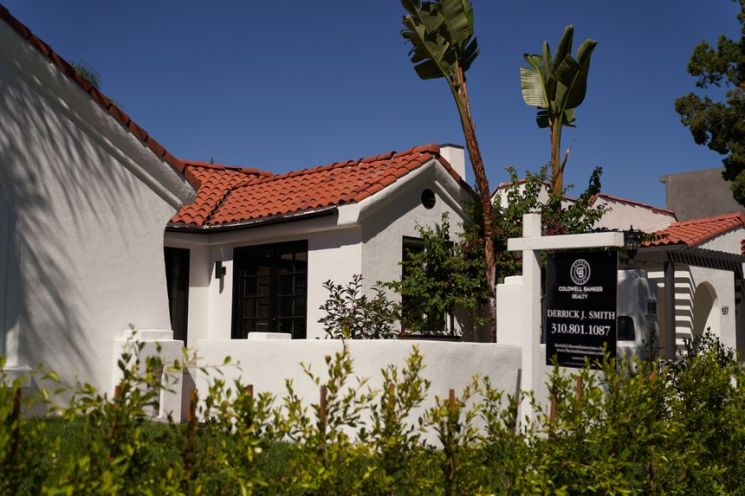
[Asia Economy Reporter Yujin Cho] U.S. home prices, which surged during the COVID-19 pandemic period fueled by low interest rates and excess liquidity, have turned downward for the first time in 10 years. Lumber prices have also fallen to their lowest level since the pandemic. This is seen as a signal that the Federal Reserve's (Fed) aggressive interest rate hikes are beginning to burden the housing market. Attention is focused on whether the decline in home prices, which account for a significant portion of the U.S. Consumer Price Index (CPI), will ease inflationary pressures.
According to the S&P CoreLogic Case-Shiller Home Price Index, a nationwide U.S. housing price index, the average home price across the U.S. in July fell 0.2% month-over-month on a seasonally adjusted basis. This marks the first monthly decline in home prices since March 2012, a span of 10 years. During this period, San Francisco saw the largest drop at -3.6%, followed by Seattle (-2.5%) and San Diego (-2%).
Although it is a monthly change, the fact that home prices have fallen for the first time in 10 years is interpreted by The Wall Street Journal (WSJ) as a sign that higher borrowing rates are starting to weigh on the housing market.
In response to inflation following the end of the pandemic, the Fed has accelerated the pace of rate hikes, including three consecutive giant steps (raising the benchmark interest rate by 0.75 percentage points at a time), causing mortgage interest rates this year to more than double compared to the pandemic period. According to Freddie Mac, a U.S. mortgage company, the average 30-year fixed mortgage rate stood at 6.29% as of the close on September 22, a significant increase from 2.88% a year earlier.
Steven Stanley, chief economist at Amherst Pierpont, evaluated that "the cooling of the housing market is occurring quickly and strongly."
Experts expect the pace of home price increases to slow significantly by the end of the year. WSJ reported, "The annual growth rate slowed from 18.1% in the previous month to 15.8% in July," adding, "The upward trend in home prices will clearly decrease by the end of this year." Zillow Group recently stated in a report, "Considering the outlook for a worsening macroeconomic environment, home prices may continue to decline."
Lumber prices also fell to their lowest level since the pandemic. On that day, lumber futures closed at $410.80 per board foot (a volume measurement of a plank 1 inch thick, 1 foot long, and 1 foot wide). This is about one-third lower than the same period last year and has plunged more than 70% compared to the peak in March.
Lumber prices, which had been driving inflation along with other raw materials, began to fall rapidly after the Fed's aggressive rate hikes cooled the real estate market since this spring. Since March, building permits for residential construction have continued to decline, suggesting that lumber demand is unlikely to recover in the near term.
The decline in home prices acts as a factor that pulls down inflation. Housing costs account for about 30% of the U.S. CPI, which is based on indicators such as housing, food, medical care, and education expenses. WSJ cited a report from U.S. real estate data firm CoStar, stating that apartment rental prices in August fell 0.1% month-over-month. This is the first monthly decline in apartment rents since December 2020.
However, some view that the effect of falling housing costs on easing inflation will be limited due to the time lag in reflecting housing cost declines in the CPI and the modest scale of the home price drop. Bloomberg News also reported signs that there is still significant suppressed demand for housing, such as a sharp increase in new home sales in August exceeding expectations.
© The Asia Business Daily(www.asiae.co.kr). All rights reserved.

















