[Asia Economy Sejong=Reporter Son Seon-hee] As global supply chain disruptions and aggressive interest rate hikes in the United States increase domestic and international uncertainties, concerns have been raised that national tax revenue after 2024 may fall short of government expectations. With fiscal spending continuously rising, a decrease in national tax revenue would ultimately lead to a deterioration of the fiscal balance, suggesting the necessity of 'tax increases.'
The Korea Institute of Public Finance (KIPF), a government-funded research institute, stated in the September issue of its 'Fiscal Forum' published on the 28th, through a report titled "Evaluation of the 2023 Budget and the 2022?2026 National Fiscal Management Plan" by Senior Research Fellow Ko Chang-soo, that "Considering the uncertainties in our economy’s asset market and corporate performance in the medium term, the actual growth rate of national tax revenue may be somewhat lower than expected, so it is necessary to prepare from a conservative perspective."
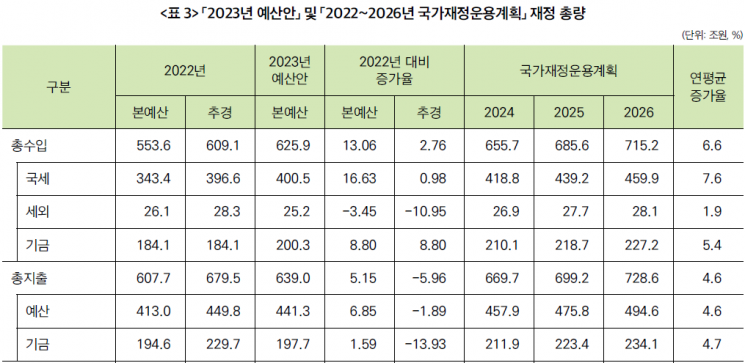
The government projected this year’s total national tax revenue at KRW 396.6 trillion (based on the supplementary budget). Additionally, while drafting next year’s budget, it estimated next year’s national tax revenue to increase by about 1% to KRW 400.5 trillion. This represents a 16.6% increase compared to this year’s original budget national tax revenue of KRW 343.4 trillion.
KIPF expects that national tax revenue for this year and next year will meet the projections. Senior Research Fellow Ko said, "Considering the latest progress rate of national tax revenue, achieving the 2022 forecast is possible," and added, "Overall, the 2023 budget’s national tax revenue forecast, which anticipates a growth rate slightly below 1% compared to the latest 2022 forecast, also appears achievable."
According to the Ministry of Economy and Finance’s monthly fiscal trend report, cumulative national tax revenue from January to July reached KRW 261 trillion, an increase of KRW 37.3 trillion compared to the same period last year. The progress rate stood at 64.7%, 0.8 percentage points higher than the same period’s settlement.
The problem arises after 2024. The government projected an average annual national tax revenue growth rate of 7.6% for 2022?2026. The year-by-year growth rates (based on the original budget) are 16.6% in 2023, 4.6% in 2024, 4.9% in 2025, and 4.7% in 2026. Senior Research Fellow Ko commented, "Currently, our economy faces relatively high levels of uncertainty both domestically and internationally," and noted, "The growth rate projections after 2024 seem somewhat optimistic compared to the medium-term economic growth pace."
In other words, amid significant external uncertainties such as global supply chain disruptions, the prolonged Russia-Ukraine war, and high-intensity tightening by major countries, tax revenue forecasts appear overly optimistic. In fact, major institutions such as the International Monetary Fund (IMF), the Organisation for Economic Co-operation and Development (OECD), and the Asian Development Bank (ADB) have all lowered South Korea’s economic growth forecasts for next year from 2.9% to 2.1%, 2.5% to 2.2%, and 2.6% to 2.3%, respectively, all hovering in the low 2% range. The government’s target economic growth rate for next year is 2.5%.
If national tax revenue falls short of government expectations, the fiscal balance will inevitably worsen. Therefore, the report suggests that social discussions on tax increases, including raising tax rates, should accompany this issue.
Senior Research Fellow Ko pointed out, "Unless total revenue growth factors requiring social consensus, such as increases in tax rates or social insurance premiums, are assumed, it will be difficult for natural total revenue growth from economic growth to offset the increase in total expenditure caused by demographic changes and rising welfare demands." He emphasized, "There is a need for in-depth discussions on the revenue side of fiscal policy," adding, "Considering future fiscal conditions, it is necessary to conduct macro-level discussions on desirable tax and national burden rates and the corresponding directions for tax and social insurance premium reforms."
© The Asia Business Daily(www.asiae.co.kr). All rights reserved.
![Clutching a Stolen Dior Bag, Saying "I Hate Being Poor but Real"... The Grotesque Con of a "Human Knockoff" [Slate]](https://cwcontent.asiae.co.kr/asiaresize/183/2026021902243444107_1771435474.jpg)
















