[Asia Economy (Suwon) = Reporter Lee Young-gyu] Four out of ten Gyeonggi Province residents have recently entered a phase of daily life recovery due to the relaxation of COVID-19 quarantine measures, but a survey revealed that psychological health issues such as depression remain vulnerable.
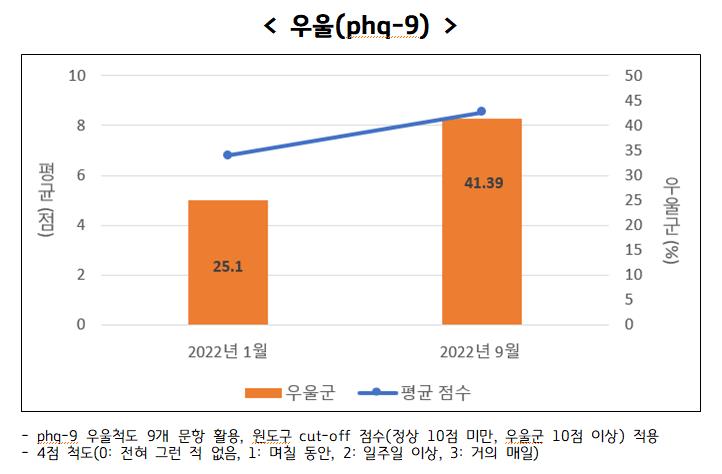
Gyeonggi Province announced on the 28th that, together with Professor Yum Myung-soon’s team from Seoul National University Graduate School of Public Health, they conducted a "Survey on Changes in Gyeonggi Residents' Perceptions of COVID-19" targeting 1,000 adult men and women in Gyeonggi Province in early September. The results showed that the proportion of those scoring 10 or higher on the self-rated depression scale (depression group) was 41.39%. This is the highest figure among four related surveys conducted since 2020. Previous survey results were ▲29.2% in July 2020 ▲28.2% in October of the same year ▲25.1% in January this year.
The proportion of those in a 'severe anger' state requiring professional help also rose to 16.7%, up from 13.1% in January this year. This psychological health condition is notable as it appeared at a time when the perception of daily life recovery had increased.
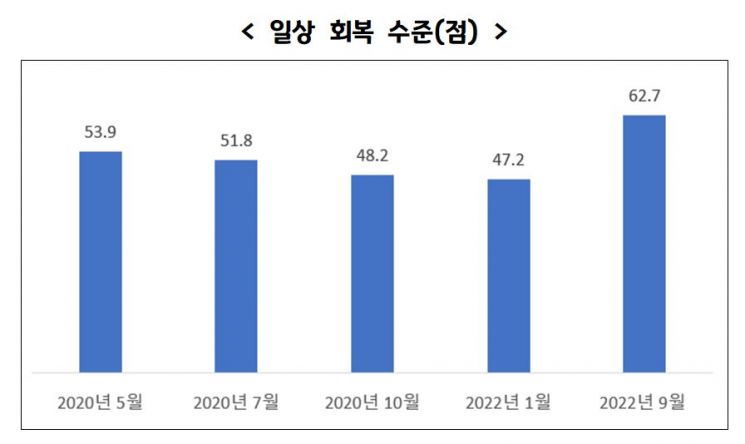
The daily life recovery level (out of 100 points) was 62.7 points, the highest among five surveys with the same question since 2020; it was 47.2 points in January this year. The daily life recovery score was lower among those with lower incomes.
Negative experiences due to COVID-19 were ranked as follows: ▲economic crisis (25%) ▲disease, injury, or violence to close persons (19.5%) ▲problems in close human relationships (18.7%). The percentage of respondents who experienced one or more of the 11 negative experiences increased from 48.9% in January this year to 62.9% in September.
Respondents who believed COVID-19 would become a controllable and manageable risk (43.6%) were twice as many as those who did not (21.8%).
The fear of being diagnosed with or reinfected by COVID-19 was 51.0%, and the fear of stigma due to infection was 28.8%, both the lowest since the 2020 survey.
Regarding the question of whether they fear another infectious disease outbreak within the next five years, 63.8% agreed.
In the medical response awareness section, 36.4% of respondents answered that they 'do not know' how to respond to abnormal symptoms or emergencies during nighttime or holidays while receiving home treatment.
Responses indicating 'do not know' how to get help if home isolation is impossible or how to receive face-to-face medical care were 33.7% and 25.4%, respectively.
Ryu Young-cheol, Director of the Provincial Health and Wellness Bureau, said, "Through this September survey, we confirmed that despite the Omicron variant surge in July and August, a considerable number of residents are entering the path of daily life recovery. However, we will also prepare measures to actively identify and assist residents who are still experiencing psychological difficulties."
This survey was conducted via a web survey method commissioned to CaseStat. The sampling error is ±3.1 percentage points at a 95% confidence level.
© The Asia Business Daily(www.asiae.co.kr). All rights reserved.


















