[Seoul District News] Dongdaemun-gu, Complete Removal in Cooperation with Railroad Corporation at Dawn on 28th & Unauthorized Old Advertisements Pose Serious Accident Risks to Railroad and Traffic Vehicles & Dail Welfare Foundation Operating Bapper Refuses Multiple Voluntary Removal Requests from Authorities ... Jung-gu, Seoul, Renovates Cheonggu Children's Park Through Communication and Compromise Amid Resident Conflicts & Resident Briefings and Opinion Collection Ensure Sufficient Reflection of Resident Views in Park Development & Children-Only Multipurpose Playground, Plaza-Style Creative Playground,
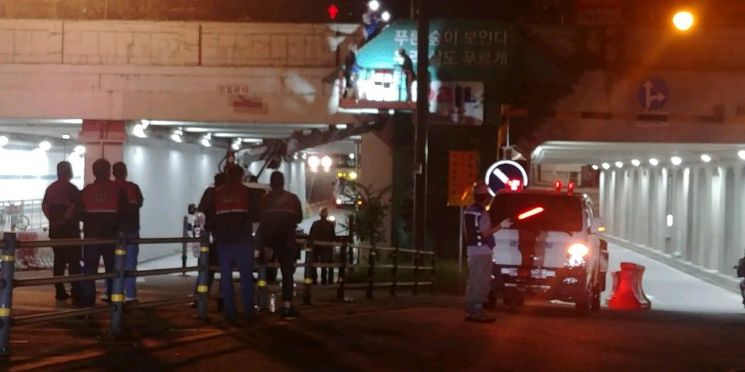
[Asia Economy Reporter Park Jong-il] Dongdaemun-gu (Mayor Lee Pil-hyung) conducted a sudden removal of the illegal outdoor advertisement for Bapper at the wall of Dapsimni Underpass (214 Wangsanno) in the early morning of the 28th.
The Bapper outdoor advertisement was a promotional material installed without proper procedures on the railway site fence by Bapper, which operates a free meal service in Dapsimni 1-dong.
Around 2008, a wooden-shaped sculpture measuring 3m wide and 8.6m high was installed on the wall of Dapsimni Underpass facing Jeonnong-dong, and in 2014, the same sculpture was installed on the wall facing Cheongnyangni. Bapper had been repeatedly instructed by administrative authorities to voluntarily remove the deteriorated sculptures but neglected to do so.
In particular, the aged facility installed adjacent to the railway tracks carrying 25,000 volts of high-voltage current posed a threat to the safety of trains and passengers if toppled, as well as potential significant damage to vehicles passing through the underpass. Therefore, in January of this year, Korea Railroad Corporation requested the Dail Welfare Foundation, which operates Bapper, and Dongdaemun-gu Office to remove the facility.
However, the Dail Welfare Foundation did not comply with the correction order (voluntary removal) even after the final removal deadline of August 24. Dongdaemun-gu issued a forced removal administrative execution warning on August 25. After two attempts to deliver the execution warrant were refused by the Dail Welfare Foundation, the district sent it by registered mail and, upon receiving emergency power cut approval from the Railroad Corporation on September 28 afternoon, carried out the sudden removal.
The removal operation mobilized nearly 50 personnel, including Dongdaemun-gu staff, Railroad Corporation, railway safety managers, removal contractors, and police officers, along with cranes and other heavy equipment.
A district official stated, “Taking this removal as an opportunity, we will conduct a thorough inspection of various facilities to create a more pleasant and safe Dongdaemun-gu and remove all elements that pose safety risks. We will do our best to ensure residents can live comfortably in their daily lives.”
After the removal news spread, comments appeared on community cafes of nearby residents such as, “Bapper enjoyed special privileges by putting up signs and promoting itself on public underpasses,” “Now let's move from abnormal to normal,” and “Dongdaemun-gu definitely seems to be changing.”
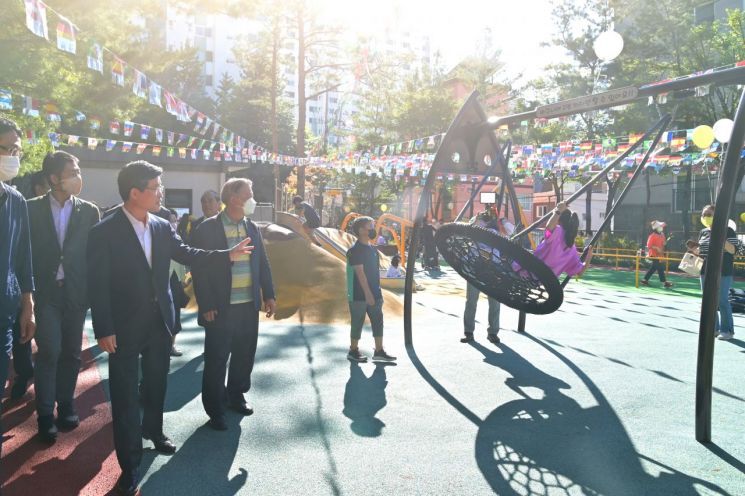
Jung-gu, Seoul (Mayor Kim Gil-seong) held an on-site briefing session on the 27th after remodeling Cheonggu Children's Park.
Cheonggu Children's Park (842-1 Sindang-dong), completed in 2003, had been a place of ongoing conflicts among residents. The conflict deepened between elderly people playing gateball, which occupied half of the park, and children who wanted to run and play freely.
To resolve this issue, the district office and Cheonggu-dong Community Service Center actively mediated. In September last year, a residents' council was formed including parents, daycare center staff, and elderly residents to gather opinions on how to remodel the park. Residents agreed that “the children's park should be returned to the children.”
Accordingly, from October last year to March this year, residents' briefings and meetings were held to incorporate residents' opinions, creating a children-only multipurpose field, a plaza-type creative playground, and walking paths. The envisioned park took shape before their eyes.
The district prepared a gateball court with grass on the rooftop green area of Cheonggu Cultural Square for the elderly who willingly gave up space for children. This process was not smooth either. Residents near the gateball court raised noise concerns. The elderly agreed to use the gateball court only during designated times. This was a result of mutual respect and concession.
At 3 p.m. on the 27th, about 50 people including children, parents, the park residents' council, and residents gathered for the on-site briefing to celebrate the results of a year-long joint effort by residents, the district, and the community.
The “Promise of Children and Parents,” jointly read by representatives of children and parents, attracted attention. The child representative pledged to “play joyfully to the fullest” and “follow the park usage rules” in the children's park.
Afterwards, attendees toured the zip line, circular track, and multipurpose field. The zip line was designed so that children move along the rope by themselves and then return the rope to its place for the next user, fostering self-regulation and consideration. A district official explained that this was also a suggestion from residents, which impressed the attendees. The circular track, where adults could enjoy walking exercise and children could enjoy inline skating and kickboarding, was also very popular.
Meanwhile, on the 24th and 25th, Dongguk University’s mural club “Painters” painted charming murals at the height of children on the walls of the public restroom in the park, refreshing the park’s atmosphere.
Kim Gil-seong, Mayor of Jung-gu, said, “Thanks to the residents’ decision to fully return the children’s park to the children, a wonderful park where children can play freely was created. I applaud the residents who proved that children should be raised by the whole community.”
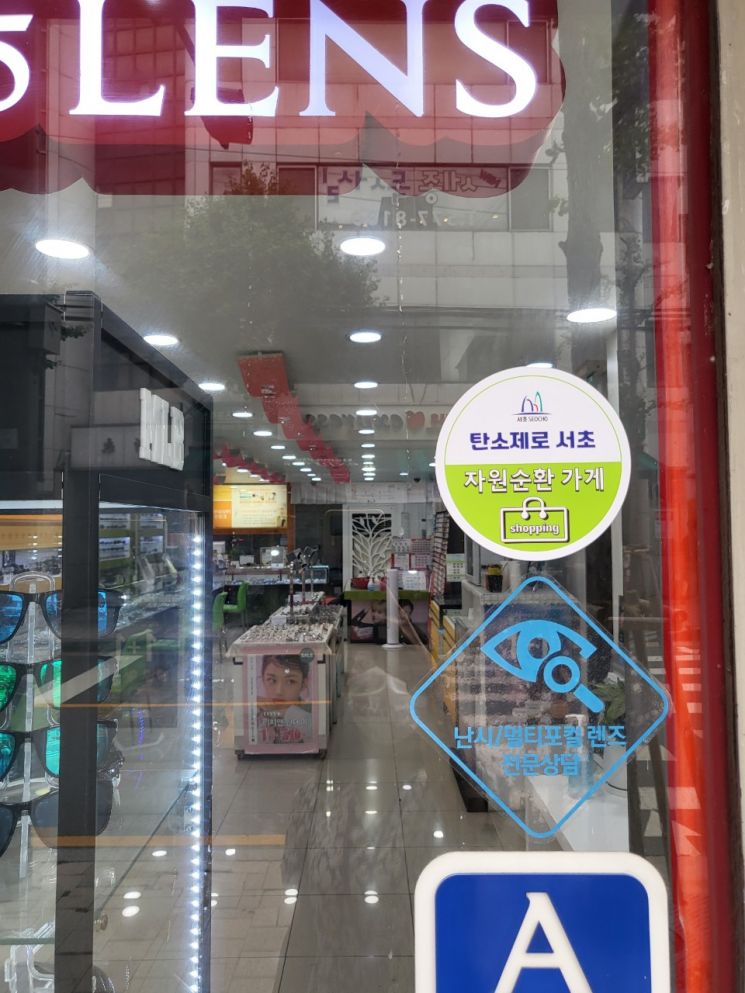
Seocho-gu is taking the lead in carbon reduction through small daily practices.
Seocho-gu (Mayor Jeon Seong-su) announced it will conduct a “Carbon Zero Shop Promotion Campaign” that exchanges reusable items, which might otherwise be discarded carelessly, for eco-friendly products.
The campaign will be held at four locations on the 28th at 2 p.m.: in front of Seocho 1-dong Community Service Center, Exit 1 of Sapyeong Station, the wall of Bangbae Memphis Hyundai Apartments, and in front of Yangjae 1-dong Civil Service Office.
The district’s “Carbon Zero Shop” is part of a resource circulation network project where residents collect five types of items?clothes hangers, plastic bags, shopping bags, ice packs, and coffee trays?and deliver them to laundries, cafes, and butcher shops for reuse.
This event aims to promote and revitalize the district’s resource circulation network project “Carbon Zero Shop,” with participation from the Green Seocho Environmental Action Group, environmental organization EcoHub, and zero waste shop Deokbunae (愛).
Residents wishing to participate should collect at least 10 reusable items such as clothes hangers, plastic bags, shopping bags, or ice packs and bring them to the event locations. The district will present eco-friendly bathroom or kitchen sets including solid toothpaste, bath bombs, rubber gloves, and scrubbers from the local business “Zero Waste Shop Deokbunae (愛)” to the first 100 participants per neighborhood.
The district expects this campaign to raise awareness of nearby zero shops and encourage voluntary participation, contributing to the establishment of a culture of resource circulation practice and carbon reduction.
The “Carbon Zero Shop” started last year after being selected in a Seoul city public contest. Through the formation of a resident monitoring group, 300 participating stores were discovered by September this year. So far, the district has collected a total of 55,752 reusable items last year, achieving a reduction of 7,507 kg of carbon dioxide annually.
Additionally, the district has created an easy-to-understand map showing the locations of 300 zero shops in the neighborhood to enable all residents to participate in resource circulation practices. The district aims to reduce 12,576 kg of carbon dioxide annually through this effort.
Seocho-gu Mayor Jeon Seong-su said, “We will continue to create a carbon-zero Seocho by promoting resource circulation projects together with residents.”
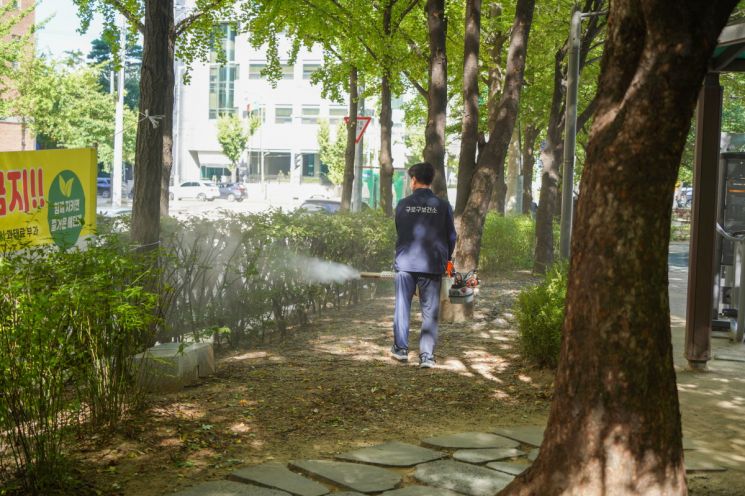
Guro-gu (Mayor Moon Heon-il) has changed its disinfection method to mist spraying.
Mist spraying is a disinfection method used in summer to exterminate pests by diluting insecticide in water and spraying it in the form of fine droplets.
The previous method, fogging, involved adding dispersants and raised concerns about environmental pollution. Therefore, in September, the district introduced mist spraying using water as the diluent for disinfectants.
Mist spraying does not produce smoke or carbon monoxide, so it does not cause visual obstruction, smoke, or odor, making it environmentally friendly. The droplet size is larger than fogging, so it is less affected by ground heat, sunlight, or wind, resulting in longer-lasting disinfection effects and excellent performance even in high temperatures. It can be sprayed anywhere such as sewers or cracks in stones, and the spraying method is simple with low pest control costs.
The district operates 18 disinfection teams composed of public health center staff, Saemaul leaders’ association, and autonomous disinfection teams in each neighborhood, conducting year-round disinfection to control infectious disease hygiene pests.
A Guro-gu official said, “The newly adopted mist spraying may cause misunderstandings about disinfection effectiveness due to its visual characteristics. We will do our best to promote eco-friendly mist spraying that protects residents’ health and prevents environmental pollution.”
© The Asia Business Daily(www.asiae.co.kr). All rights reserved.
![Clutching a Stolen Dior Bag, Saying "I Hate Being Poor but Real"... The Grotesque Con of a "Human Knockoff" [Slate]](https://cwcontent.asiae.co.kr/asiaresize/183/2026021902243444107_1771435474.jpg)


















